10-K
0001579298FYfalse2025http://fasb.org/us-gaap/2025#ProductMemberhttp://fasb.org/us-gaap/2025#ProductMemberhttp://fasb.org/us-gaap/2025#ProductMemberhttp://fasb.org/srt/2025#ChiefExecutiveOfficerMemberhttp://fasb.org/us-gaap/2025#UsefulLifeShorterOfTermOfLeaseOrAssetUtilityMemberhttp://fasb.org/us-gaap/2025#UsefulLifeShorterOfTermOfLeaseOrAssetUtilityMemberthree yearshttp://fasb.org/us-gaap/2025#AssetImpairmentChargeshttp://fasb.org/us-gaap/2025#AssetImpairmentChargeshttp://fasb.org/us-gaap/2025#AssetImpairmentChargeshttp://fasb.org/us-gaap/2025#LongTermDebtAndCapitalLeaseObligationshttp://fasb.org/us-gaap/2025#LongTermDebtAndCapitalLeaseObligationshttp://fasb.org/us-gaap/2025#LongTermDebtAndCapitalLeaseObligationshttp://fasb.org/us-gaap/2025#LongTermDebtAndCapitalLeaseObligationsCurrenthttp://fasb.org/us-gaap/2025#LongTermDebtAndCapitalLeaseObligations2022 2023 2024 20252021 2022 2023 2024 20250001579298srt:MinimumMemberus-gaap:SoftwareAndSoftwareDevelopmentCostsMember2026-01-310001579298burl:PromissoryNoteMember2025-12-230001579298burl:NewConvertibleSeniorNotesMembersrt:ParentCompanyMember2023-09-120001579298us-gaap:LeaseholdImprovementsMember2024-02-042025-02-010001579298burl:AmendmentToTermLoanFacilityMemberburl:IncrementalTermLoansMember2024-09-240001579298us-gaap:TreasuryStockCommonMember2026-01-310001579298srt:ParentCompanyMemberburl:IntercompanyNoteReceivableMember2025-02-022026-01-310001579298burl:DistributionAndPurchasingFunctionsMember2023-01-292024-02-030001579298us-gaap:RetainedEarningsMember2023-01-292024-02-030001579298burl:StoreFixturesAndEquipmentMember2024-02-042025-02-010001579298us-gaap:AccumulatedOtherComprehensiveIncomeMember2026-01-310001579298us-gaap:LetterOfCreditMemberburl:ABLSeniorSecuredRevolvingFacilityMembersrt:MaximumMember2025-02-010001579298burl:AssetImpairmentMember2025-02-022026-01-310001579298burl:TermLoanFacilityMember2025-02-022026-01-310001579298burl:StockOptionsGrantedMember2024-02-042025-02-010001579298burl:OperatingLeaseAssetsMember2024-02-042025-02-010001579298us-gaap:AllowanceForCreditLossMember2023-01-280001579298us-gaap:RestrictedStockMember2026-01-310001579298burl:StoreFixturesAndEquipmentMember2025-02-022026-01-310001579298burl:TwoThousandTwentyOneStockRepurchaseProgramsMember2023-08-150001579298us-gaap:DesignatedAsHedgingInstrumentMember2025-02-022026-01-310001579298us-gaap:SalesRevenueNetMemberburl:OuterwearMemberus-gaap:ProductConcentrationRiskMember2023-01-292024-02-030001579298burl:TwoThousandTwentyOneStockRepurchaseProgramsMember2025-02-022026-01-310001579298burl:LandlordOwnedAssetsMember2025-02-022026-01-310001579298us-gaap:ValuationAllowanceOfDeferredTaxAssetsMember2025-02-010001579298burl:ConvertibleSeniorNotesMember2020-04-160001579298burl:SubleaseIncomeMemberus-gaap:ProductAndServiceOtherMember2024-02-042025-02-010001579298us-gaap:SoftwareDevelopmentMember2025-02-022026-01-310001579298burl:ConvertibleSeniorNotesMember2025-02-010001579298burl:ABLSeniorSecuredRevolvingFacilityMember2024-02-042025-02-010001579298burl:TermLoanFacilityMember2024-02-042025-02-010001579298us-gaap:DesignatedAsHedgingInstrumentMemberus-gaap:CashFlowHedgingMemberburl:InterestRateSwapOneMember2024-09-270001579298us-gaap:RetainedEarningsMember2023-01-280001579298burl:PerformanceStockUnitGrantsMember2023-01-292024-02-030001579298srt:MinimumMemberburl:AmendedABLSeniorSecuredRevolvingFacilityMemberus-gaap:PrimeRateMember2025-02-022026-01-310001579298burl:ConvertibleSeniorNotesOnePointTwoFivePercentageDueDecemberFifteenTwoThousandTwentySevenMember2024-02-042025-02-010001579298us-gaap:EmployeeStockOptionMember2025-02-022026-01-310001579298us-gaap:BuildingMember2025-02-022026-01-3100015792982025-02-010001579298burl:TwoThousandTwentyOneStockRepurchaseProgramsMember2026-01-310001579298us-gaap:AdditionalPaidInCapitalMember2025-02-010001579298us-gaap:ValuationAllowanceOfDeferredTaxAssetsMember2026-01-310001579298burl:HomeMemberus-gaap:SalesRevenueNetMemberus-gaap:ProductConcentrationRiskMember2024-02-042025-02-010001579298us-gaap:SoftwareAndSoftwareDevelopmentCostsMember2026-01-310001579298burl:SeniorSecuredTermLoanFacilitiesMember2024-02-042025-02-010001579298us-gaap:BuildingMembersrt:MaximumMember2026-01-310001579298us-gaap:SoftwareDevelopmentMember2023-01-292024-02-030001579298us-gaap:DesignatedAsHedgingInstrumentMemberus-gaap:InterestRateSwapMemberus-gaap:CashFlowHedgingMember2021-06-240001579298burl:SeniorSecuredTermLoanFacilitiesMemberburl:SecuredOvernightFinancingRateFloorMember2024-02-042025-02-010001579298burl:NewConvertibleSeniorNotesMembersrt:ParentCompanyMember2023-09-122023-09-120001579298burl:DeferredFinancingCostsMember2026-01-310001579298us-gaap:SalesRevenueNetMemberus-gaap:ProductConcentrationRiskMemberburl:LadiesApparelMember2025-02-022026-01-310001579298us-gaap:SubsequentEventMemberburl:ConvertibleSeniorNotesMember2026-03-122026-03-130001579298us-gaap:AdditionalPaidInCapitalMember2023-01-280001579298burl:FixturesAndEquipmentMembersrt:MaximumMember2026-01-310001579298burl:TwoThousandSixPlanMembersrt:MaximumMember2025-02-022026-01-3100015792982025-11-022026-01-310001579298us-gaap:TreasuryStockCommonMember2024-02-042025-02-0100015792982024-02-042025-02-010001579298us-gaap:PerformanceSharesMember2025-02-022026-01-310001579298burl:StockOptionRestrictedStockAndRestrictedStockUnitAwardsMember2025-02-022026-01-310001579298burl:FixturesAndEquipmentMembersrt:MinimumMember2026-01-310001579298srt:ParentCompanyMemberburl:ConvertibleSeniorNotesMember2025-02-022026-01-310001579298burl:TwoThousandTwentyOneStockRepurchaseProgramsMembersrt:ParentCompanyMember2026-01-310001579298us-gaap:LeaseholdImprovementsMember2026-01-310001579298us-gaap:FairValueInputsLevel1Member2025-02-010001579298burl:AmendedABLSeniorSecuredRevolvingFacilityMember2026-01-310001579298burl:GuaranteePerformanceUnderInsuranceAndUtilityAgreementMember2026-01-310001579298burl:TwoThousandTwentyOneStockRepurchaseProgramsMembersrt:ParentCompanyMember2025-02-022026-01-310001579298burl:PropertyAndEquipmentMember2023-01-292024-02-030001579298burl:ABLSeniorSecuredRevolvingFacilityMember2025-07-250001579298srt:ParentCompanyMember2025-02-010001579298burl:StockOptionsGrantedMember2025-02-022026-01-310001579298burl:NonVestedRestrictedStockMember2026-01-310001579298us-gaap:StateAndLocalJurisdictionMember2025-02-022026-01-310001579298burl:NewConvertibleSeniorNotesMember2023-09-120001579298burl:FixturesAndEquipmentMember2026-01-310001579298us-gaap:RestrictedStockUnitsRSUMember2023-01-292024-02-030001579298us-gaap:LeaseholdImprovementsMember2023-01-292024-02-0300015792982023-01-280001579298us-gaap:LetterOfCreditMemberburl:ABLSeniorSecuredRevolvingFacilityMembersrt:MaximumMember2026-01-310001579298us-gaap:LeaseholdImprovementsMember2025-02-022026-01-310001579298us-gaap:AllowanceForCreditLossMember2024-02-030001579298us-gaap:SalesRevenueNetMemberus-gaap:ProductConcentrationRiskMemberburl:MensApparelMember2025-02-022026-01-310001579298burl:NewConvertibleSeniorNotesMember2023-09-122023-09-120001579298burl:ABLSeniorSecuredRevolvingFacilityMember2025-02-010001579298us-gaap:SalesRevenueNetMemberus-gaap:ProductConcentrationRiskMemberburl:MensApparelMember2024-02-042025-02-010001579298burl:OtherLongLivedAssetsMember2024-02-042025-02-010001579298burl:PropertyAndEquipmentMember2025-02-022026-01-310001579298us-gaap:ProductAndServiceOtherMemberburl:ServiceRevenueMember2023-01-292024-02-030001579298burl:ConvertibleNotesMembersrt:ParentCompanyMember2025-02-022026-01-310001579298burl:TwoThousandTwentyOneStockRepurchaseProgramsMember2025-05-200001579298us-gaap:AllowanceForCreditLossMember2023-01-292024-02-030001579298us-gaap:DesignatedAsHedgingInstrumentMemberus-gaap:InterestRateSwapMemberus-gaap:CashFlowHedgingMember2024-09-270001579298us-gaap:DesignatedAsHedgingInstrumentMemberus-gaap:InterestRateSwapMemberus-gaap:CashFlowHedgingMember2025-02-022026-01-310001579298burl:ConvertibleNotesMembersrt:ParentCompanyMember2023-01-292024-02-030001579298us-gaap:SalesRevenueNetMemberus-gaap:ProductConcentrationRiskMemberburl:LadiesApparelMember2024-02-042025-02-010001579298burl:PrivateLabelCreditCardMember2024-02-042025-02-0100015792982026-02-280001579298us-gaap:LongTermDebtMember2025-02-022026-01-310001579298us-gaap:ProductAndServiceOtherMemberburl:ServiceRevenueMember2024-02-042025-02-010001579298us-gaap:TreasuryStockCommonMember2023-01-280001579298us-gaap:StateAndLocalJurisdictionMember2026-01-310001579298us-gaap:ValuationAllowanceOfDeferredTaxAssetsMember2023-01-292024-02-030001579298burl:CohoesFashionsMember2026-01-310001579298country:PR2025-02-010001579298burl:OperatingLeaseAssetsMember2025-02-022026-01-310001579298burl:ConvertibleNotesMembersrt:ParentCompanyMember2024-02-042025-02-010001579298burl:StateAndForeignCountryJurisdictionMember2025-02-022026-01-310001579298burl:DistributionAndPurchasingFunctionsMember2025-02-022026-01-310001579298srt:ParentCompanyMemberus-gaap:TreasuryStockCommonMember2025-02-022026-01-310001579298us-gaap:CommonStockMember2024-02-042025-02-010001579298us-gaap:DesignatedAsHedgingInstrumentMemberus-gaap:InterestRateSwapMemberus-gaap:CashFlowHedgingMember2026-01-310001579298us-gaap:AdditionalPaidInCapitalMember2024-02-030001579298us-gaap:TreasuryStockCommonMember2023-01-292024-02-030001579298us-gaap:RetainedEarningsMember2025-02-022026-01-310001579298srt:ParentCompanyMember2025-02-022026-01-310001579298us-gaap:RestrictedStockMembersrt:MaximumMember2025-02-022026-01-310001579298us-gaap:DesignatedAsHedgingInstrumentMemberus-gaap:InterestRateSwapMemberus-gaap:CashFlowHedgingMembersrt:MaximumMember2026-01-310001579298burl:AmendedABLSeniorSecuredRevolvingFacilityMembersrt:MaximumMemberus-gaap:PrimeRateMember2025-02-022026-01-310001579298burl:AmendmentToTermLoanFacilityMemberus-gaap:SecuredOvernightFinancingRateSofrOvernightIndexSwapRateMember2024-09-232024-09-230001579298srt:ParentCompanyMemberburl:ConvertibleSeniorNotesMember2023-09-120001579298burl:SeniorSecuredTermLoanFacilitiesMember2026-01-310001579298burl:PropertyAndEquipmentMember2024-02-042025-02-010001579298us-gaap:RestrictedStockUnitsRSUMember2024-02-042025-02-010001579298us-gaap:DesignatedAsHedgingInstrumentMemberus-gaap:InterestRateContractMember2024-02-042025-02-010001579298us-gaap:RestrictedStockMember2022-01-302023-01-280001579298us-gaap:AllowanceForCreditLossMember2026-01-310001579298burl:BurlingtonStoresMember2026-01-310001579298burl:NewConvertibleSeniorNotesMember2025-02-010001579298us-gaap:BuildingMember2025-02-010001579298burl:SeniorSecuredTermLoanFacilitiesMemberus-gaap:SecuredOvernightFinancingRateSofrOvernightIndexSwapRateMember2024-02-042025-02-010001579298us-gaap:AdditionalPaidInCapitalMember2025-02-022026-01-310001579298burl:AmendmentToTermLoanFacilityMemberus-gaap:PrimeRateMember2024-09-232024-09-230001579298burl:TermLoanFacilityMember2026-01-310001579298burl:SeniorSecuredTermLoanFacilitiesMemberburl:SecuredOvernightFinancingRateFloorMember2025-02-022026-01-310001579298us-gaap:StateAndLocalJurisdictionMembersrt:MaximumMember2025-02-022026-01-310001579298us-gaap:InterestRateCapMember2026-01-310001579298burl:StockOptionsGrantedMember2023-01-292024-02-030001579298us-gaap:InterestRateSwapMemberus-gaap:OtherAssetsMember2025-02-010001579298burl:AssetImpairmentMember2023-01-292024-02-030001579298us-gaap:LongTermDebtMember2026-01-310001579298us-gaap:SalesRevenueNetMemberburl:AccessoriesAndShoesMemberus-gaap:ProductConcentrationRiskMember2024-02-042025-02-010001579298srt:MinimumMemberburl:TwoThousandSixPlanMember2025-02-022026-01-310001579298srt:MinimumMemberus-gaap:BuildingMember2026-01-310001579298us-gaap:RestrictedStockMember2025-02-022026-01-310001579298burl:SeniorSecuredTermLoanFacilitiesMember2025-02-022026-01-310001579298us-gaap:AdditionalPaidInCapitalMember2023-01-292024-02-030001579298burl:PerformanceStockUnitGrantsMember2025-02-022026-01-310001579298burl:FixturesAndEquipmentMember2025-02-010001579298burl:ConvertibleSeniorNotesOnePointTwoFivePercentageDueDecemberFifteenTwoThousandTwentySevenMember2025-02-022026-01-310001579298burl:TermLoanFacilityMember2026-01-310001579298burl:PrivateLabelCreditCardMember2023-01-292024-02-030001579298burl:HomeMemberus-gaap:SalesRevenueNetMemberus-gaap:ProductConcentrationRiskMember2023-01-292024-02-030001579298us-gaap:SalesRevenueNetMemberburl:AccessoriesAndShoesMemberus-gaap:ProductConcentrationRiskMember2023-01-292024-02-030001579298burl:AmendmentToTermLoanFacilityMemberburl:IncrementalTermLoansMember2025-06-110001579298burl:NonVestedRestrictedStockMember2025-02-022026-01-310001579298burl:TermB7LoansMember2024-09-240001579298us-gaap:LongTermDebtMember2025-02-010001579298us-gaap:TreasuryStockCommonMember2025-02-010001579298us-gaap:InternalRevenueServiceIRSMember2025-02-022026-01-310001579298srt:MinimumMemberus-gaap:SoftwareDevelopmentMember2025-02-020001579298srt:ParentCompanyMember2023-01-292024-02-030001579298burl:ABLSeniorSecuredRevolvingFacilityMember2025-07-252025-07-250001579298burl:ABLSeniorSecuredRevolvingFacilityMember2025-02-022026-01-310001579298us-gaap:RetainedEarningsMember2026-01-310001579298burl:ABLSeniorSecuredRevolvingFacilityMember2025-07-240001579298burl:AmendmentToTermLoanFacilityMember2024-09-232024-09-230001579298us-gaap:ValuationAllowanceOfDeferredTaxAssetsMember2023-01-280001579298us-gaap:ForeignCountryMember2026-01-310001579298burl:SubleaseIncomeMemberus-gaap:ProductAndServiceOtherMember2023-01-292024-02-0300015792982023-01-292024-02-030001579298burl:LandlordOwnedAssetsMember2024-02-042025-02-010001579298us-gaap:ValuationAllowanceOfDeferredTaxAssetsMember2025-02-022026-01-310001579298us-gaap:SalesRevenueNetMemberburl:OuterwearMemberus-gaap:ProductConcentrationRiskMember2025-02-022026-01-310001579298burl:MerchandisingAgreementMember2025-02-010001579298srt:ParentCompanyMemberburl:IntercompanyNoteReceivableMember2023-01-292024-02-030001579298us-gaap:SalesRevenueNetMemberus-gaap:ProductConcentrationRiskMemberburl:KidsApparelAndBabyMember2023-01-292024-02-030001579298us-gaap:AccumulatedOtherComprehensiveIncomeMember2023-01-280001579298burl:HomeMemberus-gaap:SalesRevenueNetMemberus-gaap:ProductConcentrationRiskMember2025-02-022026-01-310001579298us-gaap:SalesRevenueNetMemberus-gaap:ProductConcentrationRiskMemberburl:KidsApparelAndBabyMember2025-02-022026-01-310001579298us-gaap:PerformanceSharesMembersrt:MaximumMember2026-01-310001579298us-gaap:ProductAndServiceOtherMember2025-02-022026-01-310001579298burl:ConvertibleSeniorNotesOnePointTwoFivePercentageDueDecemberFifteenTwoThousandTwentySevenMember2025-02-010001579298us-gaap:CommonStockMember2026-01-3100015792982025-02-022026-01-310001579298burl:ConvertibleSeniorNotesTwoPointTwoFivePercentageDueAprilFifteenTwoThousandTwentyFiveMember2025-02-010001579298srt:ParentCompanyMemberburl:ConvertibleSeniorNotesMember2020-04-160001579298burl:GuaranteePerformanceUnderInsuranceAndUtilityAgreementMember2025-02-010001579298burl:ABLSeniorSecuredRevolvingFacilityMember2025-07-242025-07-240001579298burl:OtherLongLivedAssetsMember2025-02-022026-01-310001579298us-gaap:SoftwareAndSoftwareDevelopmentCostsMember2025-02-010001579298us-gaap:LongTermDebtMember2023-01-292024-02-030001579298us-gaap:SubsequentEventMemberburl:ConvertibleSeniorNotesMember2026-03-130001579298burl:PromissoryNoteMember2025-12-232025-12-230001579298burl:OtherLongLivedAssetsMember2023-01-292024-02-030001579298burl:AmendmentToTermLoanFacilityMember2024-09-242024-09-240001579298us-gaap:AllowanceForCreditLossMember2025-02-022026-01-310001579298burl:SeniorSecuredTermLoanFacilitiesMember2025-02-010001579298us-gaap:AccumulatedOtherComprehensiveIncomeMember2025-02-022026-01-310001579298burl:AssetImpairmentMember2024-02-042025-02-010001579298us-gaap:ProductAndServiceOtherMemberburl:ServiceRevenueMember2025-02-022026-01-310001579298us-gaap:BuildingMember2024-02-042025-02-010001579298burl:ConvertibleSeniorNotesMember2026-03-130001579298burl:TwoThousandTwentyOneStockRepurchaseProgramsMembersrt:ParentCompanyMember2025-05-200001579298burl:SeniorSecuredTermLoanFacilitiesMemberus-gaap:SecuredOvernightFinancingRateSofrOvernightIndexSwapRateMember2025-02-022026-01-310001579298burl:ConvertibleSeniorNotesMember2025-02-022026-01-310001579298burl:StoreFixturesAndEquipmentMember2023-01-292024-02-030001579298us-gaap:SecuredOvernightFinancingRateSofrOvernightIndexSwapRateMemberburl:AmendedABLSeniorSecuredRevolvingFacilityMembersrt:MaximumMember2025-02-022026-01-310001579298srt:MinimumMemberus-gaap:StateAndLocalJurisdictionMember2025-02-022026-01-310001579298srt:ParentCompanyMember2026-01-310001579298us-gaap:SalesRevenueNetMemberus-gaap:ProductConcentrationRiskMemberburl:AccessoriesAndShoesMember2025-02-022026-01-310001579298burl:PrivateLabelCreditCardMember2025-02-022026-01-310001579298burl:ConvertibleSeniorNotesOnePointTwoFivePercentageDueDecemberFifteenTwoThousandTwentySevenMember2026-01-310001579298burl:AmendmentToTermLoanFacilityMemberburl:SecuredOvernightFinancingRateFloorMember2024-09-242024-09-240001579298us-gaap:CommonStockMember2024-02-030001579298us-gaap:RetainedEarningsMember2024-02-042025-02-010001579298burl:TermLoanFacilityMember2023-01-292024-02-030001579298burl:OperatingLeaseAssetsMember2023-01-292024-02-030001579298us-gaap:SoftwareDevelopmentMember2024-02-042025-02-010001579298us-gaap:ValuationAllowanceOfDeferredTaxAssetsMember2024-02-042025-02-010001579298us-gaap:InterestRateSwapMemberus-gaap:OtherLiabilitiesMember2026-01-310001579298us-gaap:LeaseholdImprovementsMember2025-02-010001579298burl:TwoThousandTwentyOneStockRepurchaseProgramsMember2025-05-202025-05-200001579298us-gaap:PerformanceSharesMember2025-02-010001579298burl:TwoThousandTwentyTwoOmnibusIncentivePlanMember2025-05-202025-05-200001579298burl:AmendmentToTermLoanFacilityMemberus-gaap:SecuredOvernightFinancingRateSofrOvernightIndexSwapRateMember2024-09-242024-09-240001579298us-gaap:LandMember2025-02-010001579298us-gaap:LandMember2026-01-310001579298burl:TermLoanFacilityMember2025-02-010001579298us-gaap:StateAndLocalJurisdictionMember2025-02-010001579298burl:PerformanceStockUnitGrantsMember2024-02-042025-02-010001579298srt:ParentCompanyMember2024-02-042025-02-010001579298srt:ParentCompanyMember2014-08-122014-08-130001579298us-gaap:CommonStockMember2023-01-280001579298us-gaap:RestrictedStockMembersrt:MinimumMember2025-02-022026-01-3100015792982025-12-230001579298us-gaap:SecuredOvernightFinancingRateSofrOvernightIndexSwapRateMembersrt:MinimumMemberburl:AmendedABLSeniorSecuredRevolvingFacilityMember2025-02-022026-01-310001579298us-gaap:DesignatedAsHedgingInstrumentMemberus-gaap:ReclassificationOutOfAccumulatedOtherComprehensiveIncomeMemberus-gaap:InterestRateCapMemberus-gaap:AccumulatedGainLossCashFlowHedgeIncludingNoncontrollingInterestMember2023-01-292024-02-030001579298us-gaap:BuildingMember2026-01-310001579298burl:ConvertibleSeniorNotesTwoPointTwoFivePercentageDueAprilFifteenTwoThousandTwentyFiveMember2026-01-310001579298srt:ParentCompanyMember2024-02-030001579298srt:ParentCompanyMember2023-01-280001579298us-gaap:ProductAndServiceOtherMember2023-01-292024-02-030001579298burl:ConvertibleSeniorNotesTwoPointTwoFivePercentageDueAprilFifteenTwoThousandTwentyFiveMember2025-02-022026-01-310001579298us-gaap:InterestRateSwapMemberus-gaap:OtherAssetsMember2026-01-310001579298burl:NonVestedRestrictedStockMember2025-02-010001579298burl:ConvertibleSeniorNotesTwoPointTwoFivePercentageDueAprilFifteenTwoThousandTwentyFiveMember2024-02-042025-02-010001579298us-gaap:ForeignCountryMember2025-02-022026-01-310001579298us-gaap:SalesRevenueNetMemberburl:OuterwearMemberus-gaap:ProductConcentrationRiskMember2024-02-042025-02-010001579298srt:MaximumMember2026-01-310001579298us-gaap:TreasuryStockCommonMember2024-02-030001579298burl:AmendmentToTermLoanFacilityMemberus-gaap:PrimeRateMember2024-09-242024-09-240001579298us-gaap:AccumulatedOtherComprehensiveIncomeMember2024-02-042025-02-010001579298us-gaap:CommonStockMember2025-02-010001579298us-gaap:CommonStockMember2023-01-292024-02-030001579298srt:ParentCompanyMemberburl:ConvertibleSeniorNotesMember2026-01-310001579298burl:NewConvertibleSeniorNotesMember2026-01-310001579298us-gaap:ValuationAllowanceOfDeferredTaxAssetsMember2024-02-030001579298us-gaap:AllowanceForCreditLossMember2025-02-0100015792982025-08-020001579298us-gaap:AccumulatedOtherComprehensiveIncomeMember2024-02-030001579298us-gaap:AdditionalPaidInCapitalMember2024-02-042025-02-010001579298us-gaap:TreasuryStockCommonMember2025-02-022026-01-310001579298burl:SubleaseIncomeMemberus-gaap:ProductAndServiceOtherMember2025-02-022026-01-310001579298burl:NewConvertibleSeniorNotesMembersrt:ParentCompanyMemberus-gaap:PrivatePlacementMember2023-09-120001579298us-gaap:DesignatedAsHedgingInstrumentMemberus-gaap:InterestRateContractMember2023-01-292024-02-030001579298us-gaap:DesignatedAsHedgingInstrumentMemberus-gaap:ReclassificationOutOfAccumulatedOtherComprehensiveIncomeMemberus-gaap:InterestRateCapMemberus-gaap:AccumulatedGainLossCashFlowHedgeIncludingNoncontrollingInterestMember2024-02-042025-02-010001579298us-gaap:FairValueInputsLevel1Member2026-01-310001579298us-gaap:PerformanceSharesMember2026-01-310001579298us-gaap:DesignatedAsHedgingInstrumentMemberus-gaap:CashFlowHedgingMemberburl:InterestRateSwapOneMember2025-06-120001579298burl:StockOptionRestrictedStockAndRestrictedStockUnitAwardsMember2023-01-292024-02-030001579298srt:ParentCompanyMemberburl:IntercompanyNoteReceivableMember2024-02-042025-02-0100015792982024-02-030001579298us-gaap:ConstructionInProgressMember2026-01-310001579298srt:MaximumMemberus-gaap:SoftwareDevelopmentMember2025-02-020001579298burl:IncrementalTermLoansMember2025-06-110001579298us-gaap:ConstructionInProgressMember2025-02-010001579298us-gaap:AllowanceForCreditLossMember2024-02-042025-02-010001579298burl:AmendmentToTermLoanFacilityMemberburl:TermB6LoanMember2024-09-240001579298us-gaap:SalesRevenueNetMemberus-gaap:ProductConcentrationRiskMemberburl:KidsApparelAndBabyMember2024-02-042025-02-010001579298burl:StockOptionRestrictedStockAndRestrictedStockUnitAwardsMember2024-02-042025-02-010001579298burl:TwoThousandTwentyOneStockRepurchaseProgramsMembersrt:ParentCompanyMemberburl:ShareRepurchaseProgramAuthorizedMayTwentyTwoThousandTwentyFiveMember2026-01-310001579298us-gaap:LandMember2025-02-022026-01-310001579298us-gaap:RetainedEarningsMember2025-02-010001579298us-gaap:SoftwareAndSoftwareDevelopmentCostsMembersrt:MaximumMember2026-01-310001579298us-gaap:LandMember2024-02-042025-02-010001579298us-gaap:EmployeeStockOptionMember2026-01-310001579298us-gaap:AccumulatedOtherComprehensiveIncomeMember2025-02-010001579298burl:NewConvertibleSeniorNotesMember2025-02-022026-01-310001579298burl:ABLSeniorSecuredRevolvingFacilityMember2026-01-310001579298burl:LandlordOwnedAssetsMember2023-01-292024-02-030001579298us-gaap:ForeignCountryMember2025-02-010001579298us-gaap:RestrictedStockUnitsRSUMember2025-02-022026-01-310001579298srt:ParentCompanyMemberburl:ConvertibleSeniorNotesMember2025-02-0100015792982026-01-310001579298burl:TwoThousandTwentyOneStockRepurchaseProgramsMember2023-08-152023-08-150001579298us-gaap:CommonStockMember2025-02-022026-01-310001579298burl:TwoThousandTwentyTwoOmnibusIncentivePlanMember2026-01-310001579298us-gaap:AdditionalPaidInCapitalMember2026-01-310001579298burl:TermLoanFacilityMember2025-02-022026-01-310001579298us-gaap:AccumulatedOtherComprehensiveIncomeMember2023-01-292024-02-030001579298us-gaap:DesignatedAsHedgingInstrumentMemberus-gaap:InterestRateSwapMembersrt:MinimumMemberus-gaap:CashFlowHedgingMember2026-01-310001579298us-gaap:DesignatedAsHedgingInstrumentMemberus-gaap:InterestRateSwapMemberus-gaap:CashFlowHedgingMember2025-06-120001579298us-gaap:ProductAndServiceOtherMember2024-02-042025-02-010001579298us-gaap:DesignatedAsHedgingInstrumentMemberus-gaap:InterestRateContractMember2025-02-022026-01-310001579298us-gaap:SalesRevenueNetMemberus-gaap:ProductConcentrationRiskMemberburl:MensApparelMember2023-01-292024-02-030001579298us-gaap:RetainedEarningsMember2024-02-030001579298srt:ParentCompanyMemberburl:ConvertibleSeniorNotesMember2020-04-162020-04-160001579298burl:ConvertibleSeniorNotesMember2020-04-162020-04-160001579298us-gaap:DesignatedAsHedgingInstrumentMemberus-gaap:ReclassificationOutOfAccumulatedOtherComprehensiveIncomeMemberus-gaap:InterestRateCapMemberus-gaap:AccumulatedGainLossCashFlowHedgeIncludingNoncontrollingInterestMember2025-02-022026-01-310001579298burl:AmendmentToTermLoanFacilityMemberburl:TermB7LoansMember2024-09-240001579298burl:MerchandisingAgreementMember2026-01-310001579298us-gaap:SalesRevenueNetMemberus-gaap:ProductConcentrationRiskMemberburl:LadiesApparelMember2023-01-292024-02-030001579298burl:DistributionAndPurchasingFunctionsMember2024-02-042025-02-010001579298us-gaap:LongTermDebtMember2024-02-042025-02-01utr:acrexbrli:pureburl:Storeburl:Segmentxbrli:sharesburl:Derivativeburl:Stateiso4217:USD
re 999%
UNITED STATES
SECURITIES AND EXCHANGE COMMISSION
WASHINGTON, D.C. 20549
FORM 10-K
|
|
☒ |
ANNUAL REPORT PURSUANT TO SECTION 13 OR 15(d) OF THE SECURITIES EXCHANGE ACT OF 1934 |
For the fiscal year ended January 31, 2026
OR
|
|
☐ |
TRANSITION REPORT PURSUANT TO SECTION 13 OR 15(d) OF THE SECURITIES EXCHANGE ACT OF 1934 |
For the transition period from to
Commission File Number 001-36107

BURLINGTON STORES, INC.
(Exact name of registrant as specified in its charter)
|
|
|
Delaware |
|
80-0895227 |
(State or Other Jurisdiction of Incorporation or Organization) |
|
(I.R.S. Employer Identification No.) |
|
|
|
2006 Route 130 North Burlington, New Jersey |
|
08016 |
(Address of Principal Executive Offices) |
|
(Zip Code) |
(609) 387-7800
(Registrant’s telephone number, including area code)
Securities registered pursuant to Section 12(b) of the Act:
|
|
|
|
|
Title of each class |
|
Trading Symbol(s) |
|
Name of each exchange on which registered |
Common Stock, par value $0.0001 per share |
|
BURL |
|
New York Stock Exchange |
Securities registered pursuant to Section 12(g) of the Act: None
Indicate by check mark if the registrant is a well-known seasoned issuer, as defined in Rule 405 of the Securities Act. Yes ☒ No ☐
Indicate by check mark if the registrant is not required to file reports pursuant to Section 13 or Section 15(d) of the Act. Yes ☐ No ☒
Indicate by check mark whether the registrant (1) has filed all reports required to be filed by Section 13 or 15(d) of the Securities Exchange Act of 1934 during the preceding 12 months (or for such shorter period that the registrant was required to file such reports), and (2) has been subject to such filing requirements for the past 90 days. Yes ☒ No ☐
Indicate by check mark whether the registrant has submitted electronically every Interactive Data File required to be submitted pursuant to Rule 405 of Regulation S-T (§232.405 of this chapter) during the preceding 12 months (or for such shorter period that the registrant was required to submit such files). Yes ☒ No ☐
Indicate by check mark whether the registrant is a large accelerated filer, an accelerated filer, a non-accelerated filer, a smaller reporting company or an emerging growth company. See the definitions of “large accelerated filer,” “accelerated filer,” “smaller reporting company” and “emerging growth company” in Rule 12b-2 of the Exchange Act.
|
|
|
|
|
|
|
Large accelerated filer |
|
☒ |
|
Accelerated filer |
|
☐ |
|
|
|
|
|
|
|
Non-Accelerated filer |
|
☐ |
|
Smaller reporting company |
|
☐ |
|
|
|
|
Emerging growth company |
|
☐ |
If an emerging growth company, indicate by check mark if the registrant has elected not to use the extended transition period for complying with any new or revised financial accounting standards provided pursuant to Section 13(a) of the Exchange Act. ☐
Indicate by check mark whether the registrant has filed a report on and attestation to its management’s assessment of the effectiveness of its internal control over financial reporting under Section 404(b) of the Sarbanes-Oxley Act (15 U.S.C. 7262(b)) by the registered public accounting firm that prepared or issued its audit report. ☒
If securities are registered pursuant to Section 12(b) of the Act, indicate by check mark whether the financial statements of the registrant included in the filing reflect the correction of an error to previously issued financial statements. ☐
Indicate by check mark whether any of those error corrections are restatements that required a recovery analysis of incentive-based compensation received by any of the registrant’s executive officers during the relevant recovery period pursuant to §240.10D-1(b). ☐
Indicate by check mark whether the registrant is a shell company (as defined in Rule 12b-2 of the Act). Yes ☐ No ☒
The aggregate market value of the common stock held by non-affiliates of the registrant on August 2, 2025, the last business day of the registrant’s most recently completed second fiscal quarter, was $17,151,432,284. The aggregate market value was computed by reference to the closing price of the common stock on such date.
As of February 28, 2026, there were 62,687,426 shares of common stock of the registrant outstanding.
Documents Incorporated By Reference:
Certain provisions of the registrant’s definitive proxy statement for the 2026 Annual Meeting of Stockholders, to be filed within 120 days of the close of the registrant’s 2025 fiscal year, are incorporated by reference in Part III of this Form 10-K to the extent described herein.
|
|
|
|
|
|
|
|
Auditor Firm Id: |
34
|
|
Auditor Name: |
Deloitte & Touche LLP |
|
Auditor Location: |
Morristown, New Jersey |
BURLINGTON STORES, INC.
INDEX TO REPORT ON FORM 10-K
FOR THE FISCAL YEAR ENDED JANUARY 31, 2026
CAUTIONARY STATEMENT REGARDING FORWARD-LOOKING STATEMENTS
This Annual Report contains forward-looking statements that are based on current expectations, estimates, forecasts and projections about us, the industry in which we operate and other matters, as well as management’s beliefs and assumptions. For example, when we use words such as “projects,” “expects,” “anticipates,” “intends,” “plans,” “believes,” “seeks,” “estimates,” “should,” “would,” “could,” “will,” “opportunity,” “potential” or “may,” variations of such words or other words that convey uncertainty of future events or outcomes, or make any other statement that is not a historical fact, we are making “forward-looking statements” within the meaning of Section 27A of the Securities Act of 1933, as amended (Securities Act), and Section 21E of the Securities Exchange Act of 1934, as amended (the Exchange Act). These forward-looking statements may relate to such matters as future impacts of current macroeconomic conditions, our future actions, including expected store openings and closings, ongoing strategic initiatives and the intended results of those initiatives, future performance or results, anticipated sales, expenses and interest rates, the effect of the adoption of recent or future accounting pronouncements and the outcome of contingencies such as legal proceedings. Our forward-looking statements are subject to risks and uncertainties. Actual events or results may differ materially from the events or results anticipated in these forward-looking statements as a result of a variety of factors, including each of the factors discussed in Item 1A, Risk Factors as well as risks and uncertainties discussed elsewhere in this Annual Report. While we believe that our assumptions are reasonable, we caution that it is very difficult to predict the impact of known factors, and it is impossible for us to anticipate all factors that could affect our actual future events or results. In light of these risks and uncertainties, the forward-looking events and circumstances discussed in this Annual Report might not occur. In addition, as a result of these and other factors, our past financial performance should not be relied on as an indication of future performance. The cautionary statements referred to in this section also should be considered in connection with any subsequent written or oral forward-looking statements that may be issued by us or persons acting on our behalf. We do not undertake to publicly update or revise our forward-looking statements, except as required by law, even if experience or future changes make it clear that any projected results expressed or implied in such statements will not be realized. If we do update one or more forward-looking statements, no inference should be made that we will make additional updates with respect to those or other forward-looking statements.
PART I
Item 1. Business Overview
We are a nationally recognized off-price retailer of high-quality, branded merchandise at everyday low prices. We opened our first store in Burlington, New Jersey in 1972, selling primarily coats and outerwear. Since then, we have expanded our store base to 1,212 stores as of January 31, 2026, in 46 states, Washington D.C. and Puerto Rico. We have diversified our product categories by offering an extensive selection of in-season, fashion-focused merchandise at up to 60% off other retailers’ prices, including: women’s ready-to-wear apparel, menswear, youth apparel, baby, beauty, footwear, accessories, home, toys, gifts and coats.
We continue to focus on several ongoing strategic initiatives aimed at operating with flexibility, responsiveness, and efficiency in everything we do, while delivering great value to our customers through continued improvement in the execution of our off-price model. These initiatives include, but are not limited to, those discussed under “Ongoing Initiatives for Fiscal 2026” in Item 7, Management’s Discussion and Analysis of Financial Condition and Results of Operations.
As used in this Annual Report, the terms “Company,” “we,” “us,” or “our” refer to Burlington Stores, Inc. and all of its subsidiaries.
Fiscal Year End
We define our fiscal year as the 52- or 53-week period ending on the Saturday closest to January 31. This Annual Report covers the 52-week fiscal year ended January 31, 2026 (Fiscal 2025), the 52-week fiscal year ended February 1, 2025 (Fiscal 2024), and the 53-week fiscal year ended February 3, 2024 (Fiscal 2023).
Our Stores
Over 99% of our net sales are derived from stores we operate as Burlington Stores. We believe that our customers are attracted to our stores principally by the availability of a large assortment of first-quality, current, brand-name merchandise at everyday low prices.
Burlington Stores offer customers a complete line of merchandise. Our broad selection provides a wide range of apparel, accessories and furnishings for all ages. Our strategy to chase the sales trend allows us the flexibility to purchase less pre-season merchandise with the balance purchased in-season and opportunistically. It also provides us with the flexibility to shift purchases between suppliers and categories and to react to changes in the marketplace in real time. This enables us to obtain better terms with
our suppliers, which we expect to help offset any rising costs of goods. Furthermore, we believe the “treasure hunt” nature of the off-price buying experience drives frequent visits to our stores.
Our store base is geographically diversified with stores located in 46 states, Washington D.C. and Puerto Rico as set forth below:
|
|
|
|
|
|
|
|
|
|
|
|
|
State |
|
Number of Stores |
|
|
State |
|
Number of Stores |
|
|
State |
|
Number of Stores |
AK |
|
2 |
|
|
KY |
|
9 |
|
|
NY |
|
74 |
AL |
|
12 |
|
|
LA |
|
12 |
|
|
OH |
|
32 |
AR |
|
8 |
|
|
MA |
|
28 |
|
|
OK |
|
16 |
AZ |
|
30 |
|
|
MD |
|
25 |
|
|
OR |
|
7 |
CA |
|
123 |
|
|
ME |
|
2 |
|
|
PA |
|
43 |
CO |
|
16 |
|
|
MI |
|
36 |
|
|
PR |
|
28 |
CT |
|
19 |
|
|
MN |
|
14 |
|
|
RI |
|
6 |
DC |
|
1 |
|
|
MO |
|
13 |
|
|
SC |
|
14 |
DE |
|
3 |
|
|
MS |
|
4 |
|
|
SD |
|
2 |
FL |
|
126 |
|
|
NC |
|
39 |
|
|
TN |
|
19 |
GA |
|
43 |
|
|
ND |
|
1 |
|
|
TX |
|
147 |
IA |
|
5 |
|
|
NE |
|
5 |
|
|
UT |
|
9 |
ID |
|
3 |
|
|
NH |
|
6 |
|
|
VA |
|
33 |
IL |
|
51 |
|
|
NJ |
|
55 |
|
|
WA |
|
19 |
IN |
|
20 |
|
|
NM |
|
6 |
|
|
WI |
|
17 |
KS |
|
10 |
|
|
NV |
|
18 |
|
|
WV |
|
1 |
Store Expansion and Real Estate Strategy
We continue to explore expansion opportunities both within our current market areas and in other regions. We believe that our ability to find satisfactory locations for our stores is essential for the continued growth of our business. The opening of stores generally is contingent upon a number of factors, including the availability of desirable locations with suitable structures and the negotiation of acceptable lease terms.
We have a proven track record of new store expansion. Our store base has grown from 13 stores in 1980 to 1,212 stores as of January 31, 2026. Based on our smaller store prototype, as well as the ongoing opportunity presented by accelerating retail disruption and industry wide store closures, our long-term store target remains at 2,000 stores. If we identify appropriate locations, including locations that fit our smaller store prototype, we believe that we will be able to execute our growth strategy without significantly impacting our current stores. The table below shows our store openings and closings each of the last three fiscal years.
|
|
|
|
|
|
|
|
|
|
|
|
|
|
|
Fiscal 2025 |
|
|
Fiscal 2024 |
|
|
Fiscal 2023 |
|
Stores (beginning of period) |
|
|
1,108 |
|
|
|
1,007 |
|
|
|
927 |
|
Stores opened(a)(b) |
|
|
113 |
|
|
|
116 |
|
|
|
91 |
|
Stores closed(a) |
|
|
(9 |
) |
|
|
(15 |
) |
|
|
(11 |
) |
Stores (end of period) |
|
|
1,212 |
|
|
|
1,108 |
|
|
|
1,007 |
|
(a)Exclusive of relocations during Fiscal 2025, Fiscal 2024 and Fiscal 2023 of 18, 31 and 13 stores, respectively.
(b)Stores opened during Fiscal 2025, Fiscal 2024 and Fiscal 2023 had an average size of approximately 28,000, 27,000 and 27,000 square feet, respectively.
The total gross square footage of all stores as of the end of Fiscal 2025, Fiscal 2024 and Fiscal 2023 was 52.8 million, 51.8 million, and 51.5 million, respectively. Of this total square footage, the area that represents the total selling square footage for all stores as of the end of Fiscal 2025, Fiscal 2024 and Fiscal 2023 was 33.9 million, 32.7 million, and 31.5 million respectively.
Distribution and Warehousing
We have six distribution centers that shipped more than 99% of merchandise units to our stores in Fiscal 2025. The remaining merchandise units are drop shipped by our vendors directly to our stores. Our three east coast distribution centers are located in Edgewater Park, New Jersey; Burlington, New Jersey; and Logan, New Jersey. Our three west coast distribution centers are located in San Bernardino, California, Redlands, California, and Riverside, California. These six distribution centers occupy an aggregate of 5,135,000 square feet, and each includes processing, shipping and storage capabilities. We also entered into a lease with a purchase option during Fiscal 2023 for an additional distribution center in Ellabell, Georgia occupying approximately 2,057,000 square feet.
The purchase option was exercised during Fiscal 2024, and the building is expected to be fully operational during Fiscal 2026. During Fiscal 2025, we purchased 178 acres of land in Buckeye, Arizona for the purpose of building a distribution center, which is expected to be operational in Fiscal 2028.
We also operate warehousing facilities to support our distribution centers. The east coast has two supporting warehouses located in Burlington, New Jersey. The west coast has three supporting warehouses located in Redlands, California, Riverside, California, and San Bernardino, California. These five warehousing facilities occupy an aggregate of 2,383,000 square feet and primarily serve as storage facilities.
|
|
|
|
|
|
|
|
|
|
|
|
|
Calendar
Year
Operational |
|
|
Size
(sq. feet) |
|
|
Leased
or
Owned |
Distribution Centers: |
|
|
|
|
|
|
|
|
Edgewater Park, New Jersey (Route 130 South)(a) |
|
|
2004 |
|
|
|
648,000 |
|
|
Owned |
Burlington, New Jersey (Daniels Way) |
|
|
2014 |
|
|
|
1,000,000 |
|
|
Leased |
Logan, New Jersey |
|
|
2022 |
|
|
|
1,029,000 |
|
|
Leased |
San Bernardino, California (E. Mill St.) |
|
|
2006 |
|
|
|
758,000 |
|
|
Leased |
Redlands, California (Pioneer Ave.) |
|
|
2014 |
|
|
|
800,000 |
|
|
Leased |
Riverside, California (Cactus Ave.) |
|
|
2021 |
|
|
|
900,000 |
|
|
Owned |
Ellabell, Georgia |
|
|
2026 |
|
|
|
2,057,000 |
|
|
Owned |
Warehousing Facilities: |
|
|
|
|
|
|
|
|
Burlington, New Jersey (Route 130 North)(a) |
|
|
1987 |
|
|
|
525,000 |
|
|
Owned |
Burlington, New Jersey (Richards Run) |
|
|
2017 |
|
|
|
511,000 |
|
|
Leased |
Redlands, California (River Bluff Ave.) |
|
|
2017 |
|
|
|
543,000 |
|
|
Leased |
Riverside, California (Oleander Ave.) |
|
|
2023 |
|
|
|
410,000 |
|
|
Leased |
San Bernardino, California (Waterman Ave.) |
|
|
2020 |
|
|
|
394,000 |
|
|
Leased |
(a)Inclusive of corporate offices.
In addition to the distribution centers that we operate, we have arrangements with third parties for the use of pool point facilities throughout the United States, which we believe streamline and optimize our distribution network.
Customer Service
We are committed to providing our customers with an enjoyable shopping experience in stores that are clean, neat and easy to shop. Our goal is to facilitate a “treasure-hunt” experience for our customers with merchandise presentations that highlight the brands, value and diversity of selection within our frequently refreshed assortments. In training our associates, our goal is to emphasize friendly customer service and a sense of professional pride. We have and continue to streamline processes and strive to create opportunities for fast and friendly customer interactions.
Our Off-Price Sourcing and Merchandising Model
We believe that our ability to chase sales within the off-price model enables us to provide our customers with products that are nationally branded, fashionable, high quality and at a compelling value. We have an experienced team of General Merchandise Managers, Divisional Merchandise Managers and buyers that are continually focused on improving comparable store inventory turnover, inventory age and freshness of merchandise.
We continue to improve the quality of our brand portfolio, driven by the growth of our merchandising team, wide breadth of our product categories, and a vendor community increasingly committed to grow with Burlington. We carry many different brands, none of which accounted for more than 5% of our net purchases during Fiscal 2025, Fiscal 2024 or Fiscal 2023. We have no long-term purchase commitments or arrangements with any of our suppliers, and believe that we are not dependent on any one supplier. We continue to have good working relationships with our suppliers.
We have designed our merchant organization so that buyers focus primarily on buying, planners focus primarily on planning, and information systems help inform data-driven decisions for both groups. Buyers are in the market each week and focus on purchasing great products for great value. We seek to purchase a majority of our merchandise in-season. Buyers spend time interacting face-to-face with new and existing vendors and continuously evaluating trends in the market to which we believe our customers will respond positively. Our buyers use a merchant scorecard that rates products across four key attributes—fashion, quality, brand and price—to help formalize a framework for buying decisions.
Our merchandising model allows us to provide our customers with a wide breadth of product categories. Sales percentage by major product category over the last three fiscal years was as follows:
|
|
|
|
|
|
|
|
|
|
|
|
|
Category |
|
Fiscal 2025 |
|
|
Fiscal 2024 |
|
|
Fiscal 2023 |
|
Ladies apparel |
|
|
20 |
% |
|
|
21 |
% |
|
|
21 |
% |
Accessories and shoes |
|
|
28 |
% |
|
|
27 |
% |
|
|
27 |
% |
Home |
|
|
20 |
% |
|
|
20 |
% |
|
|
20 |
% |
Mens apparel |
|
|
17 |
% |
|
|
17 |
% |
|
|
17 |
% |
Kids apparel and baby |
|
|
12 |
% |
|
|
12 |
% |
|
|
12 |
% |
Outerwear |
|
|
3 |
% |
|
|
3 |
% |
|
|
3 |
% |
Human Capital Resources
Attracting, developing and retaining top talent is key to our growth, and our success depends on cultivating an engaged and motivated workforce. Our goal is to create a welcoming and inclusive environment where our associates can build a career for life.
Oversight and Management
Our Human Resources department is tasked with managing associate-related matters, including recruiting and hiring, compensation and benefits, performance management, and learning and development. In addition, our management and cross-functional teams also work closely to evaluate human capital management issues such as associate retention and workplace safety, as well as to implement measures to mitigate these risks. This process is informed by the results of our associate surveys, as well as other ongoing feedback channels, which are discussed in further detail below.
Our Board of Directors and Board committees provide oversight on certain human capital matters. For example, our Compensation Committee is responsible for, among other things, developing and reviewing executive management succession plans and reviewing our compensation policies for executives and associates generally to assess (i) whether the compensation structure establishes appropriate incentives and (ii) the risks associated with such policies and practices.
Associates
As of January 31, 2026, we employed 83,309 associates, of which 79% were part-time or seasonal associates. Of our associates, 91% worked in our stores, 6% worked in our distribution centers and 3% worked in our corporate organization. As of January 31, 2026, 73% of our associates are female, and 79% of our associates have a racial or ethnic minority background.
Our staffing requirements fluctuate during the year because of the seasonality of our business. We hire additional associates and increase the hours of part-time associates during seasonal peak selling periods. As of January 31, 2026, associates at one of our stores were subject to a collective bargaining agreement.
Corporate Culture
We recognize the critical importance of talent and culture to our success. Our value proposition, “Our Burlington,” which defines who we are as an employer and what is important to us as a team, is based on five tenets:
•We Are an Off-Price Retailer: We deliver great values to our customers every day.
•We Live by Our Core Values: Drive Results. Trust & Respect Each Other. Build Teams & Partnerships.
•We Believe Everyone Matters: We listen to the individual viewpoints of our diverse workforce through open and honest communication.
•We Win Together: We recognize those who make a difference. Great performance leads to exciting career opportunities.
•We Are a Caring Company: We have a caring work environment, and the generosity of our associates and customers helps to improve the communities we live and work in and beyond.
We employ a continuous listening strategy that relies on a combination of associate surveys, focus groups, and ongoing feedback channels. This feedback helps us understand the associate experience, evaluate our performance, identify our strengths and pinpoint opportunities for improvement.
Learning and Development
We support our associates’ career growth by offering a blended learning approach that includes online education, on-the-job training, coaching and career development. All associates, including full- and part-time, in our stores, distribution centers and corporate offices, are offered training and development opportunities. Our learning and development programs are integral to the development of our associates and enable them to take on new and expanded roles across our organization.
Compensation and Benefits
As part of our commitment to offer competitive wages, Burlington works to ensure that our pay structure aligns with industry standards. In addition to being merit based, Burlington reviews compensation for all associates at every level of the business based on market analysis, seeking to ensure associates are fairly and appropriately compensated. Through this process, we have increased the wages of our hourly associates every year since 2010. We also offer a wide array of benefits for our associates and their families, including health and wellness and retirement benefits.
Customer Demographic
Our core customer is 25-49 years old, is more ethnically diverse than the general population, and most have an annual household income of $25,000-$100,000. The core customer resides in midsize to large metropolitan areas and shops for themselves, their family, and their home. We appeal to value-oriented and brand-conscious customers who seek quality merchandise at compelling prices and are motivated by a frequently changing assortment that encourages repeat visits.
Marketing and Advertising
We use a mix of broad-based and targeted marketing strategies to efficiently deliver the right message to our audience at the right time. Our broad-based strategies include television and radio, while our digital and streaming audio strategies allow for more personalized and targeted messaging. Email reaches our loyal customers, while social media marketing, including influencers and user-generated content, allows for authentic consumer engagement. Burlington.com showcases our great merchandise values, while encouraging customers to visit our stores to discover a wide and continually refreshed in-store assortment. We believe this balanced mix of marketing channels is important to effectively reach and engage our customer base as media consumption continues to evolve.
Competition
The U.S. retail apparel and home furnishings markets are highly fragmented and competitive. We compete on a combination of factors, such as price, breadth, quality and style of merchandise offered, in-store experience, level of customer service, ability to identify and respond to new and emerging fashion trends, brand image and scalability. We compete for business with department stores, off-price retailers, specialty stores, online retailers, discount stores, wholesale clubs, and outlet stores, as well as with certain traditional, full-price retail chains that have developed off-price concepts. At various times throughout the year, traditional full-price department store chains and specialty shops offer brand-name merchandise at substantial markdowns, which can result in prices approximating those offered by us at our stores.
Seasonality
Our business, like that of most retailers, is subject to seasonal influences. In the second half of the year, which includes the back-to-school and holiday seasons, we generally realize a higher level of sales and net income. Weather is also a contributing factor to the sale of our merchandise. Generally, our sales are higher if the weather is cold during the Fall and warm during the early Spring. Sales of cold weather clothing are increased by early cold weather during the Fall, while sales of warm weather clothing are improved by early warm weather conditions in the Spring. Although we have diversified our product offering, we believe traffic to our stores is still driven, in part, by weather patterns.
Trademarks
We are the owner of certain registered and common law trademarks, service marks and tradenames (collectively referred to as the Marks) that we use in connection with our business. Our Marks include, but are not limited to, “Burlington,” “Burlington Coat Factory,” “B, stylized” and “DEALS. BRANDS. WOW!” We consider these Marks and the accompanying name recognition to be valuable to our business. We believe that our rights to these properties are adequately protected. Our rights in these Marks endure for as long as they are used.
Available Information
We are subject to the reporting requirements of the Exchange Act. Therefore, we file reports, proxy statements and other information with the Securities and Exchange Commission (SEC). The SEC maintains a website (www.sec.gov) that contains reports, proxy and information statements, and other information regarding issuers that file electronically with the SEC, including us.
You can access financial and other information about us on the Investor Relations page of our website at www.burlingtoninvestors.com. We make available through our website, free of charge, copies of our annual report on Form 10-K, quarterly reports on Form 10-Q, current reports on Form 8-K and amendments to those reports filed with or furnished to the SEC under Section 13(a) or 15(d) of the Exchange Act as soon as reasonably practicable after electronically filing or furnishing such material to the SEC.
Investors and others should note that we currently announce material information using SEC filings, press releases, public conference calls and webcasts. In the future, we will continue to use these channels to distribute material information about the Company, and may also utilize our website and/or various social media sites to communicate important information about the Company, key personnel, new brands and services, trends, new marketing campaigns, corporate initiatives and other matters. Information that we post on our website or on social media channels could be deemed material; therefore, we encourage investors, the media, our customers, business partners and others interested in the Company to review the information posted on our website, as well as the following social media channels: Facebook (www.facebook.com/BurlingtonStores) and X (formerly Twitter) (www.x.com/burlington). Any updates to the list of social media channels we may use to communicate material information will be posted on the Investor Relations page of our website at www.burlingtoninvestors.com.
The information contained on, or accessible through, our website and these social media channels is not part of this Annual Report and is therefore not incorporated by reference. The references to our website and these social media channels are intended to be inactive textual references only.
Item 1A. Risk Factors
Set forth below are material risks and uncertainties that could adversely affect our results of operations, financial condition or cash flows and cause our actual results to differ materially from those expressed in forward-looking statements made by us. Although we believe that we have identified and discussed below the key risks and uncertainties affecting our business, there may be additional risks and uncertainties that are not presently known or that are not currently believed to be material that may adversely affect our results of operations, financial condition or cash flows. Before making an investment decision, you should carefully consider the risks and uncertainties described below together with all of the other information included or incorporated by reference in this Annual Report.
Macroeconomic, Industry and Business Risks
A downturn in general economic conditions or consumer spending or inflationary conditions could adversely affect our business.
Consumer spending levels and shopping behaviors are affected by various economic conditions, which can affect our business or the retail industry generally as a result. These factors include, among other things, prevailing global economic conditions, inflation (including the costs of basic necessities and other goods), levels of employment, salaries and wage rates, prevailing interest rates, housing and food costs, energy and fuel costs, commodities pricing, income tax rates and policies, immigration policies (including enforcement practices, particularly in regions with a relatively high concentration of Hispanic customers, which is an important demographic group within our customer base), consumer confidence and consumer perception of economic conditions. In addition, consumer purchasing patterns may be influenced by consumers’ disposable income, credit availability and debt levels. Slowdown in the U.S. economy, an uncertain global economic outlook, interest rate volatility, or a credit crisis could adversely affect consumer spending habits, resulting in lower net sales and profits than expected on a quarterly or annual basis. Consumer confidence is also affected by the domestic and international political situation and periods of social unrest. The occurrence of terrorist acts or other hostilities in or affecting the U.S. could lead to a decrease in spending by consumers. In addition, natural disasters, industrial accidents, acts of war or global international conflicts (such as the conflict in Ukraine or the conflict in the Middle East), and public health issues (such as pandemics or epidemics) have in the past and may in the future have the effect of disrupting supplies and raising prices globally which, in turn, may have adverse effects on the world and U.S. economies and lead to a downturn in consumer confidence and spending. Certain of these risks, such as risks arising from economic volatility, may be enhanced in light of the U.S. administration’s trade and tariff policies. General uncertainty regarding the future political and economic environment and potential adverse economic changes could reduce consumer confidence and could negatively affect our operating results. We cannot predict when macroeconomic uncertainty may arise, whether or when such circumstances may improve or worsen or what impact such circumstances could have on our business.
The imposition of significant tariffs on imports from certain countries by the U.S. have heightened uncertainty in the global trade environment. These tariffs, along with retaliatory measures by other countries, may increase inflationary pressure and raise the
costs of our merchandise. Additionally, on February 20, 2026, the U.S. Supreme Court issued a ruling limiting the authority to impose tariffs under the International Emergency Economic Powers Act (“IEEPA”), creating uncertainty regarding the potential recovery of tariffs previously assessed under that statute. The availability, timing, and amount of any such refunds remain uncertain and depend on further legal, regulatory, and administrative actions. There remains substantial uncertainty regarding the impacts of the U.S. Supreme Court’s decision on the availability, timing, and amount of potential refunds, if any, as well as the scope and duration of any newly announced tariffs or retaliatory actions.
There can be no assurance that we will be able to offset inflationary pressure and other fluctuations in costs in the future, or that consumer behavior or our business, operations, liquidity, and/or financial results, will not be negatively affected by continued inflation in the future. We may not be able to adequately increase our prices over time to offset increased costs, whether due to inflation or otherwise. Any decreases in consumer discretionary spending could result in a decrease in store traffic and same store sales, all of which could negatively affect the Company’s business, operations, liquidity, financial results and/or stock price, particularly if consumer spending levels are depressed for a prolonged period of time.
We face increased competition from other retailers that could adversely affect our business.
The retail sector is highly competitive, and retailers are constantly adjusting their business models, promotional activities and pricing strategies in response to changing conditions. We compete on the basis of a combination of factors, including, among others, price, breadth, quality and style of merchandise offered, in-store experience, level of customer service, ability to identify and respond to new and emerging fashion trends, brand image and scalability. We compete with a wide variety of retailers for customers, vendors, suitable store locations and personnel. Some of our competitors are larger than we are or have more experience than we do in selling certain product lines or through certain channels. Additionally, existing competitors may consolidate with other retailers, expand their merchandise offerings, expand their e-commerce capabilities, and/or add new sales channels, change their pricing strategies, or use technology more effectively than we do, including the use of artificial intelligence (“AI”) or other emerging technologies. More generally, consumer e-commerce spending may continue to increase, as it has in recent years, while our business is exclusively in brick-and-mortar stores. If we fail to compete effectively, our sales and results of operations could be adversely affected.
In order to increase traffic and drive consumer spending, competitors, including department stores, mass merchants and specialty apparel stores, have been offering brand-name merchandise at substantial markdowns. Continuation of this trend, or the possible effect on consumer buying patterns that improving economic conditions could have, may cause consumer demand to shift from off-price retailers to other retailers, which could have a material adverse effect on our business and results of operations.
Certain traditional, full-price retail chains have developed off-price concepts, which may directly compete with our business. Our competitors, including such retail chains, may seek to emulate facets of our business strategy, which could result in a reduction of any competitive advantage or special appeal that we might possess. In addition, most of our products are sold to us on a non-exclusive basis. As a result, our current and future competitors may be able to duplicate or improve on some or all of our product offerings that we believe are important in differentiating our stores. If our competitors were to duplicate or improve on some or all of our in-store experience or product offerings, obtaining the products we sell may become increasingly difficult, competition for customers may increase, and our competitive position and our business could suffer.
Our net sales, operating income and inventory levels fluctuate on a seasonal basis.
Our net sales and operating income fluctuate seasonally, with a higher level of our operating income typically realized during the second half of the year. Any decrease in sales or margins during this period could have a disproportionate effect on our financial condition and results of operations. Seasonal fluctuations also affect our inventory levels. We must carry a significant amount of inventory, especially before the holiday season selling period. If we are not successful in selling our inventory, we may have to write down our inventory or sell it at significantly reduced prices or we may not be able to sell such inventory at all, which could have a material adverse effect on our financial condition and results of operations.
A reduction in traffic to, or the closing of, the other destination retailers in the shopping areas where our stores are located could significantly reduce our sales.
Many of our stores are strategically located in off-mall shopping areas known as “power centers.” Power centers typically contain three to five big-box anchor stores along with a variety of smaller specialty tenants. Due to many of our stores being located in such shopping areas, our sales are derived, in part, from the volume of traffic generated by the other destination retailers and the anchor stores in power centers where our stores are located. Customer traffic to these shopping areas may be adversely affected by the closing of such destination retailers or anchor stores, or by a reduction in traffic to such stores resulting from a regional or global economic downturn, a general downturn in the local area where our store is located, increased competition from alternative retail options such as those accessible via the internet or a decline in the desirability of the shopping environment of a particular power center. Such a reduction in customer traffic would reduce our sales and leave us with excess inventory, which could have a material
adverse effect on our business, financial condition, profitability and cash flows. We may respond by increasing markdowns or transferring product to other stores to reduce excess inventory, which would further decrease our gross profits and net income.
Failure to identify customer trends and preferences to meet customer demand could negatively impact our performance and reputation.
Because our success depends on our ability to meet customer demand, we work to follow customer trends and preferences on an ongoing basis and to buy inventory in response to those trends and preferences. However, identifying consumer trends and preferences in the diverse product lines and many markets in which we do business and successfully meeting customer demand across those lines and for those markets on a timely basis is challenging. Although our flexible business model allows us to buy close to need and in response to consumer preferences and trends, and to expand and contract merchandise categories in response to consumers’ changing tastes, we may not do so successfully, which could adversely affect our sales and the markdowns required to move the resulting excess inventory will adversely affect our operating margins.
Customers may also have expectations about how they shop in stores, or more generally engage with businesses across different channels or media (through internet-based and other digital or mobile channels or particular forms of social media), which may vary across demographics and may evolve rapidly. Customers are increasingly using technology and mobile devices to rapidly compare products and prices and to purchase products. Failure to effectively meet these changing expectations and demands may adversely impact our reputation and our financial results.
Extreme and/or unseasonable weather conditions caused by climate change or otherwise, or natural disasters, could have a significant adverse effect on our business.
Our business is susceptible to risks associated with climate change, which may cause more frequent and extreme weather events. Extreme weather conditions in the areas in which our stores or distribution centers are located - especially in areas with a high concentration of our stores - could have a material adverse effect on our business, financial condition and results of operations. For example, heavy snowfall or other extreme weather conditions over a prolonged period, caused by climate change or otherwise, might make it difficult for our customers or employees to travel to our stores. In addition, natural disasters such as hurricanes, tornados, floods, earthquakes, and other extreme weather or climate conditions, or a combination of these or other factors, could severely damage or destroy one or more of our stores or distribution facilities located in the affected areas, or disrupt our computer systems, thereby disrupting our business operations. Any of these events or circumstances also could disrupt the operations of one or more of our vendors. Day-to-day operations, particularly our ability to receive products from our vendors or transport products to our stores, could be adversely affected, or we could be required to close stores.
Our business is also susceptible to unseasonable weather conditions. For example, extended periods of unseasonably warm temperatures during the Fall or Winter seasons or cool weather during the Spring or Summer seasons could render a portion of our inventory incompatible with those unseasonable conditions, particularly in light of our historical product mix. These prolonged unseasonable weather conditions could adversely affect our business, financial condition and results of operations. In addition, because higher net sales historically have occurred during the second half of the year, unseasonably warm weather during these months could have a disproportionately large effect on our business and materially adversely affect our financial condition and results of operations.
We may be unable to meet evolving regulatory requirements and stakeholder expectations regarding environmental, social or governance (ESG) matters.
Many stakeholders, including investors, customers, employees, consumers and others, have increasingly focused on ESG topics, including environmental sustainability and corporate social responsibility matters such as climate change, packaging and waste reduction, and energy consumption in a variety of ways that are not necessarily consistent. We face pressures from certain constituencies to meet our goals related to, and to make significant advancements toward achievements in, these areas. Achievement of our goals is subject to risks and uncertainties, many of which are outside of our control, and it is possible that we may fail to achieve these goals or that these constituencies may not be satisfied with the goals we set or our efforts to achieve them. Our disclosure on these matters and our failure, or perceived failure, to meet our goals and otherwise address these matters to our stakeholders’ satisfaction, could harm our reputation, which could negatively impact our business, our relationship with our various stakeholders, and our results of operations. In addition, we could be criticized for the scope of our ESG initiatives. Our failure to meet shifting stakeholder expectations could negatively impact our brand, image, reputation, credibility, and the willingness of our customers and suppliers to do business with us.
In addition, complying with ESG-related rules and regulations, including collecting, measuring and reporting related data, can be costly, difficult and time consuming. Significant expenditures and commitment of time by management, employees and outside advisors may be involved in developing, implementing and overseeing policies, practices and internal controls related to ESG risk and performance, and we may undertake additional costs to meet our reporting and compliance obligations related to ESG matters. For example, the State of California passed the Climate Corporate Data Accountability Act and the Climate-Related Financial Risk Act that would impose broad climate-related disclosure obligations on companies doing business in California and may increase our costs
of compliance as a result; however, claimants have sought to permanently enjoin the two laws and there remains much uncertainty with respect to the final outcome of these and other climate-related laws.
We also may face stakeholder scrutiny, potential governmental enforcement actions or private litigation regarding our ESG initiatives and sustainability goals, or our disclosure of those goals and our metrics for measuring achievement of them, which may increase our costs of compliance, damage our reputation, or cause investors or consumers to lose confidence in us.
Strategic Risks
We may not be able to sustain our growth plans or successfully implement our long-range strategic goals.
Our growth largely depends on our ability to successfully open and operate new stores, as well as to expand our distribution capabilities in order to support that growth. While we have identified numerous market opportunities that we believe will allow us to operate 2,000 stores over the long term, the success of these strategies is dependent upon, among other things, the current retail environment, the identification of suitable markets and the availability of real estate that meets our criteria for traffic, square footage, co-tenancies, lease economics, demographics and other factors, the negotiation of acceptable lease terms, construction costs, the availability of financing, the hiring, training and retention of competent sales personnel, and the effective management of inventory to meet the needs of new and existing stores on a timely basis.
Notably, as we continue to evolve our off-price model, we plan on more effectively chasing the sales trend, making greater investments in our merchandising capabilities, operating with leaner inventories, improving operational flexibility, and challenging expenses, among other strategic initiatives. Executing these initiatives while also maintaining the current pace of our expansion may place increased demands on our operational, managerial and administrative resources. These initiatives may require us to increase the number of merchants and other associates we employ, modify how we manage our liquidity and inventory, as well as to monitor and upgrade our management information and other systems and our distribution infrastructure.
We may not be able to successfully execute our growth and other strategies on a timely basis or at all. If we fail to implement these strategies successfully, if we cannot keep up with the pace required for execution, or if these strategies do not yield the desired outcomes, our financial condition and results of operations would be adversely affected.
Failure to execute our opportunistic buying and inventory management process could adversely affect our business.
We purchase the majority of our inventory opportunistically, with our buyers purchasing close to need. Establishing the “treasure hunt” nature of the off-price buying experience to drive traffic to our stores requires us to offer changing assortments of merchandise in our stores. While opportunistic purchasing provides our buyers the ability to buy at desirable times and prices, in the quantities we need and into market trends, it places considerable discretion with our buyers, which subjects us to risks related to the pricing, quantity, nature and timing of inventory flowing to our stores. If we are unable to provide frequent replenishment of fresh, high quality, attractively priced merchandise in our stores, it could adversely affect traffic to our stores as well as our sales and margins. We base our purchases of inventory, in part, on our sales forecasts. If our sales forecasts do not match customer demand, we may experience higher inventory levels and need to mark down excess or slow-moving inventory, leading to decreased profit margins, or we may have insufficient inventory to meet customer demand, leading to lost sales, either of which could adversely affect our financial performance. We need to purchase inventory sufficiently below conventional retail to maintain our pricing differential to regular department and specialty store prices, and to attract customers and sustain our margins, which we may not achieve at various times and which could adversely affect our results.
In order to better serve our customers and maximize sales, we must properly execute our inventory management strategies by appropriately allocating merchandise among our stores, timely and efficiently distributing inventory to such locations, maintaining an appropriate mix and level of inventory in such locations, appropriately changing the allocation of floor space of stores among product categories to respond to customer demand, and effectively managing pricing and markdowns, and there is no assurance we will be able to do so. In addition, as we execute inventory localization initiatives, there could be disruptions in inventory flow and placement. Failure to effectively execute our opportunistic inventory buying and inventory management strategies could adversely affect our performance and our reputation.
In addition to our own execution, we may need to react to factors affecting inventory flow that are outside our control, such as adverse weather, natural disasters, epidemics or pandemics or other changes in conditions affecting our vendors and others in our supply chain, such as political instability, labor issues (including strikes or threats of strikes and scarcity of labor) and increased labor costs, reduced freight capacity and other transportation issues, or increasing cost of regulations. If we are not able to adjust appropriately to such factors, our inventory management may be affected, which could impact our performance and our reputation.
Operational Risks
If we cannot optimize our existing stores or maintain favorable lease terms, our growth strategy and profitability could be negatively impacted.
We lease substantially all of our store locations. Most of our current leases expire at various dates after ten-year terms, the majority of which are subject to our option to renew such leases for several additional five-year periods. While we have the right to terminate some of our leases under specified conditions, including by making specified payments, we may not be able to terminate a particular lease if or when we would like to close a particular store. If we decide to close stores, we are generally required to continue to perform obligations under the applicable leases, which generally include, among other things, paying rent and operating expenses for the balance of the lease term, or paying to exercise rights to terminate, and performing any of these obligations may be expensive. When we assign leases or sublease space to third parties, we may remain liable on the lease obligations, which could lead to significant expense if the assignee or sublessee does not perform. In addition, when the lease terms for the stores in our ongoing operations expire, our ability to renew such expiring leases on commercially acceptable terms or, if such leases cannot be renewed, our ability to lease a suitable alternative location, and our ability to enter into leases for new stores on favorable terms will each depend on many factors, some of which may not be within our control, such as conditions in the local real estate market, competition for desirable properties and our relationships with current and prospective lessors. As we renew and replace our store leases, we also strive to optimize the size of our existing stores to ensure maximum space utilization, which frequently means adjusting operations to accommodate smaller space through alternative floor plans and inventory turn optimization.
In addition, to the extent that our new store openings are in existing markets, we may experience reduced net sales volumes in existing stores in those markets. If we experience a decline in performance or landlord allowances become unavailable, we may slow or discontinue store openings, relocations, downsizes and/or remodels.
If any of the foregoing occurs, our growth and profitability may be negatively impacted.
If we are unable to purchase attractive brand name merchandise in sufficient quantities at competitive prices, we may be unable to offer an appealing merchandise mix and our sales may be harmed.
Our ability to purchase merchandise opportunistically from third party vendors depends upon the continuous, sufficient availability of high-quality merchandise that we can acquire at prices sufficiently below those paid by conventional retailers in order to achieve the value proposition we strive to provide to our customers. Some of our key vendors may limit the number of retail channels they use to sell their merchandise, which may result in intense competition among retailers to obtain and sell these goods. Moreover, we typically buy products from our vendors on a purchase order basis. We have no long-term purchase contracts with any of our vendors and, therefore, have no contractual assurances of continued supply, pricing or access to products, and any vendor could change the terms upon which they sell to us or discontinue selling to us at any time. Finally, if our vendors are better able to manage their inventory levels and reduce the amount of their excess inventory, the amount of high-quality merchandise available to us could be materially reduced.
If our relationships with our vendors are disrupted, we may not be able to acquire the merchandise we require in sufficient quantities or on terms acceptable to us. Any inability to acquire high quality merchandise would have a negative effect on our business and operating results because we would be missing products from our merchandise mix unless and until alternative supply arrangements were made, resulting in deferred or lost sales. In addition, events that adversely affect our vendors could impair our ability to obtain desired merchandise in sufficient quantities. Such events include difficulties or problems associated with our vendors’ businesses, finances, labor, importation of products, costs, production, insurance and reputation.
Our failure to attract, train and retain quality employees and temporary personnel in sufficient numbers could adversely affect our business.
Our performance depends on recruiting, developing, training and retaining quality store, distribution center and other employees in large numbers as well as experienced buying and management personnel, and we invest significant resources in training and motivating them to maintain a high level of job satisfaction. Many of our store and distribution center employees are in entry level or part-time positions with historically high rates of turnover, which can lead to increased training and retention costs, particularly if employment opportunities increase. Availability and skill of employees may differ across markets in which we do business and in new markets we enter, and we need to manage our labor needs effectively.
In addition, because of the distinctive nature of our off-price model, we must provide significant internal training and development for key employees across the company, including within our buying organization. Similar to other retailers, we face challenges in securing and retaining sufficient talent in management and other key areas for many reasons, including competition in the retail industry generally and for talent in various geographic markets. If we do not continue to attract qualified individuals, train them in our business model, support their development and retain them, our performance could be adversely affected or our growth could be limited.
We are also dependent upon temporary personnel to adequately staff our distribution facilities, with heightened dependence during busy periods such as the holiday season. Although we strive to secure long-term contracts on favorable terms with our service providers and other vendors, we may not be able to avoid unexpected operating cost increases in the future, such as those associated with minimum wage increases or enhanced health care requirements. In addition, there can be no assurance that we will receive adequate assistance from our temporary personnel, or that there will be sufficient sources of suitable temporary personnel to meet our demand. Any such failure to meet our staffing needs or any material increases in associate turnover rates could have a material adverse effect on our business or results of operations. Further, any negative publicity regarding the agencies from which we source temporary personnel, such as in connection with immigration issues or employment practices, could damage our reputation, disrupt our ability to obtain needed labor or result in financial harm to our business.
Labor costs, including healthcare costs, and other challenges from our large workforce may adversely affect our results and profitability.
We have a large workforce, and our ability to meet our labor needs while controlling costs, including costs of providing health, retirement and other associate benefits, is subject to various factors such as unemployment levels; prevailing wage rates and minimum wage requirements; participant benefit levels; economic conditions; interest rate changes; health and other insurance costs; and the regulatory environment, including health care legislation, and with respect to governmental labor and employment and associate benefits programs and requirements. When wage rates or benefit levels increase in the market or the unemployment rate is otherwise low, increasing our wages or benefits to compete for employees may cause our earnings to decrease, while failing to increase our wages or benefits competitively or reducing our wages or benefits could result in a decline in our ability to attract or retain employees or in the quality of our workforce, causing our customer service or performance to suffer, which could negatively impact our results.
Parties with whom we do business may be subject to insolvency risks or may otherwise become unable or unwilling to perform their obligations to us.
We are party to contracts, transactions and business relationships with various third parties, including vendors, suppliers, service providers and lenders, pursuant to which such third parties have performance, payment and other obligations to us. In some cases, we depend upon such third parties to provide essential leaseholds, products, services or other benefits, including with respect to store and distribution center locations, merchandise, advertising, software development and support, logistics, other agreements for goods and services in order to operate our business in the ordinary course, extensions of credit, hedging instruments and other vital matters. Economic, industry and market conditions could result in increased risks to us associated with the potential financial distress of such third parties.
If any of the third parties with which we do business become subject to bankruptcy, receivership or similar insolvency proceedings, our rights and benefits in relation to our contracts, transactions and business relationships with such third parties could be terminated, modified in a manner adverse to us, or otherwise impaired. We cannot make any assurances that we would be able to arrange for alternate or replacement contracts, transactions or business relationships on terms as favorable as our existing contracts, transactions or business relationships, if at all. Any inability on our part to do so could negatively affect our cash flows, financial condition and results of operations.
Many of our vendors produce merchandise overseas, and our business is exposed to the risk of foreign and domestic operations and international tax and tariff policies and trade relations.
We do not own or operate any manufacturing facilities. As a result, we are dependent upon the timely receipt of quality merchandise from vendors, many of which produce merchandise overseas. Factors which affect overseas production could affect our vendors and, in turn, our ability to obtain inventory and the price levels at which they may be obtained. Factors that cause an increase in merchandise costs or a decrease in supply could lead to generally lower sales and gross margins in the retail industry.
Such factors include:
•political or labor instability in countries where vendors are located or at foreign ports which could result in lengthy shipment delays, which, particularly if timed ahead of the Fall and Winter peak selling periods, could materially and adversely affect our ability to stock inventory on a timely basis;
•disruptions in the operations of domestic ports through which we import our merchandise, including labor disputes involving work slowdowns, lockouts or strikes, which could require us and/or our vendors to ship merchandise to alternative ports in the United States or through the use of more expensive means, and shipping to alternative ports in the United States could result in increased lead times and transportation costs; disruptions at ports through which we import our goods could also result in unanticipated inventory shortages;
•political or military conflict, which could cause a delay in the transportation of our products to us and an increase in transportation costs;
•heightened terrorism security concerns, which could subject imported goods to additional, more frequent or more thorough inspections, leading to delays in deliveries or impoundment of goods for extended periods;
•disease epidemics, pandemics, outbreaks and other health-related concerns, which could result in closed factories, reduced workforces, scarcity of raw materials and scrutiny or embargoing of goods produced in affected areas;
•natural disasters and industrial accidents, which could have the effect of curtailing production and disrupting supplies;
•increases in labor and production costs in goods-producing countries, which would result in an increase in our inventory costs;
•the migration and development of manufacturers, which can affect where our products are or will be produced;
•fluctuation in our vendors’ local currency against the dollar, which may increase our cost of goods sold; and
•changes in import duties, tariffs, taxes, charges, quotas, loss of “most favored nation” trading status with the United States for a particular foreign country, trade restrictions (including the United States imposing antidumping or countervailing duty orders, safeguards, remedies or compensation and retaliation due to illegal foreign trade practices) and other barriers to trade.
Any of the foregoing factors, or a combination thereof, could have a material adverse effect on our business.
Over the past few years, uncertainty has increased with respect to tax and trade policies, tariffs and government regulations affecting trade between the U.S. and other countries. Although we source the majority of our merchandise from third party vendors located in the U.S., the production of that merchandise occurs primarily overseas. As a result, we have been impacted by the volatility in effective tariffs, including new tariffs that commenced in 2025, retaliatory tariffs and other restrictions on trade that have resulted and may result in the future. We can provide no assurance that any strategies we implement to mitigate the impact of such tariffs or other trade actions will be successful.
In addition, other major developments in tax policy or trade relations, such as the disallowance of tax deductions for imported merchandise or the imposition of additional unilateral tariffs on imported products, could increase the cost of products purchased from suppliers in such countries or restrict the importation of products from such countries. It remains unclear how tax or trade policies, tariffs or trade relations may change in the future, and additional changes in turn could have a material adverse effect on our business, results of operations and liquidity.
Any disruption to our distribution network could cause disruptions in our business, a loss of sales and profits, increases in our expenses, and other material adverse effects.
Most of the merchandise we purchase is shipped directly to our distribution centers, where it is prepared for shipment to the appropriate stores. The success of our stores depends in part on their timely receipt of merchandise, and a strong, efficient and flexible distribution network is critical to our ability to grow and to maintain a low-cost operating structure. A disruption within our distribution network, including the shutdown of or loss of significant capacity by one or more of our current primary distribution centers could adversely affect our ability to deliver inventory in a timely manner and significantly disrupt our business. In addition, any failure to continue to add capacity to our existing distribution centers and build out planned additional distribution centers timely and cost effectively could adversely affect our business.
In addition to the distribution centers that we operate, we have arrangements with third parties for the use of pool point facilities, which we believe streamline and optimize our distribution network. If complications arise with a pool point facility or its operator, or if any such facility is severely damaged or destroyed, it may cause delays in the delivery of our merchandise to our stores. We also may be affected by disruptions in the global transportation network such as port strikes, weather conditions, work stoppages or other labor unrest, which may also adversely affect our ability to deliver inventory on a timely basis. We also depend upon third-party carriers for shipment of merchandise; any interruption in service by these carriers for any reason could cause disruptions in our business, a loss of sales and profits, and other material adverse effects.
If we are unable to protect our information systems against service interruption, misappropriation of data, breaches of security, or other cyber-related attacks, our operations could be disrupted, we may suffer financial losses and our reputation may be damaged.
We rely extensively on various information systems, including data centers, hardware, software and applications to manage many aspects of our business, including to process and record transactions in our stores, to enable effective communication systems, to plan and track inventory flow, to manage logistics and to generate performance and financial reports. In addition, some aspects of our business, like that of most retailers, involve the receipt, storage and transmission of customers’ personal information and consumer preferences, as well as confidential information about our employees, our vendors and our Company, some of which is entrusted to third-party service providers and vendors. We are dependent on the integrity, security and consistent operations of these systems and related back-up systems, software, tools and monitoring to maintain reliable operations, provide
security and oversight for processing, transmission, storage and the protection of confidential information, and to recover from unexpected outages.
Like most major corporations, we and our third‑party service providers face an increasingly complex threat landscape, with cybercriminals using techniques such as stolen credentials, malware, ransomware, phishing, and denial‑of‑service attacks to disrupt operations or access sensitive information. Hardware, software or applications (including AI capabilities) we develop or obtain from third parties may contain defects in design or manufacture or other problems that are not presently known and could unexpectedly compromise information security. In addition, our employees, contractors, or third parties may intentionally or inadvertently circumvent security controls, which could result in data breaches or other cybersecurity incidents. Further, our systems and third‑party systems may also experience non‑malicious disruptions, such as power outages, telecommunications failures, software defects, or human error. Moreover, the rapid evolution and increased adoption of artificial intelligence, machine learning, Software as a Service (SaaS), and cloud technologies may intensify our cybersecurity risks, especially as threat actors use AI to enhance attacks that are harder to detect and defend against.
If we or third parties with which we do business were to fall victim to successful cyber-attacks or experience other material cybersecurity incidents, including the loss of individually identifiable customer or other confidential data or the inability to provide contracted services, we may incur substantial costs and suffer other negative consequences, which may include:
•remediation costs, such as liability for stolen assets or information, repairs of system damage or replacement of systems, and incentives to customers or business partners in an effort to maintain relationships after an attack;
•increased cybersecurity protection costs, which may include the cost of continuing to make organizational changes, deploy additional personnel and protection technologies, train employees, and engage third party consultants;
•lost revenues resulting from operational disruption or the unauthorized use of proprietary information or the failure to retain or attract customers following an incident;
•litigation and legal risks, including regulatory actions by state and federal governmental authorities;
•increased cybersecurity and other insurance premiums;
•reputational damage that adversely affects customer or investor confidence; and
•damage to our competitiveness, stock price, and long-term stockholder value.
We employ various security measures and technologies to actively monitor, prevent, mitigate, and recover from cyber-attacks. Despite advances in security hardware, and software, the methods and tools used to obtain unauthorized access, disable or degrade service, or sabotage systems are constantly changing and evolving, and may be difficult to anticipate or detect, and there is no guarantee that the proactive measures we put in place will be adequate to safeguard against all data security breaches or misuses of data. As many of our non-store associates continue to work in a hybrid model, we face an increased risk due to the potential interruptions to internal or external information technology infrastructure as well as ongoing threats and attempts to breach our security networks. The Company carries information security risk insurance that is designed to mitigate against certain potential losses arising from a cybersecurity incident. However, there is no guarantee that this insurance coverage will be sufficient to cover all possible claims and we could suffer losses that could have a material adverse effect on our business.
Although we endeavor to maintain reliable operations and protect consumer identity and payment information through the development of security talent and the implementation of technologies, processes and procedures, including training programs for employees to raise awareness about phishing, malware and other cyber risks, we could experience increased costs associated with maintaining these protections as threats of cyber-attacks increase in sophistication and complexity. In addition, there are inherent risks associated with modifying or replacing systems, and with new or changed relationships, including accurately capturing and maintaining data, realizing the expected benefit of the change and managing the potential disruption of the operation of the systems as the changes are implemented. Potential issues associated with implementing technology initiatives and the time and resources required to optimize the benefits of new elements of our systems and infrastructure could reduce the efficiency of our operations in the short term.
We are subject to payment-related risks that could increase our operating costs, expose us to fraud or theft, subject us to potential liability and potentially disrupt our business.
We accept payments using a variety of methods, including cash, checks, credit and debit cards, buy now pay later, and gift cards, and we may offer new payment options over time. Acceptance of these payment methods subjects us to rules, regulations, contractual obligations and compliance requirements, including payment network rules and operating guidelines, data security standards and certification requirements, and rules governing electronic funds transfers. These requirements may change over time or be reinterpreted, making compliance more difficult or costly.
For certain payment methods, including credit and debit cards, we pay interchange and other fees, which may increase over time and raise our operating costs. We rely on third parties to provide payment processing services, including the processing of credit cards, debit cards, and other forms of electronic payment. If these companies become unable to provide these services to us, or if their systems are compromised, it could potentially disrupt our business. The payment methods that we offer also subject us to potential fraud and theft by criminals, who are becoming increasingly sophisticated, seeking to obtain unauthorized access to or exploit weaknesses that may exist in the payment systems. If we fail to comply with applicable rules or requirements for the payment methods we accept, or if payment-related data is compromised due to a breach or misuse of data, we may be liable for costs incurred by payment card issuing banks and other third parties or subject to fines and higher transaction fees, or our ability to accept or facilitate certain types of payments may be impaired. In addition, our customers could lose confidence in certain payment types, which may result in a shift to other payment types or potential changes to our payment systems that may result in higher costs. As a result, our business and operating results could be adversely affected.
Our future growth and profitability could be adversely affected if our advertising and marketing programs are not effective in generating sufficient levels of customer awareness and traffic.
We rely on advertising to increase consumer awareness of our product offerings and pricing to drive traffic to our stores. In addition, we rely and will increasingly rely on other forms of media advertising, including digital, social media and e-marketing. Our future growth and profitability will depend in part upon the effectiveness and efficiency of our advertising and marketing programs. Our advertising and marketing programs may not be successful if we do not:
•manage advertising and marketing costs effectively in order to maintain acceptable operating margins and return on our marketing investment; and
•convert customer awareness into actual store visits and product purchases.
Our planned advertising and marketing expenditures may not result in increased total or comparable store sales or generate sufficient levels of product awareness. Further, we may not be able to manage our advertising and marketing expenditures on a cost-effective basis. Additionally, some of our competitors may have substantially larger marketing budgets, which may provide them with a competitive advantage over us.
Damage to our corporate reputation or brand could adversely affect our sales and operating results.
Building brand reputation is important to our continuing success. Our reputation is partially based on perceptions of various subjective qualities and overall integrity. Any incident that erodes the trust or confidence of our customers or the general public could adversely affect our reputation and business, particularly if the incident results in significant adverse publicity or governmental inquiry. Such an incident could also include alleged acts or omissions by or situations involving our vendors (or their contractors or subcontractors), the landlords for our stores, or our associates outside of work, and may pertain to social or political issues or protests largely unrelated to our business. In addition, information concerning us, whether or not true, may be instantly and easily posted on social media platforms and similar devices at any time, which information may be adverse to our reputation or business.
The harm may be immediate without affording us an opportunity for redress or correction. Damage to our reputation in any form could result in declines in customer loyalty and sales, affect our vendor relationships, development opportunities and associate retention, and otherwise adversely affect our business.
The loss of executives or other key personnel may disrupt our business and adversely affect our financial results.
We depend on the contributions of key personnel in various functions for our continued success. These executives and other key personnel may be hired by our competitors, some of which have considerably more financial resources than we do. The loss of key personnel, or the inability to hire, train, motivate and retain qualified employees, or changes to our organizational structure, operating results, or business model that adversely affect morale or retention, could adversely affect our business, financial condition and results of operations.
Effective succession planning is also a key factor for our success. Our failure to enable the effective transfer of knowledge and facilitate smooth transitions with regard to key personnel could adversely affect our strategic planning and execution and negatively affect our business, financial condition and results of operations. If we fail to enable the effective transfer of knowledge and facilitate smooth transitions for key personnel, the operating results and future growth for our business could be adversely affected, and the morale and productivity of the workforce could be disrupted.
Legal, Regulatory, Compliance and Tax Risks
Difficulty complying with existing and changing laws, rules, regulations and local codes could negatively affect our business operations and financial performance.
We are subject to federal, state and local laws, rules and regulations in the operation of our business. In addition to complying with current laws, rules and regulations, we must also comply with new and changing laws and regulations, executive orders and other directives, new regulatory initiatives, evolving interpretation of existing laws by judicial and regulatory authorities, and reforms in jurisdictions where we do business. Complying with local zoning codes, real estate land use restrictions, employment-related laws, and other local laws across numerous jurisdictions is particularly challenging as we grow the number of our stores in new municipalities and need to stay abreast of changes in such local laws. The increasing proliferation of local laws, some of which may be conflicting, further complicates our efforts to comply with all of the various laws, rules and regulations that apply to our business. We could also be negatively impacted by changes in government regulations, initiatives or programs in areas including taxes, healthcare, immigration and environmental protection.
All of the above legal, regulatory and administrative requirements may, individually or collectively, affect multiple aspects of our business, including those involving labor and employment benefits; health, welfare and finance; real estate management; consumer protection and product safety; climate change, supply chain, energy and waste; electronic communications, data protection and privacy; protection of third-party intellectual property rights; and income taxes. Changes to these laws and regulations could increase our costs of compliance or of doing business, and could adversely affect our operating results. In addition, we require our vendors to adhere to various conduct, compliance and other requirements, including those relating to employment and labor (including wages and working conditions), health and safety, and anti-bribery standards. Although we have implemented policies and procedures to facilitate compliance with laws and regulations, this does not guarantee that vendors and other third parties with whom we do business will not violate such laws and regulations or our policies. If we or other third parties with whom we do business fail to comply with these laws, rules and regulations, we may be subject to judgments, fines or other costs or penalties, which could materially adversely affect our business operations and financial performance.
The insurance we carry may not always pay, or be sufficient to pay or reimburse us, for our losses.
We are primarily self-insured and we purchase insurance only for catastrophic types of events for such risks as workers’ compensation, employment practices liability, employee health benefits, product and other general liability claims, among others. If we suffer a substantial loss that is not covered by commercial insurance or our self-insurance reserves, the loss and related expenses could harm our business and operating results.
Issues with safety and merchandise shrinkage could damage our sales and financial results.
Various governmental authorities in the jurisdictions where we do business regulate the safety of the merchandise we sell to consumers. Regulations and standards in this area, including those related to the U.S. Consumer Product Safety Improvement Act of 2008, state regulations like California’s Proposition 65, and similar legislation, impose restrictions and requirements on the merchandise we sell in our stores. These regulations change from time to time as new federal, state or local regulations are enacted. If we or our merchandise vendors are unable to comply with regulatory requirements on a timely basis or at all, or to adequately monitor new regulations that may apply to existing or new merchandise categories, significant fines or penalties could be incurred or we could have to curtail some aspects of our sales or operations, which could have a material adverse effect on our financial results.
We rely on our vendors to provide quality merchandise that complies with applicable product safety laws and other applicable laws, but they may not comply with their obligations to do so. Although our arrangements with our vendors frequently provide for indemnification for product liabilities, the vendors may fail to honor those obligations to an extent we consider sufficient or at all. Issues with the safety of merchandise, and issues with the authenticity of merchandise, or customer concerns about such issues, regardless of our fault, could cause damage to our reputation and could result in lost sales, uninsured product liability claims or losses, merchandise recalls and increased costs, and regulatory, civil or criminal fines or penalties, any of which could have a material adverse effect on our financial results.
An unfavorable, uncertain or volatile economic environment, as we have experienced recently as a result of inflation, fluctuating interest rates and supply chain disruptions, among other things, has and may continue to cause an increase in inventory shrinkage. Risk of loss or theft of assets, including inventory shrinkage, is inherent in the retail business, and we experienced increased shrinkage, as well as increased loss prevention costs, in recent years. Loss or theft may be caused by error or misconduct of associates, customers, vendors, organized retail theft, or other third parties. Our inability to effectively prevent and/or minimize the loss or theft of assets, or to effectively reduce the impact of those losses, could adversely affect our financial performance. Additionally, acts of violence at, or threatened against, our stores, including active shooter situations, may, in addition to other operational impact, result in damage and restricted access to our stores and/or store closures for short or extended periods of time, all of which could materially adversely affect our financial performance.
Compliance with increasingly rigorous privacy and data security regulations could be costly, affect or limit our business opportunities and how we collect and/or use data, and potentially subject us to fines and lawsuits.
As described above, the protection of customer, employee, vendor and Company data is critical to our business. As the regulatory environment relating to retailers’ and other companies’ obligation to protect such sensitive data becomes increasingly rigorous, with new and evolving requirements applicable to our business, compliance with those requirements could result in additional costs and could have a significant impact on our current and planned privacy, data protection and information security-related practices, our collection, use, sharing, retention and safeguarding of customer and/or employee information, and some of our current or future business plans. A material failure on our part to comply could subject us to fines or other regulatory sanctions and potentially to lawsuits.
In recent years, there has been increasing regulatory enforcement and litigation activity in the areas of privacy, data protection and information security in various states in which we operate. Compliance with the evolving privacy regulatory landscape will likely increase the costs of doing business, especially if we face differing regulatory requirements across multiple jurisdictions and/or a lack of adequate regulatory guidance. New legislation or regulations, including any potential comprehensive federal privacy legislation, as well as any associated inquiries or investigations or any other government actions, could also result in negative publicity, require significant management time and attention, and subject us to remedies that may harm our business, including fines or demands or orders that we modify or cease existing business practices.
Legal and regulatory proceedings could have an adverse impact on our results of operations.
We are subject to various legal and regulatory proceedings relating to our business, certain of which may involve jurisdictions with reputations for aggressive application of laws and procedures against corporate defendants. We are impacted by trends in litigation, such as representative claims under the California Private Attorneys’ General Act and class action litigation brought under various consumer protection, employment, and privacy and information security laws. Accruals are established based on our best estimates of our potential liability. However, we cannot accurately predict the ultimate outcome of any such proceedings due to the inherent uncertainties of litigation. Regardless of the outcome or whether the claims are meritorious, legal and regulatory proceedings may require that we devote substantial time and expense to defend our Company. Unfavorable rulings could result in a material adverse impact on our business, financial condition or results of operations.
Use of social media by the Company or third parties at our direction in violation of applicable laws and regulations may adversely impact our reputation or subject us to fines or other penalties.
There has been a substantial increase in the use of social media platforms and other forms of internet-based communications, which allow individuals access to a broad audience of consumers and other interested persons. We have increasingly utilized social media in our marketing and employment recruiting efforts in order to reach as many current and potential new customers and potential employment candidates as efficiently and cost effectively as possible, and have also retained third parties, such as influencers, with expertise and distinction in the social media realm to bolster our social media efforts and our perceived affiliation with these individuals could cause us brand or reputational damage in the event they are perceived to be or take actions inconsistent with our brands and values. As laws and regulations rapidly evolve to govern the use of these platforms, the failure by us, our employees or third parties acting at our direction to abide by applicable laws and regulations in the use of these platforms could adversely impact our reputation or subject us to fines or other penalties.
Risk Related to Our Substantial Indebtedness and Corporate Structure
Our ability to generate sufficient cash depends on numerous factors beyond our control, and we may be unable to generate sufficient cash flow to service our debt obligations.
As of January 31, 2026, our obligations include (i) $1,719.4 million, inclusive of original issue discount, under our senior secured term loan facility (Term Loan Facility) and (ii) $297.1 million under our 1.25% Convertible Notes due December 15, 2027 (our “2027 Convertible Notes”). We had no outstanding balance on our $1,000.0 million asset-based lending facility (ABL Line of Credit) as of January 31, 2026. Our debt obligations also include $22.9 million of finance lease obligations as of January 31, 2026. Estimated cash required to make interest payments for these debt obligations, net of the impact of our interest rate swap, amounts to approximately $93.2 million in the aggregate for the fiscal year ending January 30, 2027.
Our ability to make payments on and to refinance our debt, and to fund planned capital expenditures, will depend on our ability to generate cash in the future, which is to some extent subject to general economic, financial, competitive, legislative, regulatory and other factors that are beyond our control. If we are unable to generate sufficient cash flow to service our debt and meet our other commitments, we will be required to adopt one or more alternatives, such as refinancing all or a portion of our debt, selling material assets or operations or raising additional debt or equity capital. We may not be able to successfully carry out any of these actions on a
timely basis, on commercially reasonable terms or at all, or be assured that these actions would be sufficient to meet our capital requirements. In addition, the terms of our existing or future debt agreements may restrict us from affecting any of these alternatives.
Our failure to comply with the agreements relating to our outstanding indebtedness, including as a result of events beyond our control, could result in an event of default that could materially and adversely affect our results of operations and our financial condition.
If an event of default under any of the agreements relating to our outstanding indebtedness occurred, the holders of the defaulted debt could cause all amounts outstanding with respect to that debt to be due and payable immediately. Our assets or cash flow may not be sufficient to fully repay borrowings under our outstanding debt instruments if accelerated upon an event of default, resulting in a need for an alternate source of funding. We cannot make any assurances that we would be able to obtain such an alternate source of funding on satisfactory terms, if at all, and our inability to do so could cause the holders of our securities to experience a partial or total loss of their investments in the Company. Further, if we are unable to repay, refinance or restructure our secured indebtedness, the holders of such debt could proceed against the collateral securing that indebtedness through foreclosure proceedings and/or by forcing us into bankruptcy or liquidation. In addition, any event of default or acceleration under one debt instrument could also result in an event of default under one or more of our other debt instruments.
The conditional conversion feature of the 2027 Convertible Notes, if triggered, may adversely affect our financial condition and operating results.
In the event the conditional conversion feature of our 2027 Convertible Notes is triggered, holders of our 2027 Convertible Notes will be entitled to convert their notes at any time during specified periods at their option. If one or more holders elect to convert their 2027 Convertible Notes, we would be required to settle the principal portion of our conversion obligation in cash, which could adversely affect our liquidity. In addition, even if holders of our 2027 Convertible Notes do not elect to convert their notes, we could be required under applicable accounting rules to reclassify all or a portion of the outstanding principal of the 2027 Convertible Notes as a current rather than long-term liability, which would result in a material reduction of our net working capital.
Conversion of the 2027 Convertible Notes will dilute the ownership interest of existing stockholders, including holders who had previously converted their 2027 Convertible Notes, or may otherwise depress the price of our common stock.
The conversion of some or all of the 2027 Convertible Notes will dilute the ownership interests of existing stockholders, as we will deliver shares of our common stock with respect to any excess over principal upon conversion of any of the 2027 Convertible Notes. The 2027 Convertible Notes may from time to time in the future be convertible at the option of their holders prior to their scheduled terms under certain circumstances. Any sales in the public market of the common stock issuable upon such conversion could adversely affect prevailing market prices of our common stock. In addition, the existence of the 2027 Convertible Notes may encourage short selling by market participants because the conversion of the 2027 Convertible Notes could be used to satisfy short positions, or anticipated conversion of the 2027 Convertible Notes into shares of our common stock could depress the price of our common stock.
We are a holding company and rely on dividends, distributions and other payments, advances and transfers of funds from our subsidiaries to meet our obligations.
We are a holding company that does not conduct any business operations of our own. As a result, we are largely dependent upon cash dividends and distributions and other transfers from our subsidiaries to meet our obligations. The deterioration of income from, or other available assets of, our subsidiaries for any reason could limit or impair their ability to pay dividends or other distributions to us.
Risks Related to Ownership of Our Common Stock
Our stock price has been and may continue to be volatile.
The market price of our common stock has fluctuated substantially in the past and may continue to fluctuate significantly. For example, in Fiscal 2025, our stock price fluctuated from a high of $315.14 to a low of $212.92. Future announcements or disclosures concerning us or any of our competitors, our strategic initiatives, our sales and profitability, our financial condition, any quarterly variations in actual or anticipated operating results or comparable sales, any failure to meet analysts’ expectations and sales of large blocks of our common stock, among other factors, could cause the market price of our common stock to fluctuate substantially. In addition, the stock market has experienced price and volume fluctuations that have affected the market price of many retail and other stocks that have often been unrelated or disproportionate to the operating performance of these companies.
Anti-takeover provisions in our charter documents and Delaware law might discourage or delay acquisition attempts for us that stockholders might consider favorable.
Our amended and restated certificate of incorporation and amended and restated bylaws contain provisions that may make the acquisition of the Company more difficult without the approval of our Board of Directors. These provisions:
•authorize the issuance of undesignated preferred stock, the terms of which may be established and the shares of which may be issued without stockholder approval, and which may include super voting, special approval, dividend, or other rights or preferences superior to the rights of the holders of common stock;
•prohibit stockholder action by written consent, requiring all stockholder actions be taken at a meeting of our stockholders;
•establish advance notice requirements for nominations for elections to our Board of Directors or for proposing matters that can be acted upon by stockholders at stockholder meetings;
•establish a classified Board of Directors, as a result of which our Board of Directors is divided into three classes, with each class serving for staggered three-year terms, which will be phased out by the time of the 2027 Annual Meeting of Stockholders, in accordance with an amendment to our Certificate of Incorporation, approved by our stockholders in 2024, to declassify the Board in phases and provide for the annual election of the entire Board for one-year terms;
•until the 2027 Annual Meeting of Stockholders, limit the ability of stockholders to remove directors only for cause and only upon the affirmative vote of at least 75% of the voting power of all outstanding shares of capital stock entitled to vote generally in the election of directors, voting together as a single class; beginning with the 2027 Annual Meeting of Stockholders, when the Board will no longer be classified, directors may be removed with or without cause as required by Delaware law;
•prohibit stockholders from calling special meetings of stockholders;
•provide that the Board of Directors is expressly authorized to alter or repeal our amended and restated bylaws; and
•require the approval of holders of at least 75% of the outstanding shares of our voting common stock to amend the amended and restated bylaws and certain provisions of the amended and restated certificate of incorporation.
These anti-takeover provisions and other provisions under Delaware law could discourage, delay or prevent a transaction involving a change in control of the Company, even if doing so would benefit our stockholders. These provisions could also discourage proxy contests and make it more difficult for stockholders to elect directors they choose or to cause us to take other corporate actions they desire.
Our business could be impacted as a result of actions by activist stockholders or others.
From time to time, we may be subject to legal and business challenges in the operation of our Company due to stockholder proposals, media campaigns, proxy contests, and other such actions instituted by activist stockholders or others. Responding to such actions could be costly and time-consuming, disrupt our operations, may not align with our business strategies and could divert the attention of our Board of Directors and senior management from the pursuit of current business strategies. Perceived uncertainties as to our future direction as a result of stockholder activism or potential changes to the composition of the Board of Directors may lead to the perception of a change in the direction of the business or other instability, and may affect our stock price or may make it more difficult to attract and retain qualified personnel and business partners.
Not Applicable.
Item 1C. Cybersecurity
Risk Governance and Oversight
Cybersecurity represents an important component of the Company’s overall cross-functional approach to risk management. Our cybersecurity practices are integrated into the Company’s enterprise risk management (ERM) approach, and cybersecurity risks are among the core enterprise risks identified for oversight by the Board through our annual ERM assessment. While the Board is ultimately responsible for risk oversight, the Audit Committee oversees the overall review of our policies and procedures with respect to risk assessment and risk management, and has oversight of information technology and security matters, which includes cybersecurity strategies and risks, as well as data privacy and data protection (Information Security). The Audit Committee oversees the management of risks from cybersecurity threats, including the policies, processes, and practices that the Company’s management implements to address risks from cybersecurity threats.
On a quarterly basis, our Chief Information Officer (CIO) and Chief Information Security Officer (CISO) report to the Audit Committee on our Information Security program, including presentations and reports on cybersecurity risks, which address a wide range of topics including, for example, recent developments, security initiatives, vulnerability assessments, the threat environment,
technological trends, and information security considerations arising with respect to the Company’s peers and vendors; recent cybersecurity-related developments; strategic activities; and the execution of our cybersecurity awareness training. In turn, the chair of the Audit Committee reports out to the full Board on a quarterly basis regarding these matters, among other matters addressed by the Audit Committee.
Management utilizes a cross-functional approach designed to address the risk from cybersecurity threats, involving senior management personnel from the technology, operations, legal, risk management, internal audit and other key business functions, as well as members of the Company’s Board and the Audit Committee of the Board. The Company’s CIO, with support from our CISO and the other members of the cybersecurity team, is the member of the Company’s management that is principally responsible for overseeing the Company’s cybersecurity risk management program.
The CIO, in coordination with the CISO, works to implement a program designed to protect the Company’s information systems from cybersecurity threats and to promptly respond to cybersecurity incidents. To facilitate the success of this program, the cybersecurity team works to address cybersecurity threats and respond to cybersecurity incidents in accordance with the Company’s written incident response plan. The CISO and cybersecurity team regularly meet to monitor the prevention, detection, mitigation and remediation of cybersecurity incidents, and the CISO consults with the CIO and executive management, including the Chief Executive Officer, to report such incidents to the Audit Committee and the Board and initiate a response to incidents when appropriate.
We believe our cybersecurity team, led by our CISO, has the appropriate expertise, background and depth of experience to manage risks arising from cybersecurity threats. Our CISO is a credentialed and industry-recognized security executive with over 20 years' experience in healthcare, government and the private sector implementing enterprise cybersecurity and privacy programs, building high performing teams, creating a risk-aware culture, managing cybersecurity incidents, and communicating cyber risks to boards of directors. He holds a Master degree in Computer Engineering and has obtained certifications, including Certified Information Security Manager and Certified Information Systems Security Professional. Prior to joining Burlington, the CISO served as the CISO at Hospital for Special Surgery for 6 years and as a CISO at NYC Health+Hospitals for 4 years. Our CISO reports to our CIO, who has more than 25 years of information technology leadership experience. Together our CIO and CISO have decades of leadership experience in information technology, cybersecurity and retail.
Risk Management
We have established a cybersecurity risk management program designed to prevent, detect, contain, and respond to material risks from cybersecurity threats and incidents. Cybersecurity risk is integrated into the Company’s enterprise risk management (“ERM”) framework and considered alongside other enterprise risks in business and strategic decision‑making.
The program consists of policies, procedures, and supporting technical and organizational measures for identification, assessment, remediation, response, and reporting of cybersecurity threats and incidents.
The cybersecurity program employs a risk‑based approach and draws upon elements of recognized industry frameworks, including the National Institute of Standards and Technology (“NIST”) Cybersecurity Framework and the Payment Card Industry Data Security Standard (“PCI DSS”), which are applied in a manner tailored to the Company’s risk profile and business operations.
Our cybersecurity risk management approach and processes are designed to manage risks from cybersecurity threats associated with our use of third-party service providers, ranging from vendor cyber vetting to conducting security assessments and monitoring activities. We also operate an employee awareness and training program to help ensure all relevant associates are equipped to recognize and respond to potential threats. Additionally, we leverage threat intelligence technologies to inform our response posture to potential emerging threats to our digital business infrastructure and systems. Furthermore, we engage with third-party cybersecurity consultants and technology vendors to assess our cybersecurity program and test our technical capabilities. The Company also carries information security risk insurance that is designed to mitigate against certain potential losses arising from a cybersecurity incident.
To date, we have not identified any risks from cybersecurity threats, including as a result of any previous cybersecurity incidents, that have materially affected or are reasonably likely to materially affect the Company, including its business strategy, results of operations, or financial condition. As further discussed in Item 1A, Risk Factors, if we are unable to protect our information systems against service interruption, misappropriation of data, breaches of security, or other cyber-related attacks, our operations could be disrupted, we may suffer financial losses and our reputation may be damaged.
Item 2. Properties
We own the land and/or buildings for 19 of our stores and have leases for 1,193 of our stores. Our new stores are generally leased for an initial term of ten years, the majority of which are subject to our option to renew such leases for several additional five-year periods. Store leases generally provide for fixed monthly rental payments, plus the payment, in most cases, of real estate taxes
and other charges with escalation clauses. In some locations, our store leases contain formulas providing for the payment of additional rent based on sales. Some of our stores are freestanding or located in regional power centers, strip shopping centers or in malls.
We own approximately 235 acres of land in Burlington and Florence, New Jersey on which we have constructed our corporate campus, which includes our corporate headquarters and the Burlington, New Jersey (Route 130 North) warehousing facility. We own approximately 43 acres of land in Edgewater Park, New Jersey on which we have constructed our Edgewater Park, New Jersey (Route 130 South) distribution center and an office facility. We lease approximately 171,000 square feet of office space in New York City (east coast buying office), and 50,000 square feet of office space in Los Angeles, California (west coast buying office). During Fiscal 2025, we signed a lease for an additional approximately 36,000 square feet of space at the east coast buying office, which we expect to take possession of during Fiscal 2026.
As described in Item 1, Business, we currently operate multiple distribution centers and warehousing facilities.
Item 3. Legal Proceedings
In the course of business, the Company is party to class or collective actions alleging violations of federal and state wage and hour and other labor statutes, representative claims under the California Private Attorneys’ General Act and various other lawsuits and regulatory proceedings from time to time including, among others, commercial, product, employee, customer, intellectual property, privacy and other claims. Actions against us are in various procedural stages. Many of these proceedings raise factual and legal issues and are subject to uncertainties. Refer to Note 14, "Commitments and Contingencies," to our Consolidated Financial Statements for further detail.
Item 4. Mine Safety Disclosures
Not applicable.
PART II
Item 5. Market for Registrant’s Common Equity, Related Stockholder Matters and Issuer Purchases of Equity Securities
Market Information
Our common stock is listed on the New York Stock Exchange under the symbol “BURL.”
Holders
As of February 28, 2026, we had one holder of record of our common stock. This figure does not include the significantly greater number of beneficial holders of our common stock.
Dividends
We have not declared, and do not anticipate declaring in the near term, dividends on shares of our common stock. We currently do, and intend to continue to, retain all available funds and any future earnings to fund all of the Company's capital expenditures, business initiatives, and to support any potential opportunistic capital structure initiatives. Any determination to pay dividends in the future will be at the discretion of our Board of Directors and will depend upon results of operations, financial condition, contractual restrictions, including those under agreements governing our existing indebtedness, or any potential future indebtedness we may incur, restrictions imposed by applicable law, capital requirements and other factors our Board of Directors deems relevant.
In addition, since we are a holding company, substantially all of the assets shown on our consolidated balance sheets are held by our subsidiaries. Accordingly, our earnings, cash flow and ability to pay dividends are largely dependent upon the earnings and cash flows of our subsidiaries and the distribution or other payment of such earnings to us in the form of dividends.
Stock Performance Graph
The performance graph below and related information shall not be deemed “soliciting material” or to be “filed” with the SEC for purposes of Section 18 of the Exchange Act, or otherwise subject to the liabilities under that Section, and shall not be deemed to be incorporated by reference into any future filing under the Securities Act or the Exchange Act, except to the extent that we specifically incorporate it by reference into such filing.
The following graph compares the cumulative total stockholder return on our common stock from the closing prices as of the end of each fiscal year from January 30, 2021 through January 31, 2026, with the return on the Standard & Poor’s (S&P) 500 Index and the Dow Jones United States Apparel Retailers Index over the same period. This graph assumes an initial investment of $100 and
assumes the reinvestment of dividends, if any. Such returns are based on historical results and are not intended to suggest future performance.
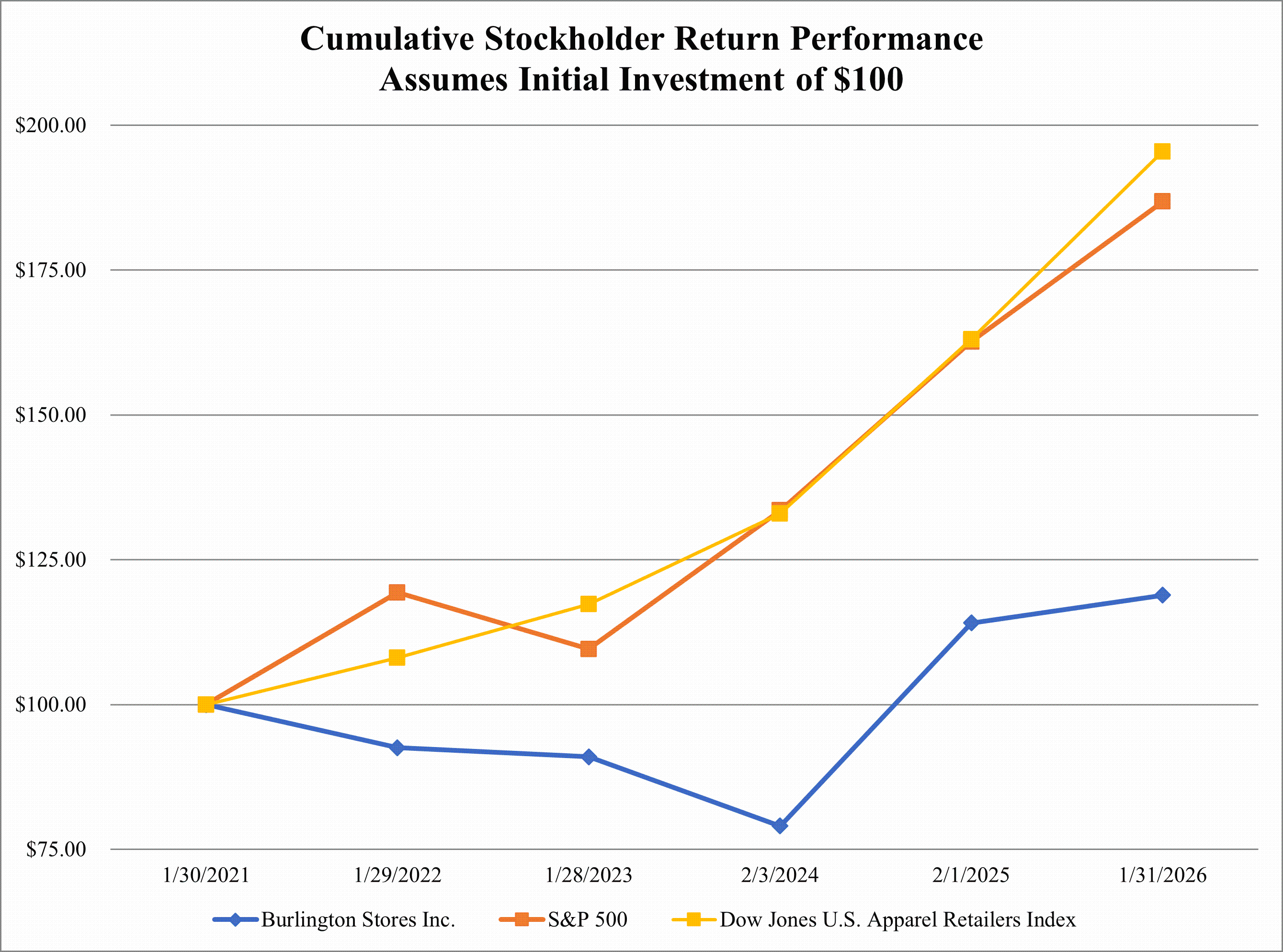
|
|
|
|
|
|
|
|
|
|
|
|
|
|
|
|
|
|
|
|
|
|
|
|
|
|
|
Base Period |
|
|
Indexed Returns for Fiscal Years Ended |
|
Company / Index |
|
January 30,
2021 |
|
|
January 29,
2022 |
|
|
January 28,
2023 |
|
|
February 3,
2024 |
|
|
February 1,
2025 |
|
|
January 31,
2026 |
|
Burlington Stores, Inc. |
|
$ |
100.00 |
|
|
$ |
92.52 |
|
|
$ |
90.95 |
|
|
$ |
79.04 |
|
|
$ |
114.07 |
|
|
$ |
118.87 |
|
S&P 500 Index |
|
$ |
100.00 |
|
|
$ |
119.32 |
|
|
$ |
109.59 |
|
|
$ |
133.50 |
|
|
$ |
162.63 |
|
|
$ |
186.82 |
|
Dow Jones U.S. Apparel Retailers Index |
|
$ |
100.00 |
|
|
$ |
108.05 |
|
|
$ |
117.29 |
|
|
$ |
132.95 |
|
|
$ |
163.05 |
|
|
$ |
195.42 |
|
Purchases of Equity Securities by the Issuer and Affiliated Purchasers
The following table provides information regarding our purchases of common stock during the three fiscal months ended January 31, 2026:
|
|
|
|
|
|
|
|
|
|
|
|
|
|
|
|
|
Month |
|
Total Number
of Shares
Purchased |
|
|
Average Price
Paid Per
Share (a) |
|
|
Total Number
of Shares
Purchased as
Part of Publicly
Announced
Plans or
Programs (b) |
|
|
Approximate
Dollar Value
of Shares
That May Yet
Be Purchased
Under the
Plans or
Programs
(in thousands) |
|
November 2, 2025 through November 29, 2025 |
|
|
33,064 |
|
|
$ |
279.68 |
|
|
|
33,064 |
|
|
$ |
435,204 |
|
December 2, 2025 through January 3, 2026 |
|
|
155,877 |
|
|
$ |
254.53 |
|
|
|
155,877 |
|
|
$ |
395,528 |
|
January 4, 2026 through January 31, 2026 |
|
|
34,922 |
|
|
$ |
302.11 |
|
|
|
34,922 |
|
|
$ |
384,977 |
|
Total |
|
|
223,863 |
|
|
|
|
|
|
223,863 |
|
|
|
|
(a)Includes commissions for the shares repurchased under our publicly announced share repurchase programs.
(b)On August 15, 2023, our Board of Directors authorized the repurchase of up to $500.0 million of common stock, which expired on August 15, 2025. During the second quarter of Fiscal 2025, the Company's Board of Directors authorized the repurchase of up to an additional $500.0 million of common stock, which is authorized to be executed through May 20, 2027. For a further discussion of our share repurchase program, see “Part II, Item 7. Management’s Discussion and Analysis of Financial Condition and Results of Operations—Liquidity and Capital Resources—Share Repurchase Program.”
Item 6. Reserved
Item 7. Management’s Discussion and Analysis of Financial Condition and Results of Operations
The following discussion summarizes the significant factors affecting our consolidated operating results, financial condition, liquidity and cash flows as of and for the periods presented below. The following discussion and analysis should be read in conjunction with our Consolidated Financial Statements, including the notes thereto, appearing elsewhere in this Annual Report.
In addition to historical information, this discussion and analysis contains forward-looking statements based on current expectations that involve risks, uncertainties and assumptions, such as our plans, objectives, expectations and intentions as further described under the caption above entitled “Cautionary Statement Regarding Forward-Looking Statements.” Our actual results or other events and the timing of events may differ materially from those anticipated in these forward-looking statements as a result of various factors, including those set forth in Item 1A, Risk Factors and elsewhere in this Annual Report.
General
We are a nationally recognized off-price retailer of high-quality, branded merchandise at everyday low prices. We opened our first store in Burlington, New Jersey in 1972, selling primarily coats and outerwear. Since then, we have expanded our store base to 1,212 stores as of January 31, 2026 in 46 states, Washington D.C. and Puerto Rico. We have diversified our product categories by offering an extensive selection of in-season, fashion-focused merchandise at up to 60% off other retailers’ prices, including: women’s ready-to-wear apparel, menswear, youth apparel, baby, beauty, footwear, accessories, home, toys, gifts and coats. We sell a broad selection of desirable, first-quality, current-brand, labeled merchandise acquired directly from nationally-recognized manufacturers and other suppliers.
Executive Summary
Store Openings, Closings and Relocations
During the fiscal year ended February 1, 2025 (Fiscal 2025), we opened 131 new stores, inclusive of 18 relocations, and closed nine stores, exclusive of the aforementioned relocations, bringing our store count as of January 31, 2026 to 1,212 stores. We continue to pursue our growth plans and invest in capital projects that meet our financial requirements. During the fiscal year ending January 30, 2027 (Fiscal 2026), we plan to open approximately 110 net new stores.
Fiscal Year Ended
Our fiscal year ends on the Saturday closest to January 31. We report fiscal years under a 52/53-week format and as a result, certain fiscal years will contain 53 weeks. Fiscal 2025 included 52 weeks, the fiscal year ended February 1, 2025 (Fiscal 2024) included 52 weeks, and the fiscal year ended February 3, 2024 (Fiscal 2023) included 53 weeks. Fiscal 2026 will have 52 weeks.
Ongoing Initiatives for Fiscal 2026
We continue to focus on several ongoing strategic initiatives aimed at operating with flexibility, responsiveness, and efficiency in everything we do, while delivering great value to our customers through continued improvement in the execution of our off-price model. These initiatives are outlined below.
Merchandising
Our merchandising strategy is centered on delivering compelling value while remaining responsive to evolving customer preferences. Key initiatives include:
•focusing on fashion, quality, brand, and price to inform our buying decisions and provide customers with outstanding value on their purchases;
•delivering remarkable value every day with speed and agility through a culture of customer focus and continuous learning and innovation;
•enabling buyers to spend more time in the market and take data-driven actions informed by current trends and opportunities;
•following the off-price principles of opportunistic buying and in-season purchasing to more effectively chase the sales trend;
•building capabilities to localize the assortment by region and store; and
•continuing to grow our merchandising talent base.
Stores
We remain focused on delivering a neat, clean, easy-to-shop, organized, and consistent shopping experience for our customers while maintaining disciplined cost and inventory controls. Key initiatives include:
•redesigning our stores with new interior layouts, signage and fixtures to better highlight our selection of trend-right, branded merchandise, and create an inviting environment for customers that accentuates the thrill of the treasure hunt;
•optimizing shortage reduction by identifying risks and implementing innovative physical security solutions and technologies; and
•getting fresh receipts out to the sales floor rapidly and efficiently.
Real Estate
We continue to selectively expand our store footprint in attractive locations to support long-term growth. Key initiatives include:
•opening 100 stores per year on average, which we believe will allow us to operate 2,000 stores over the long-term;
•prioritizing 25,000 square foot stores located in busy, convenient strip malls; and
•downsizing existing stores to incorporate our new store designs and reduce occupancy costs.
Supply Chain
We continue to invest in supply chain capabilities to support growth and improve operational efficiency. Key initiatives include:
•driving cost savings through speed, flexibility, and efficiency in distribution and transportation; and
•expanding and modernizing our supply chain network with flexible and efficient distribution centers purpose-built to execute our off-price business model.
Marketing
Our marketing efforts are focused on building a strong and renewed reputation with consumers. Key initiatives include:
•communicating a strong value message to new and existing shoppers; and
•investing in advertising that drives traffic to our stores.
Uncertainties and Challenges
As we strive to increase profitability, there are uncertainties and challenges that we face that could have a material impact on our revenues or income.
General Economic Conditions. There remains a high level of uncertainty in the current macroeconomic and geopolitical environments, and prolonged inflationary pressures could continue to negatively impact the discretionary spending of the low-income shopper, our core customer. In addition to inflation, consumer spending habits, including spending for the merchandise that we sell, are affected by, among other things, prevailing global economic conditions, the costs of basic necessities and other goods, levels of employment, salaries and wage rates, prevailing interest rates, reductions in government benefits and lower tax refunds, housing and food costs, energy and fuel costs, commodities pricing, income tax rates and policies, immigration policies, consumer confidence and consumer perception of economic conditions. In addition, consumer purchasing patterns are generally influenced by consumers’ disposable income, credit availability and debt levels.
A broad, protracted slowdown or downturn in the U.S. economy, an extended period of high unemployment or inflation rates, an uncertain domestic or global economic outlook or a financial crisis could adversely affect consumer spending habits resulting in lower net sales and profits than expected on a quarterly or annual basis. Conversely, if inflation declines, it could benefit our core customers who have been impacted by higher cost of living, and if economic growth slows, it could cause moderate and higher-income shoppers to become more value conscious. Either of these developments, if they occur, would be expected to improve our business. Consumer confidence is also affected by the domestic and international political situation. Our financial condition and operations could be impacted by changes in government regulations, initiatives or programs in areas including, but not limited to, trade and tariffs, taxes, healthcare, and immigration. In addition, trade and tariff regulations have had and are expected to continue to
have an indirect impact on consumer prices. We will continue to monitor changes in tariff policy and the impact of these changes on our industry and the economy and seek to adjust to these changes as efficiently as possible. The outbreak or escalation of war, or the occurrence of terrorist acts or other hostilities in or affecting the U.S., or public health issues such as pandemics or epidemics, could lead to a decrease in spending by consumers. In addition, natural disasters, public health issues, industrial accidents and acts of war or conflicts in various parts of the world (such as the conflict in Ukraine or the conflict in the Middle East), could have the effect of disrupting supplies and raising prices globally which, in turn, may have adverse effects on the world and U.S. economies and lead to a downturn in consumer confidence and spending.
We closely monitor our net sales, gross margin and expenses. We have performed scenario planning such that if our net sales decline for an extended period of time, we have identified variable costs that could be reduced to partially mitigate the impact of these declines. If we were to experience adverse sales trends and if our efforts to counteract the impacts of these trends are not sufficiently effective, there could be a negative impact on our financial performance and position in future fiscal periods.
Seasonality of Sales and Weather Conditions. Our business, like that of most retailers, is subject to seasonal influences. In the second half of the year, which includes the back-to-school and holiday seasons, we generally realize a higher level of sales and net income.
Weather continues to be a contributing factor to the sale of our merchandise. Generally, our sales are higher if the weather is cold during the Fall and warm during the early Spring. Sales of cold weather clothing are generally increased by early cold weather during the Fall, while sales of warm weather clothing are generally increased by early warm weather conditions in the Spring. Although we have diversified our product offerings, we believe traffic to our stores is still driven, in part, by weather patterns.
Competition and Margin Pressure. We believe that in order to remain competitive with retailers, including off-price retailers and discount stores, we must continue to offer brand-name merchandise at a discount to prices offered by other retailers as well as an assortment of merchandise that is appealing to our customers.
The U.S. retail apparel and home furnishings markets are highly fragmented and competitive. We compete for business with department stores, off-price retailers, internet retailers, specialty stores, discount stores, wholesale clubs, and outlet stores as well as with certain traditional, full-price retail chains that have developed off-price concepts. At various times throughout the year, traditional full-price department store chains and specialty shops offer brand-name merchandise at substantial markdowns, which can result in prices approximating those offered by us at our Burlington Stores. We anticipate that competition will increase in the future. Therefore, we will continue to look for ways to differentiate our stores from those of our competitors.
The U.S. retail industry continues to face increased pressure on margins as overall challenging retail conditions have led consumers to be more value conscious. Additionally, lower-to-moderate income shoppers continue to face economic pressure due to higher cost of living. Our strategy to chase the sales trend allows us the flexibility to purchase less pre-season merchandise with the balance purchased in-season and opportunistically. It also provides us with the flexibility to shift purchases between suppliers and categories. We believe that this enables us to obtain better terms with our suppliers, which we expect will help offset any rising costs of goods.
Key Performance and Non-GAAP Measures
We consider numerous factors in assessing our performance. Key performance and non-GAAP measures used by management include net income, Adjusted Net Income, Adjusted EBITDA, Adjusted EBIT, comparable store sales, gross margin, inventory and liquidity.
Net income. We earned net income of $610.2 million during Fiscal 2025 compared with $503.6 million during Fiscal 2024. This increase was primarily driven by higher sales and increased gross margin rate. Refer to the section below entitled “Results of Operations” for further explanation.
Adjusted Net Income, Adjusted EBITDA and Adjusted EBIT: Adjusted Net Income, Adjusted EBITDA and Adjusted EBIT are non-GAAP financial measures of our performance.
We define Adjusted Net Income as net income, exclusive of the following items, if applicable: (i) net favorable lease costs; (ii) loss on extinguishment of debt; (iii) costs related to debt amendments; (iv) impairment charges; (v) amounts related to certain litigation matters; and (vi) other unusual, non-recurring expenses, losses, charges or gains, all of which are tax effected to arrive at Adjusted Net Income.
We define Adjusted EBITDA as net income, exclusive of the following items, if applicable: (i) interest expense; (ii) interest income; (iii) loss on extinguishment of debt; (iv) costs related to debt amendments; (v) income tax expense; (vi) depreciation and amortization; (vii) net favorable lease costs; (viii) impairment charges; (ix) amounts related to certain litigation matters; and (x) other unusual, non-recurring expenses, losses, charges or gains.
We define Adjusted EBIT as net income, exclusive of the following items, if applicable: (i) interest expense; (ii) interest income; (iii) loss on extinguishment of debt; (iv) costs related to debt amendments; (v) income tax expense; (vi) impairment charges; (vii) net favorable lease costs; (viii) amounts related to certain litigation matters; and (ix) other unusual, non-recurring expenses, losses, charges or gains.
We present Adjusted Net Income, Adjusted EBITDA and Adjusted EBIT because we believe they are useful supplemental measures in evaluating the performance of our business and provide greater transparency into our results of operations. In particular, we believe that excluding certain items that may vary substantially in frequency and magnitude from what we consider to be our core operating results are useful supplemental measures that assist investors and management in evaluating our ability to generate earnings and leverage sales, and to more readily compare core operating results between past and future periods.
We believe that these non-GAAP measures provide investors helpful information with respect to our operations and financial condition. Other companies in the retail industry may calculate these non-GAAP measures differently such that our calculation may not be directly comparable.
Adjusted Net Income has limitations as an analytical tool, and should not be considered either in isolation or as a substitute for net income or other data prepared in accordance with GAAP. Among other limitations, Adjusted Net Income does not reflect the following items, net of their tax effect:
•net favorable lease costs;
•losses on extinguishment of debt;
•costs related to debt amendments;
•impairment charges on long-lived assets;
•amounts charged for certain litigation matters; and
•other unusual, non-recurring expenses, losses, charges or gains.
During Fiscal 2025, Adjusted Net Income improved $97.7 million to $625.7 million. This increase was primarily driven by higher sales and increased gross margin rate. Refer to the section below entitled “Results of Operations” for further explanation.
The following table shows our reconciliation of net income to Adjusted Net Income for Fiscal 2025, Fiscal 2024 and Fiscal 2023:
|
|
|
|
|
|
|
|
|
|
|
|
|
|
|
(unaudited) |
|
|
|
(in thousands) |
|
|
|
|
|
|
|
|
|
|
|
|
|
Fiscal Year Ended |
|
|
|
January 31, |
|
|
February 1, |
|
|
February 3, |
|
|
|
2026 |
|
|
2025 |
|
|
2024 |
|
|
|
|
|
|
|
|
|
(53 Weeks) |
|
|
|
|
|
|
|
|
|
|
|
Net income |
|
$ |
610,153 |
|
|
$ |
503,639 |
|
|
$ |
339,649 |
|
Net favorable lease costs (a) |
|
|
7,742 |
|
|
|
11,189 |
|
|
|
15,263 |
|
Loss on extinguishment of debt (b) |
|
|
— |
|
|
|
1,412 |
|
|
|
38,274 |
|
Costs related to debt amendments (c) |
|
|
112 |
|
|
|
4,553 |
|
|
|
97 |
|
Impairment charges - long-lived assets |
|
|
9,857 |
|
|
|
12,921 |
|
|
|
6,367 |
|
Litigation matters (d) |
|
|
4,175 |
|
|
|
2,525 |
|
|
|
1,500 |
|
Layaway liabilities (e) |
|
|
(12,716 |
) |
|
|
— |
|
|
|
— |
|
Security tags (f) |
|
|
11,657 |
|
|
|
— |
|
|
|
— |
|
Tax effect (g) |
|
|
(5,297 |
) |
|
|
(8,298 |
) |
|
|
(7,770 |
) |
Adjusted Net Income |
|
$ |
625,683 |
|
|
$ |
527,941 |
|
|
$ |
393,380 |
|
(a)Net favorable lease costs represent the non-cash expense associated with favorable and unfavorable leases that were recorded as a result of purchase accounting related to the April 13, 2006 Bain Capital acquisition of Burlington Coat Factory Warehouse Corporation (the Merger Transaction). These expenses are recorded in the line item “Selling, general and administrative expenses” in our Consolidated Statements of Income.
(b)Fiscal 2024 amount relates to the partial write-off of the original issue discount and deferred debt costs related to the September 2024 extension and upsize of the Term Loan Facility. Fiscal 2023 amount relates to the partial repurchases of the 2.25% Convertible Senior Notes due 2025 (the “2025 Convertible Notes”) and the exchange of a portion of the 2025 Convertible Notes.
(c)Fiscal 2025 amount relates to the settlement of the 2025 Convertible Notes during the first quarter of Fiscal 2025. Fiscal 2024 amount relates to the September 2024 extension and upsizing of the Term Loan Facility. Fiscal 2023 amount relates to the Term Loan Facility amendment changing from the Adjusted LIBOR Rate to the Adjusted Term SOFR Rate.
(d)Represents amounts charged for certain litigation matters.
(e)Represents a one-time settlement of certain layaway liabilities on our Consolidated Balance Sheet, resulting in a gain.
(f)Represents a one-time write-off to amortization related to certain merchandise security tags on our Consolidated Balance Sheet.
(g)Tax effect is calculated based on the effective tax rates (before discrete items) for the respective periods, adjusted for the tax effect for the impact of items (a) through (f).
Adjusted EBIT and Adjusted EBITDA have limitations as analytical tools, and should not be considered either in isolation or as a substitute for net income or other data prepared in accordance with GAAP. Among other limitations, Adjusted EBIT and Adjusted EBITDA do not reflect:
•net favorable lease costs;
•losses on the extinguishments of debt;
•costs related to debt issuances and amendments;
•amounts charged for certain litigation matters;
•impairment charges on long-lived assets;
•other unusual, non-recurring expenses, losses, charges or gains.
Adjusted EBITDA is further adjusted for cash requirements for replacement of assets. Although depreciation and amortization are non-cash charges, the assets being depreciated and amortized will likely have to be replaced in the future.
During Fiscal 2025, Adjusted EBIT improved $141.7 million to $887.1 million. During Fiscal 2025, Adjusted EBITDA increased $200.3 million to $1,293.3 million. These increases were primarily driven by higher sales and increased gross margin rate. Refer to the section below entitled “Results of Operations” for further explanation.
The following table shows our reconciliation of net income to Adjusted EBIT and Adjusted EBITDA for Fiscal 2025, Fiscal 2024 and Fiscal 2023:
|
|
|
|
|
|
|
|
|
|
|
|
|
|
|
(unaudited) |
|
|
|
(in thousands) |
|
|
|
|
|
|
|
|
|
|
|
|
|
Fiscal Year Ended |
|
|
|
January 31, |
|
|
February 1, |
|
|
February 3, |
|
|
|
2026 |
|
|
2025 |
|
|
2024 |
|
|
|
|
|
|
|
|
|
(53 Weeks) |
|
Reconciliation of net income to Adjusted EBIT and Adjusted EBITDA |
|
|
|
|
|
|
|
|
|
Net income |
|
$ |
610,153 |
|
|
$ |
503,639 |
|
|
$ |
339,649 |
|
Interest expense |
|
|
71,041 |
|
|
|
69,522 |
|
|
|
78,399 |
|
Interest income |
|
|
(20,904 |
) |
|
|
(31,519 |
) |
|
|
(24,633 |
) |
Net favorable lease costs (a) |
|
|
7,742 |
|
|
|
11,189 |
|
|
|
15,263 |
|
Loss on extinguishment of debt (b) |
|
|
— |
|
|
|
1,412 |
|
|
|
38,274 |
|
Costs related to debt amendments (c) |
|
|
112 |
|
|
|
4,553 |
|
|
|
97 |
|
Impairment charges - long-lived assets |
|
|
9,857 |
|
|
|
12,921 |
|
|
|
6,367 |
|
Litigation matters (d) |
|
|
4,175 |
|
|
|
2,525 |
|
|
|
1,500 |
|
Layaway liabilities (e) |
|
|
(12,716 |
) |
|
|
— |
|
|
|
— |
|
Security tags (f) |
|
|
11,657 |
|
|
|
— |
|
|
|
— |
|
Income tax expense |
|
|
205,965 |
|
|
|
171,175 |
|
|
|
126,124 |
|
Adjusted EBIT |
|
|
887,082 |
|
|
|
745,417 |
|
|
|
581,040 |
|
Depreciation and amortization (g) |
|
|
406,214 |
|
|
|
347,575 |
|
|
|
307,064 |
|
Adjusted EBITDA |
|
$ |
1,293,296 |
|
|
$ |
1,092,992 |
|
|
$ |
888,104 |
|
(a)Net favorable lease costs represent the non-cash expense associated with favorable and unfavorable leases that were recorded as a result of purchase accounting related to the Merger Transaction. These expenses are recorded in the line item “Selling, general and administrative expenses” in our Consolidated Statements of Income.
(b)Fiscal 2024 amount relates to the partial write-off of the original issue discount and deferred debt costs related to the September 2024 extension and upsize of the Term Loan Facility. Fiscal 2023 amount relates to the partial repurchases of the 2025 Convertible Notes and the exchange of a portion of the 2025 Convertible Notes.
(c)Fiscal 2025 amount relates to the settlement of the 2025 Convertible Notes during the first quarter of Fiscal 2025. Fiscal 2024 amount relates to the September 2024 extension and upsizing of the Term Loan Facility. Fiscal 2023 amount relates to the Term Loan Facility amendment changing from the Adjusted LIBOR Rate to the Adjusted Term SOFR Rate.
(d)Represents amounts charged for certain litigation matters.
(e)Represents a one-time settlement of certain layaway liabilities on our Consolidated Balance Sheet, resulting in a gain.
(f)Represents a one-time write-off to amortization related to certain merchandise security tags on our Consolidated Balance Sheet.
(g)Depreciation and amortization excludes the write-off of security tags in item (f).
Comparable Store Sales. Comparable store sales measure performance of a store during the current reporting period against the performance of the same store in the corresponding period of a prior year. The method of calculating comparable store sales varies across the retail industry. As a result, our definition of comparable store sales may differ from other retailers.
We define comparable store sales as merchandise sales of those stores commencing on the first day of the fiscal month one year after the end of their grand opening activities, which normally conclude within the first two months of operations. If a store is closed for seven or more days during a month, our policy is to remove that store from our calculation of comparable store sales for any such month, as well as during the month(s) of their grand re-opening activities. The table below depicts the change in our comparable store sales during Fiscal 2025, Fiscal 2024 and Fiscal 2023, all of which are calculated on a 52-week basis.
|
|
|
|
|
Comparable
Store Sales |
Fiscal 2025 |
|
2% |
Fiscal 2024 |
|
4% |
Fiscal 2023 |
|
4% |
Various factors affect comparable store sales, including, but not limited to, weather conditions, current economic conditions, the timing of our releases of new merchandise and promotional events, the general retail sales environment, consumer preferences and buying trends, changes in sales mix among distribution channels, competition, and the success of marketing programs.
Gross Margin. Gross margin is the difference between net sales and the cost of sales. Our cost of sales and gross margin may not be comparable to those of other entities, since some entities may include all of the costs related to their buying and distribution functions, certain store-related costs and other costs, in cost of sales. We include certain of these costs in the line items “Selling, general and administrative expenses” and “Depreciation and amortization” in our Consolidated Statements of Income. We include in our “Cost of sales” line item all costs of merchandise (net of purchase discounts and certain vendor allowances), inbound freight, distribution center outbound freight and certain merchandise acquisition costs, primarily commissions and import fees.
Gross margin as a percentage of net sales expanded to 43.8% during Fiscal 2025, compared with 43.2% during Fiscal 2024, driven primarily by improved merchandise margin and freight costs.
Product sourcing costs, which are included in selling, general and administrative expenses, decreased approximately 20 basis points as a percentage of net sales during the fiscal year ended January 31, 2026, compared with the fiscal year ended February 1, 2025. Product sourcing costs include the costs of processing goods through our supply chain and buying costs.
Inventory. Inventory as of January 31, 2026 increased to $1,311.9 million from $1,250.8 million at February 1, 2025. This increase primarily relates to an increase in comparable store inventory and new store inventory at 104 net new stores since the end of Fiscal 2024.
Reserve inventory includes all inventory that is being stored for release either later in the season, or in a subsequent season. We intend to use our reserve merchandise to effectively chase sales trends. Reserve inventory was 40% of total inventory at the end of Fiscal 2025 compared to 46% at the end Fiscal 2024.
In order to better serve our customers and maximize sales, we continue to refine our merchandising mix and inventory levels within our stores. By appropriately managing our inventories, we believe we will be better able to deliver a continual flow of fresh merchandise to our customers.
Liquidity. Liquidity measures our ability to generate cash. Management measures liquidity through cash flow, which is the measure of cash generated from or used in operating, financing, and investing activities. Cash and cash equivalents increased $237.8 million during Fiscal 2025, compared with an increase of $69.3 million during Fiscal 2024. Refer to the section below entitled “Liquidity and Capital Resources” for further explanation.
Results of Operations
The following table sets forth certain items in the Consolidated Statements of Income as a percentage of net sales for the periods indicated.
|
|
|
|
|
|
|
|
|
|
|
|
|
|
|
Percentage of Net Sales |
|
|
|
Fiscal Year Ended |
|
|
|
January 31, |
|
|
February 1, |
|
|
February 3, |
|
|
|
2026 |
|
|
2025 |
|
|
2024 |
|
Net sales |
|
|
100.0 |
% |
|
|
100.0 |
% |
|
|
100.0 |
% |
Other revenue |
|
|
0.1 |
|
|
|
0.2 |
|
|
|
0.2 |
|
Total revenue |
|
|
100.1 |
|
|
|
100.2 |
|
|
|
100.2 |
|
Cost of sales |
|
|
56.2 |
|
|
|
56.8 |
|
|
|
57.5 |
|
Selling, general and administrative expenses |
|
|
33.1 |
|
|
|
33.4 |
|
|
|
33.9 |
|
Costs related to debt amendments |
|
|
0.0 |
|
|
|
0.0 |
|
|
|
0.0 |
|
Depreciation and amortization |
|
|
3.6 |
|
|
|
3.3 |
|
|
|
3.2 |
|
Impairment charges - long-lived assets |
|
|
0.1 |
|
|
|
0.1 |
|
|
|
0.1 |
|
Other income - net |
|
|
(0.3 |
) |
|
|
(0.2 |
) |
|
|
(0.2 |
) |
Loss on extinguishment of debt |
|
|
— |
|
|
|
0.0 |
|
|
|
0.4 |
|
Interest income |
|
|
(0.2 |
) |
|
|
(0.3 |
) |
|
|
(0.2 |
) |
Interest expense |
|
|
0.6 |
|
|
|
0.7 |
|
|
|
0.8 |
|
Total costs and expenses |
|
|
93.1 |
|
|
|
93.8 |
|
|
|
95.5 |
|
Income before income tax expense |
|
|
7.0 |
|
|
|
6.4 |
|
|
|
4.7 |
|
Income tax expense |
|
|
1.8 |
|
|
|
1.6 |
|
|
|
1.3 |
|
Net income |
|
|
5.2 |
% |
|
|
4.8 |
% |
|
|
3.4 |
% |
Performance for Fiscal Year Ended January 31, 2026 (Fiscal 2025) Compared with Fiscal Year Ended February 1, 2025 (Fiscal 2024)
Net sales
Net sales improved $932.9 million, or 8.8%, to $11,549.6 million, primarily driven by both an increase in net sales of $691.4 million from our new stores and non-comparable stores as well as an increase of 2%, or $241.5 million, in comparable store sales during Fiscal 2025.
Cost of sales
Cost of sales as a percentage of net sales decreased to 56.2% during Fiscal 2025, compared with 56.8% during Fiscal 2024, primarily driven by improved merchandise margin and freight costs. On a dollar basis, cost of sales increased $461.7 million, or 7.7%, primarily driven by our overall increase in sales.
Selling, general and administrative expenses
Selling, general and administrative expenses as a percentage of net sales decreased to 33.1% during the fiscal year ended January 31, 2026, compared to 33.4% during the fiscal year ended February 1, 2025. The decrease was primarily driven by supply chain efficiency initiatives and store payroll costs, partially offset by increased occupancy costs. On a dollar basis, selling, general and administrative expenses increased by $270.2 million, or 7.6%, to $3,817.2 million during the fiscal year ended January 31, 2026. The increase was primarily driven by our 104 net new stores opened since the end of Fiscal 2024.
During Fiscal 2025 and Fiscal 2024, the Company acquired leases through bankruptcy proceedings. The acquisition of these leases resulted in $35.5 million and $15.7 million of pre-opening costs that are recorded in the line item, “Selling, general and administrative expenses” in our Consolidated Statements of Income during Fiscal 2025 and Fiscal 2024, respectively.
Depreciation and amortization
Depreciation and amortization expense amounted to $417.9 million during Fiscal 2025, compared with $347.6 million during Fiscal 2024. The increase in depreciation and amortization expense was primarily driven by new and non-comparable stores, as well as capital expenditures related to investments in our supply chain infrastructure.
Impairment charges—long-lived assets
Impairment charges related to long-lived assets were $9.9 million and $12.9 million during Fiscal 2025 and Fiscal 2024, respectively. Fiscal 2025 relates to an owned store selling below carrying value, unrecoverable assets at underperforming stores, as well as stores relocated and closed before the end of the respective lease-end dates. Fiscal 2024 relates to two owned stores selling below carrying value, unrecoverable assets at underperforming stores, and stores relocated and closed before the end of the respective lease-end dates.
The recoverability assessment related to these store-level assets requires various judgments and estimates, including estimates related to future revenues, gross margin rates, store expenses and other assumptions. We base these estimates upon our past and expected future performance. We believe our estimates are appropriate in light of current market conditions. However, future impairment charges could be required if we do not achieve our current revenue or cash flow projections for each store. Refer to Note 4, “Impairment Charges,” for further discussion.
Other income, net
Other income, net improved $14.6 million to $31.3 million during Fiscal 2025. The improvement in other income was primarily driven by a one-time settlement of certain layaway liabilities, resulting in a gain.
Loss on Extinguishment of Debt
There were no loss on extinguishment of debt charges during Fiscal 2025. During Fiscal 2024, debt extinguishment charges amounted to $1.4 million related to the partial write-off of the original issue discount and deferred debt costs, as a result of the September 2024 extension and upsize of our Term Loan Facility. Refer to Note 5, “Long Term Debt,” for further discussion regarding our debt transactions.
Interest income
Interest income decreased $10.6 million to $20.9 million. The decrease was primarily driven by more investments in Fiscal 2024 compared to Fiscal 2025.
Interest expense
Interest expense increased $1.5 million to $71.0 million. The increase is related to the upsize of the Term Loan Facility, partially offset by increased capitalized interest as a result of the ongoing construction of a distribution center and paydown of the 2025 Convertible Notes during the first quarter of Fiscal 2025.
The average interest rate on the Term Loan Facility was 5.9% and 7.0% for the fiscal year ended January 31, 2026 and the fiscal year ended February 1, 2025, respectively. The average balance on the Term Loan Facility, excluding the original issue discount, was $1,561.2 million and $1,047.0 million for the fiscal year ended January 31, 2026 and the fiscal year ended February 1, 2025, respectively.
Income tax expense
Income tax expense was $206.0 million for Fiscal 2025 compared with $171.2 million for Fiscal 2024. The effective tax rate was 25.2% related to pretax income of $816.1 million for Fiscal 2025, and 25.4% related to pretax income of $674.8 million for Fiscal 2024. The increase in income tax expense is primarily driven by higher pre‑tax income.
Net income
We earned net income of $610.2 million during Fiscal 2025 compared with net income of $503.6 million for Fiscal 2024. This increase was primarily driven by higher sales and increased gross margin rate. Net income included $26.4 million and $11.7 million of expense, net of income taxes, for Fiscal 2025 and Fiscal 2024, respectively, related to the bankruptcy acquired leases.
Performance for Fiscal Year Ended February 1, 2025 (Fiscal 2024) Compared with Fiscal Year Ended February 3, 2024 (Fiscal 2023)
For a discussion related to Fiscal 2024 performance compared to Fiscal 2023 performance, refer to Part II, Item 7, “Management’s Discussion and Analysis of Financial Condition and Results of Operations,” included in our Annual Report on Form 10-K for the fiscal year ended February 1, 2025 (Fiscal 2024 10-K).
Liquidity and Capital Resources
Our ability to satisfy interest payment and future principal payment obligations on our outstanding debt will depend largely on our future performance which, in turn, is subject to prevailing economic conditions and to financial, business and other factors beyond our control. If we do not have sufficient cash flow to service interest payment and future principal payment obligations on our outstanding indebtedness and if we cannot borrow or obtain equity financing to satisfy those obligations, our business and results of operations will be materially adversely affected. We cannot be assured that any replacement borrowing or equity financing could be successfully completed on terms similar to our current financing agreements, or at all.
We believe that cash generated from operations, along with our existing cash and our ABL Line of Credit, will be sufficient to fund our expected cash flow requirements and planned capital expenditures for at least the next twelve months as well as the foreseeable future. However, there can be no assurance that we would be able to offset declines in our comparable store sales with savings initiatives.
As market conditions warrant, we may, from time to time, repurchase our outstanding debt securities in the open market, in privately negotiated transactions, by tender offer, by exchange transaction or otherwise. Such repurchases, if any, will depend on prevailing market conditions, our liquidity and other factors and may be commenced or suspended at any time. The amounts involved and total consideration paid may be material.
From time to time, we evaluate options to opportunistically increase, refinance or extend our debt. Our assessment will be based on our capital needs for, among other things, facility purchases, capital improvements and expenditures. No assurance can be given that we will enter into such agreements.
Cash Flows
Cash Flows for Fiscal 2025 Compared with Fiscal 2024
We generated $237.8 million of cash flows during Fiscal 2025 compared with $69.3 million during Fiscal 2024.
Net cash provided by operating activities amounted to $1,231.4 million and $863.4 million during Fiscal 2025 and Fiscal 2024, respectively. The increase in our operating cash flows was primarily driven by improved net income as well as changes in working capital.
Net cash used in investing activities was $1,055.1 million and $882.3 million during Fiscal 2025 and Fiscal 2024, respectively. This change was primarily the result of investments in our supply chain infrastructure, as well as new store construction.
Net cash provided by financing activities was $61.5 million during Fiscal 2025 compared to a use of $88.2 million during Fiscal 2024. This change was primarily driven by the settlement of the 2025 Convertible Notes during the first quarter of Fiscal 2025 and an increase in treasury stock repurchases, partially offset by net proceeds related to the upsize of the Term Loan Facility during the second quarter of Fiscal 2025.
Changes in working capital also impact our cash flows. Working capital equals current assets minus current liabilities. We had working capital at January 31, 2026 of $522.3 million compared with $356.3 million at February 1, 2025. The increase in working capital was primarily driven by increased cash balance and a decrease in current maturity of long term debt, partially offset by a decrease in prepaid assets.
Cash Flows for Fiscal 2024 Compared with Fiscal 2023
For a discussion of our cash flows for Fiscal 2024 compared to Fiscal 2023, refer to Part II, Item 7, “Management’s Discussion and Analysis of Financial Condition and Results of Operations,” included in our Fiscal 2024 10-K.
Capital Expenditures
For Fiscal 2025, capital expenditures, net of $56.9 million of landlord allowances, amounted to $1,104.1 million (inclusive of accrued capital expenditures). These capital expenditures include approximately $482.0 million, net of the previously mentioned landlord allowances, for store expenditures (new stores, downsizes, remodels and other store expenditures). In addition, we made capital expenditures of $464.0 million to support our supply chain initiatives, largely related to the purchase of the distribution center in California and build-out of the distribution center in Georgia, with the remaining capital to support information technology and other business initiatives. During Fiscal 2024, we incurred capital expenditures of $843.9 million (inclusive of accrued capital expenditures), net of approximately $28.9 million of landlord allowances.
We estimate that we will spend approximately $875 million, net of approximately $55 million of landlord allowances, in capital expenditures during Fiscal 2026, including approximately $420 million, net of the previously mentioned landlord allowances, for store expenditures (new stores, downsizes, remodels and other store expenditures). In addition, we estimate that we will spend approximately $290 million to support our supply chain initiatives, largely related to completing the build-out of the distribution center in Georgia and beginning construction on a distribution center in Arizona. The remaining capital will be used to support our information technology and other business initiatives.
Share Repurchase Program
On August 15, 2023, our Board of Directors authorized the repurchase of up to $500.0 million of common stock, which expired on August 15, 2025.
On May 20, 2025, our Board of Directors authorized the repurchase of up to an additional $500.0 million of common stock, which is authorized to be executed through May 20, 2027.
During Fiscal 2025, we repurchased 985,594 shares of common stock for $251.4 million under our share repurchase program. As of January 31, 2026, we had $385.0 million remaining under our share repurchase authorization.
We are authorized to repurchase shares of our outstanding common stock from time to time on the open market or in privately negotiated transactions under our repurchase program. The timing and amount of stock repurchases will depend on a variety of factors, including the market conditions as well as corporate and regulatory considerations. Our share repurchase program may be suspended, modified or discontinued at any time, and we have no obligation to repurchase any amount of our common stock under the program.
Dividends
We currently do, and intend to continue to, retain all available funds and any future earnings to fund all of our capital expenditures, business initiatives, and to support any potential opportunistic capital structure initiatives. Therefore, at this time, we do not anticipate paying cash dividends in the near term. Our ability to pay dividends on our common stock will be limited by restrictions on the ability of our subsidiaries to pay dividends or make distributions under the terms of current and any future agreements governing our indebtedness. Any future determination to pay dividends will be at the discretion of our Board of Directors, subject to compliance with covenants in our current and future agreements governing our indebtedness, and will depend upon our results of operations, financial condition, capital requirements and other factors that our Board of Directors deems relevant.
In addition, since we are a holding company, substantially all of the assets shown on our Consolidated Balance Sheets are held by our subsidiaries. Accordingly, our earnings, cash flow and ability to pay dividends are largely dependent upon the earnings and cash flows of our subsidiaries and the distribution or other payment of such earnings to us in the form of dividends.
Debt and Hedging
As of January 31, 2026, our obligations, inclusive of original issue discount, include $1,719.4 million under our Term Loan Facility, $297.1 million of 2027 Convertible Notes and no outstanding borrowings on our ABL Line of Credit. Our debt obligations also include $22.9 million of finance lease obligations as of January 31, 2026. Refer to Note 5 to our Consolidated Financial Statements, “Long Term Debt,” for an overview of the terms and conditions of these instruments.
Term Loan Facility
BCFWC and certain of its subsidiaries and holding companies are party to a Credit Agreement (as amended, supplemented and otherwise modified, the Term Loan Facility) that provides for term loans in an aggregate principal amount as of January 31, 2026 of $1,730.6 million maturing on September 24, 2031.
On September 24, 2024, we entered into an amendment to the Term Loan Facility dated as of February 24, 2011 (the "Amendment"), which among other things, (i) refinanced the outstanding $933.0 million principal amount of Term B-6 Loans with Term B-7 Loans in an aggregate principal amount of $1,250.0 million, which includes incremental term loans in an aggregate principal amount of $317.0 million, (ii) extended the maturity date from June 24, 2028 to September 24, 2031, and (iii) reduced the interest rate margins applicable to our term loan facility from 1.00% to 0.75%, in the case of prime rate loans, and from 2.00% to
1.75%, in the case of SOFR loans, with a 0.00% SOFR floor, and removed the SOFR adjustment. The Term B-7 Loans were issued with an original issue discount of 99.5.
On June 11, 2025, we entered into an amendment to the Term Loan Facility, which among other things, provided for $500.0 million of incremental term loans under the Term Loan Credit Agreement as additional Term B-7 Loans. The incremental term loans were issued with an original issue discount of 99.0 and are otherwise on terms identical to, and fungible with, the existing Term B-7 Loans.
The Term Loan Facility is collateralized by a first lien on BCFWC’s and each guarantor’s equity interests, equipment, intellectual property, and certain favorable leases and real estate, and certain related assets and proceeds thereof (subject to certain exceptions), and a second lien on BCFWC’s and each guarantor’s other assets and proceeds thereof (subject to certain exceptions).
At January 31, 2026, our borrowing rate related to the Term Loan Facility, exclusive of the impact of interest rate swaps, was 5.4%.
ABL Line of Credit
BCFWC and certain of its subsidiaries and holding companies are party to a Second Amended and Restated Credit Agreement (as amended, supplemented and otherwise modified, the ABL Line of Credit) that provides for $1,000.0 million of revolving commitments (subject to a borrowing base limitation) maturing on July 25, 2030, and, subject to the satisfaction of certain conditions, BCFWC can increase the aggregate amount of commitments up to an amount not to exceed the sum of (i) the greater of (x) $300.0 million and (y) the amount by which the Borrowing Base exceeds the aggregate Commitments, plus (iii) the amount of all permanent reductions in commitments after July 25, 2025. The interest rate margin applicable under the ABL Line of Credit is 1.125% to 1.375% in the case of a daily SOFR rate or a term SOFR rate, and 0.125% to 0.375% in the case of a prime rate, depending on the average daily availability of the lesser of (a) the total commitments or (b) the borrowing base. The ABL Line of Credit is collateralized by a first priority lien on BCFWC’s and each guarantor's inventory, receivables, bank accounts, and certain related assets and proceeds thereof (subject to certain exceptions), and a second priority lien on BCFWC’s and each guarantor's other assets and proceeds thereof (other than real estate and subject to certain exceptions)
On July 25, 2025, we entered into an amendment to the ABL Line of Credit in order to, among other things, (i) increase the aggregate principal amount of the commitments from $900.0 million to $1,000.0 million and (ii) extend the maturity date of the commitments and loans from December 22, 2026 to July 25, 2030.
At January 31, 2026, we had $934.5 million available under the ABL Line of Credit. Average borrowings during Fiscal 2025 amounted to $20.2 million at an average interest rate of 5.5%.
2025 Convertible Notes
On April 16, 2020, we issued 2025 Convertible Notes, which matured on April 15, 2025. The 2025 Convertible Notes were general unsecured obligations of the Company and bore interest at a rate of 2.25% per year, payable semi-annually in cash, in arrears, on April 15 and October 15 of each year.
Prior to maturity, holders of the 2025 Convertible Notes submitted conversion notices with respect to approximately $155.5 million aggregate principal amount of the 2025 Convertible Notes. On the conversion settlement date, the Company paid to the converting holders the aggregate principal amount of 2025 Convertible Notes subject to conversion, and issued and delivered to such holders 57,149 shares of common stock, in respect of the remainder of its conversion obligation in excess of such aggregate principal amount. At maturity, the Company paid in cash the principal balance and related accrued and unpaid interest on the 2025 Convertible Notes not previously converted. There was no resulting debt extinguishment charge from this transaction.
2027 Convertible Notes
On September 12, 2023, we closed the issuance of approximately $297.1 million aggregate principal amount of our 2027 Convertible Notes pursuant to separate, privately negotiated exchange and subscription agreements with a limited number of holders of our 2025 Convertible Notes and certain investors, in each case pursuant to exemptions from registration under the Securities Act of 1933. An aggregate of up to 1,422,568 shares of common stock may be issued upon conversion of the 2027 Convertible Notes, which number is subject to adjustment up to an aggregate of 1,911,372 shares following certain corporate events that occur prior to the maturity date or if we issue a notice of redemption, and which is also subject to certain anti-dilution adjustments.
The 2027 Convertible Notes bear interest at a rate of 1.25% per year, payable semi-annually in arrears on June 15 and December 15 of each year. The 2027 Convertible Notes will mature on December 15, 2027, unless earlier converted, redeemed or repurchased.
Prior to the close of business on the business day immediately preceding September 15, 2027, the 2027 Convertible Notes will be convertible at the option of the holders only upon the occurrence of certain events and during certain periods. Thereafter, the 2027 Convertible Notes will be convertible at the option of the holders at any time until the close of business on the second scheduled trading day immediately preceding the maturity date. The 2027 Convertible Notes have an initial conversion rate of 4.8560 shares per $1,000 principal amount of 2027 Convertible Notes (equivalent to an initial conversion price of approximately $205.93 per share of our common stock), subject to adjustment if certain events occur. The initial conversion price represents a conversion premium of approximately 32.50% over $155.42 per share, the last reported sale price of our common stock on September 7, 2023 on The New York Stock Exchange. Upon conversion, we will pay cash up to the aggregate principal amount of 2027 Convertible Notes being converted, and pay (and deliver, if applicable) cash, shares of our common stock or a combination thereof, at its election, in respect of the remainder (if any) of our conversion obligation in excess of such aggregate principal amount. We will not be able to redeem the 2027 Convertible Notes prior to December 20, 2025. On or after December 20, 2025 and prior to the 21st scheduled trading day immediately preceding December 15, 2027, we will be able to redeem for cash all or any portion of the 2027 Convertible Notes, at its option, if the last reported sale price of our common stock is equal to or greater than 130% of the conversion price for a specified period of time, at a redemption price equal to 100% of the aggregate principal amount of the 2027 Convertible Notes to be redeemed, plus accrued and unpaid interest, if any, to, but excluding, the redemption date.
If we undergo a fundamental change, subject to certain conditions, holders of the 2027 Convertible Notes may require us to repurchase for cash all or any portion of our 2027 New Convertible Notes. The fundamental change repurchase price will be 100% of the aggregate principal amount of the 2027 Convertible Notes to be repurchased plus any accrued and unpaid interest to, but excluding, the fundamental change repurchase date.
On March 12, 2026 and March 13, 2026, we entered into separate, privately negotiated exchange agreements with certain holders of the 2027 Convertible Notes. Under the terms of the Exchange Agreements, the holders have agreed to exchange $111.0 million in aggregate principal amount of 2027 Convertible Notes held by them for a combination of an aggregate of $128.6 million in cash and 150,831 shares of our common stock. These exchange transactions are expected to close on or around March 19, 2026, subject to the satisfaction of customary closing conditions.
Hedging
During the second quarter of Fiscal 2025, we entered into a $200.0 million interest rate swap agreement with a fixed interest rate of 3.76%. On the same date, we also entered into a $100.0 million interest rate swap agreement with a fixed interest rate of 3.73%.
In total, we have interest rate swaps which hedge $1,100.0 million of variable rate exposure under our Term Loan Facility. The interest rate swaps are designated as cash flow hedges and expire on September 24, 2031. Refer to Note 6, “Derivative Instruments and Hedging Activities,” for further discussion regarding our derivative transactions.
Certain Information Concerning Material Cash Requirements
The following table sets forth certain information regarding our obligations to make future payments under current contracts as of January 31, 2026:
|
|
|
|
|
|
|
|
|
|
|
|
|
|
|
|
|
|
|
|
|
|
|
Payments Due By Period |
|
|
|
Total |
|
|
1 Year |
|
|
2-3 Years |
|
|
4-5 Years |
|
|
Thereafter |
|
|
|
(in thousands) |
|
Debt obligations (a) |
|
$ |
2,078,290 |
|
|
$ |
68,140 |
|
|
$ |
332,119 |
|
|
$ |
35,050 |
|
|
$ |
1,642,981 |
|
Interest on debt obligations (b) |
|
|
501,229 |
|
|
|
93,185 |
|
|
|
181,014 |
|
|
|
172,246 |
|
|
|
54,784 |
|
Finance lease obligations (c) |
|
|
31,514 |
|
|
|
3,640 |
|
|
|
7,087 |
|
|
|
4,144 |
|
|
|
16,643 |
|
Operating lease obligations (d) |
|
|
5,046,394 |
|
|
|
654,698 |
|
|
|
1,386,061 |
|
|
|
1,153,582 |
|
|
|
1,852,053 |
|
Purchase obligations (e) |
|
|
1,774,019 |
|
|
|
1,774,019 |
|
|
|
— |
|
|
|
— |
|
|
|
— |
|
Other (f) |
|
|
2,024 |
|
|
|
1,950 |
|
|
|
74 |
|
|
|
— |
|
|
|
— |
|
Total |
|
$ |
9,433,470 |
|
|
$ |
2,595,632 |
|
|
$ |
1,906,355 |
|
|
$ |
1,365,022 |
|
|
$ |
3,566,461 |
|
(a)Represents future principal payments on outstanding borrowings as of January 31, 2026.
(b)Represents interest payments on (i) the outstanding balance of the Term Loan Facility with an interest rate of 5.4%; (ii) 1,100.0 million interest rate swap; and (iii) the outstanding balance of the 2027 Convertible Notes.
(c)Finance lease obligations include future interest payments.
(d)Represents minimum rent payments for operating leases under the current terms. The above table excludes approximately $536.9 million for 96 stores and one office that we have committed to open or relocate but have not yet taken possession of the space.
(e)Represents commitments to purchase merchandise that have not been received as of January 31, 2026. The table above excludes estimated commitments for non-merchandise goods of approximately $225 million, which primarily relates to capital expenditures for our stores as well as other miscellaneous operating expenses.
(f)Represents severance payments in the normal course of business that are included in the line item “Selling, general and administrative expenses” in our Consolidated Statements of Income.
The table above excludes ASC Topic No. 740 “Income Taxes” (Topic No. 740) liabilities which represent uncertain tax positions related to temporary differences. The total Topic No. 740 liability was $5.8 million, inclusive of $4.3 million of interest and penalties, neither of which is presented in the table above as we are not certain if and when these payments would be required.
The table above excludes our irrevocable letters of credit guaranteeing payment and performance under certain leases, insurance contracts, debt agreements, merchandising agreements and utility agreements in the amount of $50.4 million as of January 31, 2026.
As of January 31, 2026, insurance reserves amounted to $111.0 million. These amounts are excluded from the table above as we are not certain if and when these payments would be required.
Critical Accounting Policies and Estimates
Our Consolidated Financial Statements have been prepared in accordance with GAAP. We believe there are several accounting policies that are critical to understanding our historical and future performance as these policies affect the reported amounts of revenues and other significant areas that involve management’s judgments and estimates. The preparation of our Consolidated Financial Statements requires management to make estimates and assumptions that affect (i) the reported amounts of assets and liabilities; (ii) the disclosure of contingent assets and liabilities at the date of the Consolidated Financial Statements; and (iii) the reported amounts of revenues and expenses during the reporting period. On an ongoing basis, management evaluates its estimates and judgments, including those related to revenue recognition, inventories, long-lived assets, intangible assets, goodwill, insurance reserves, leases, and income taxes. Historical experience and various other factors that are believed to be reasonable under the circumstances form the basis for making estimates and judgments about the carrying values of assets and liabilities that are not readily apparent from other sources. Actual results may differ from these estimates under different assumptions or conditions. As events continue to evolve and additional information becomes available, our estimates may change materially in future periods. A critical accounting estimate meets two criteria: (1) it requires assumptions about highly uncertain matters and (2) there would be a material effect on the Consolidated Financial Statements from either using a different, although reasonable, amount within the range of the estimate in the current period or from reasonably likely period-to-period changes in the estimate.
While there are a number of accounting policies, methods and estimates affecting our Consolidated Financial Statements as addressed in Note 1 to our Consolidated Financial Statements, “Summary of Significant Accounting Policies,” areas that are particularly critical and significant include:
Revenue Recognition. While our revenue recognition does not involve significant judgment, it represents an important accounting policy. We record revenue at the time control of goods are transferred to the customer, which we determine to be at point of sale and delivery of merchandise, net of allowances for estimated future returns, which is estimated based on historical return rates. We present sales, net of sales taxes, in our Consolidated Statements of Income. We account for layaway sales in compliance with ASC Topic No. 606 “Revenue from Contracts with Customers.” Layaway sales are recognized upon delivery of merchandise to the customer. The amount of cash received upon initiation of the layaway is recorded as a deposit liability within the line item “Other current liabilities” in our Consolidated Balance Sheets. Stored value cards (gift cards and store credits issued for merchandise returns) are recorded as a liability at the time of issuance, and the related sale is recorded upon redemption.
We estimate and recognize stored value card breakage income in proportion to actual stored value card redemptions. We determine an estimated stored value card breakage rate by continuously evaluating historical redemption data. Breakage income is recognized on a monthly basis in proportion to the historical redemption patterns for those stored value cards for which the likelihood of redemption is remote.
Inventory. Our inventory is valued at the lower of cost or market using the retail inventory method. Under the retail inventory method, the valuation of inventory and the resulting gross margin are determined by applying a calculated cost to retail ratio to the retail value of inventory. The retail inventory method is an averaging method that results in valuing inventory at the lower of cost or market provided markdowns are taken timely to reduce the retail value of inventory. Inherent in the retail inventory method calculation are certain significant management judgments and estimates including merchandise markups, markdowns and shortage, which significantly impact the ending inventory valuation as well as the resulting gross margin. Management believes that our retail inventory method provides an inventory valuation which approximates cost using a first-in, first-out assumption and results in carrying value at the lower of cost or market. We reserve for aged inventory based on historical trends and specific identification. Our aged inventory reserve contains uncertainties as the calculations require management to make assumptions and to apply judgment regarding a number of factors, including market conditions, the selling environment, historical results and current inventory trends. A 1% change in the dollar amount of retail markdowns would have resulted in an increase in markdown dollars, at cost, of approximately $2.8 million for Fiscal 2025.
Estimates are used to record inventory shortage at retail stores between physical inventories. Actual physical inventories are conducted at least annually to calculate actual shortage. While we make estimates on the basis of the best information available to us at the time the estimates are made, over accruals or under accruals of shortage may be identified as a result of the physical inventory counts, requiring adjustments.
Insurance Reserves. We have risk participation agreements with insurance carriers with respect to workers’ compensation, general liability insurance and health insurance. Pursuant to these arrangements, we are responsible for paying individual claims up to designated dollar limits. The amounts included in our costs related to these claims are estimated and can vary based on changes in assumptions or claims experience included in the associated insurance programs. For example, changes in legal trends and interpretations, as well as changes in the nature and method of how claims are settled, can impact ultimate costs. An increase in workers’ compensation claims by employees, health insurance claims by employees or general liability claims may result in a corresponding increase in our costs related to these claims. Insurance reserves amounted to $111.0 million and $102.8 million at January 31, 2026 and February 1, 2025, respectively.
Recent Accounting Pronouncements
Refer to Note 2, “Recent Accounting Pronouncements,” of our Consolidated Financial Statements for a discussion of recent accounting pronouncements and their impact on our Consolidated Financial Statements.
Fluctuations in Operating Results
We expect that our revenues and operating results may fluctuate from fiscal quarter to fiscal quarter or over the longer term. Certain of the general factors that may cause such fluctuations are discussed in Item 1A, Risk Factors and elsewhere in this Annual Report.
Inflation
There can be no assurance that we will be able to offset inflationary pressure in the future by increasing prices or through other means, or that our business will not be negatively affected by continued inflation in the future. We may not be able to adequately increase our prices over time to offset increased costs, whether due to inflation or otherwise. Any decreases in consumer discretionary spending could result in a decrease in store traffic and same store sales, all of which could negatively affect our business, operations, liquidity, financial results and/or stock price, particularly if consumer spending levels are depressed for a prolonged period of time.
The U.S. retail industry continues to face increased pressure on margins as commodity prices increase and the overall challenging retail conditions have led consumers to be more value conscious. Additionally, lower-to-moderate income shoppers continue to face economic pressure due to higher cost of living. Our strategy of chasing sales, in which we purchase both pre-season and in-season merchandise, allows us the flexibility to purchase less pre-season with the balance purchased in-season and opportunistically. It also provides us the flexibility to shift purchases between suppliers and categories. This enables us to obtain better terms with our suppliers, which we expect to help offset the expected rising costs of goods.
Market Risk
We are exposed to market risks relating to fluctuations in interest rates. Our borrowings contain floating rate obligations and are subject to interest rate fluctuations. The objective of our financial risk management is to minimize the negative impact of interest rate fluctuations on our earnings and cash flows. We manage interest rate risk through the use of our interest rate swap contracts.
As more fully described in Note 6 to our Consolidated Financial Statements, “Derivative Instruments and Hedging Activities,” we enter into interest rate derivative contracts to manage interest rate risks associated with our long term debt obligations. The effective portion of changes in the fair value of derivatives designated and that qualify as cash flow hedges is recorded in the line item “Accumulated other comprehensive income” on the Consolidated Balance Sheets and is subsequently reclassified into earnings in the period that the hedged forecasted transaction affects earnings. We continue to have exposure to interest rate risks to the extent they are not hedged.
Item 7A. Quantitative and Qualitative Disclosures About Market Risk
We are exposed to certain market risks as part of our ongoing business operations. Primary exposures include changes in interest rates, as borrowings under our ABL Line of Credit and Term Loan Facility bear interest based on SOFR, in each case plus an applicable borrowing margin. The interest rate of our Term Loan Facility is also dependent on the prime rate, and the federal funds rate as further discussed in Note 5 to our Consolidated Financial Statements, “Long Term Debt.” On September 24, 2024, we entered into an amendment to the Credit Agreement dated as of February 24, 2011, which among other things, (i) refinanced the outstanding $933 million principal amount of term B-6 loans with term B-7 loans in an aggregate principal amount of $1,250 million, which includes incremental term loans in an aggregate principal amount of $317 million, (ii) extended the maturity date from June 24, 2028 to September 24, 2031, and (iii) reduced the interest rate margins applicable to our term loan facility from 1.00% to 0.75%, in the case of prime rate loans, and from 2.00% to 1.75%, in the case of SOFR loans, with a 0.00% SOFR floor, and removing the SOFR adjustment.
On June 11, 2025, we entered into an amendment to the Term Loan Facility, which among other things, provided for $500.0 million of incremental term loans under the Term Loan Credit Agreement as additional Term B-7 Loans. The incremental term loans were issued with an original issue discount of 99.0 and are otherwise on terms identical to, and fungible with, the existing Term B-7 Loans.
We manage our interest rate risk through the use of interest rate derivative contracts. For our floating-rate debt, interest rate changes generally impact our earnings and cash flows, assuming other factors are held constant.
On September 27, 2024, we terminated the previous $450.0 million interest rate swap, and entered into a new interest rate swap in the notional amount of $500.0 million with a blended interest rate of 2.83%. On this same date, we also entered into a new interest rate swap for $300.0 million with an interest rate of 3.37%.
On June 12, 2025, we entered into an interest rate swap agreement with a notional amount of $200.0 million and a fixed interest rate of 3.76%. On the same date, we also entered into an interest rate swap agreement with a notional amount of $100.0 million and a fixed interest rate of 3.73%. These interest rate swap agreements are designated as cash flow hedges. Refer to Note 6, “Derivative Instruments and Hedging Activities,” for further discussion regarding our derivative transactions.
We have unlimited interest rate risk related to borrowings on our variable rate debt in excess of the notional principal amount of our interest rate swap contract.
At January 31, 2026, we had $1,730.6 million of floating-rate debt, exclusive of original issue discount. Based on this, a one percentage point interest rate increase or decrease as of January 31, 2026 (after considering our interest rate swap contract and assuming current borrowing level remains constant), would cause an increase or decrease, respectively, to cash interest expense of $6.3 million per year. This sensitivity analysis assumes our mix of financial instruments and all other variables will remain constant in future periods. These assumptions are made in order to facilitate the analysis and are not necessarily indicative of our future intentions.
Our ability to satisfy our interest payment obligations on our outstanding debt will depend largely on our future performance, which, in turn, is in part subject to prevailing economic conditions and to financial, business and other factors beyond our control. If we do not have sufficient cash flow to service our interest payment obligations on our outstanding indebtedness and if we cannot borrow or obtain equity financing to satisfy those obligations, our business and results of operations will be materially adversely affected. We cannot be assured that any replacement borrowing or equity financing could be successfully completed.
Item 8. FINANCIAL STATEMENTS AND SUPPLEMENTARY DATA
|
|
|
|
|
Page |
Consolidated Financial Statements |
|
|
Report of Independent Registered Public Accounting Firm |
|
41 |
Consolidated Statements of Income for the fiscal years ended January 31, 2026, February 1, 2025 and February 3, 2024 |
|
43 |
Consolidated Statements of Comprehensive Income for the fiscal years ended January 31, 2026, February 1, 2025 and February 3, 2024 |
|
44 |
Consolidated Balance Sheets as of January 31, 2026 and February 1, 2025 |
|
45 |
Consolidated Statements of Cash Flows for the fiscal years ended January 31, 2026, February 1, 2025 and February 3, 2024 |
|
46 |
Consolidated Statements of Stockholders’ Equity for the fiscal years ended January 31, 2026, February 1, 2025 and February 3, 2024 |
|
47 |
Notes to Consolidated Financial Statements for the fiscal years ended January 31, 2026, February 1, 2025 and February 3, 2024 |
|
48 |
REPORT OF INDEPENDENT REGISTERED PUBLIC ACCOUNTING FIRM
To the shareholders and the Board of Directors of Burlington Stores, Inc.
Opinion on the Financial Statements
We have audited the accompanying consolidated balance sheets of Burlington Stores, Inc. and subsidiaries (the "Company") as of January 31, 2026 and February 1, 2025, the related consolidated statements of income, comprehensive income, stockholders’ equity, and cash flows, for each of the three years in the period ended January 31, 2026, and the related notes and the schedules listed in the Index at Item 15 (collectively referred to as the "financial statements"). In our opinion, the financial statements present fairly, in all material respects, the financial position of the Company as of January 31, 2026 and February 1, 2025, and the results of its operations and its cash flows for each of the three years in the period ended January 31, 2026, in conformity with accounting principles generally accepted in the United States of America.
We have also audited, in accordance with the standards of the Public Company Accounting Oversight Board (United States) (PCAOB), the Company's internal control over financial reporting as of January 31, 2026, based on criteria established in Internal Control — Integrated Framework (2013) issued by the Committee of Sponsoring Organizations of the Treadway Commission and our report dated March 19, 2026, expressed an unqualified opinion on the Company's internal control over financial reporting.
Basis for Opinion
These financial statements are the responsibility of the Company's management. Our responsibility is to express an opinion on the Company's financial statements based on our audits. We are a public accounting firm registered with the PCAOB and are required to be independent with respect to the Company in accordance with the U.S. federal securities laws and the applicable rules and regulations of the Securities and Exchange Commission and the PCAOB.
We conducted our audits in accordance with the standards of the PCAOB. Those standards require that we plan and perform the audit to obtain reasonable assurance about whether the financial statements are free of material misstatement, whether due to error or fraud. Our audits included performing procedures to assess the risks of material misstatement of the financial statements, whether due to error or fraud, and performing procedures that respond to those risks. Such procedures included examining, on a test basis, evidence regarding the amounts and disclosures in the financial statements. Our audits also included evaluating the accounting principles used and significant estimates made by management, as well as evaluating the overall presentation of the financial statements. We believe that our audits provide a reasonable basis for our opinion.
Critical Audit Matter
The critical audit matter communicated below is a matter arising from the current-period audit of the financial statements that was communicated or required to be communicated to the audit committee and that (1) relates to accounts or disclosures that are material to the financial statements and (2) involved our especially challenging, subjective, or complex judgments. The communication of
critical audit matters does not alter in any way our opinion on the financial statements, taken as a whole, and we are not, by communicating the critical audit matter below, providing a separate opinion on the critical audit matter or on the accounts or disclosures to which it relates.
Retail Inventory Method—Impact of Markdowns—Refer to Note 1 to the financial statements
Critical Audit Matter Description
The Company values merchandise inventories at the lower of cost or market using the retail inventory method. Under this method, the valuation of inventories at cost and the resulting gross margins are determined by applying a calculated cost-to-retail ratio to the retail value of inventories. The retail inventory method is an averaging method that results in valuing inventory at the lower of cost or market provided markdowns are taken timely to reduce the retail value of inventory.
The judgments involved in determining when to record markdowns can significantly impact the ending inventory valuation and the resulting gross profit. Given the significant judgments necessary to identify and record markdowns timely, performing audit procedures to evaluate the timeliness of markdowns involved a high degree of auditor judgment.
How the Critical Audit Matter Was Addressed in the Audit
Our audit procedures related to the timing of markdowns taken included the following, among others:
•We tested the effectiveness of management’s controls over inventory valuation, specifically those over the determination and execution of markdowns.
•We made a selection of markdowns recorded throughout the year to test the timeliness of markdowns taken.
•We made a selection of markdowns recorded after year-end to determine if the selected markdowns should have been taken as of the year-end balance sheet date.
•We made a selection of purchases made throughout the year; determined if those purchases were subsequently marked down; and, if marked down, that the markdown was recorded timely.
•We analyzed trends in the aging of inventory to determine if there were any significant fluctuations in aged inventory that would indicate markdowns were not taken timely.
•We developed an expectation of markdowns in ending inventory based on historical relationships between markdowns and inventory balances on hand and compared to recorded markdowns.
/s/ Deloitte & Touche LLP
Morristown, New Jersey
March 19, 2026
We have served as the Company’s auditor since 1983.
BURLINGTON STORES, INC.
CONSOLIDATED STATEMENTS OF INCOME
(All amounts in thousands, except per share data)
|
|
|
|
|
|
|
|
|
|
|
|
|
Fiscal Year Ended |
|
|
January 31, |
|
|
February 1, |
|
|
February 3, |
|
|
2026 |
|
|
2025 |
|
|
2024 |
|
|
|
|
|
|
|
|
(53 Weeks) |
|
REVENUES: |
|
|
|
|
|
|
|
|
Net sales |
$ |
11,549,607 |
|
|
$ |
10,616,743 |
|
|
$ |
9,708,973 |
|
Other revenue |
|
17,303 |
|
|
|
18,080 |
|
|
|
18,494 |
|
Total revenue |
|
11,566,910 |
|
|
|
10,634,823 |
|
|
|
9,727,467 |
|
COSTS AND EXPENSES: |
|
|
|
|
|
|
|
|
Cost of sales |
|
6,486,922 |
|
|
|
6,025,272 |
|
|
|
5,584,060 |
|
Selling, general and administrative expenses |
|
3,817,180 |
|
|
|
3,546,967 |
|
|
|
3,288,315 |
|
Costs related to debt amendments |
|
112 |
|
|
|
4,553 |
|
|
97 |
|
Depreciation and amortization |
|
417,871 |
|
|
|
347,575 |
|
|
|
307,064 |
|
Impairment charges - long-lived assets |
|
9,857 |
|
|
|
12,921 |
|
|
|
6,367 |
|
Other income - net |
|
(31,287 |
) |
|
|
(16,694 |
) |
|
|
(16,249 |
) |
Loss on extinguishment of debt |
|
— |
|
|
|
1,412 |
|
|
|
38,274 |
|
Interest income |
|
(20,904 |
) |
|
|
(31,519 |
) |
|
|
(24,633 |
) |
Interest expense |
|
71,041 |
|
|
|
69,522 |
|
|
|
78,399 |
|
Total costs and expenses |
|
10,750,792 |
|
|
|
9,960,009 |
|
|
|
9,261,694 |
|
Income before income tax expense |
|
816,118 |
|
|
|
674,814 |
|
|
|
465,773 |
|
Income tax expense |
|
205,965 |
|
|
|
171,175 |
|
|
|
126,124 |
|
Net income |
$ |
610,153 |
|
|
$ |
503,639 |
|
|
$ |
339,649 |
|
|
|
|
|
|
|
|
|
|
Net income per common share: |
|
|
|
|
|
|
|
|
Common stock - basic |
$ |
9.69 |
|
|
$ |
7.91 |
|
|
$ |
5.25 |
|
Common stock - diluted |
$ |
9.51 |
|
|
$ |
7.80 |
|
|
$ |
5.23 |
|
Weighted average number of common shares: |
|
|
|
|
|
|
|
|
Common stock - basic |
|
62,984 |
|
|
|
63,634 |
|
|
|
64,672 |
|
Common stock - diluted |
|
64,126 |
|
|
|
64,595 |
|
|
|
64,917 |
|
See Notes to Consolidated Financial Statements.
BURLINGTON STORES, INC.
CONSOLIDATED STATEMENTS OF COMPREHENSIVE INCOME
(All amounts in thousands)
|
|
|
|
|
|
|
|
|
|
|
|
|
Fiscal Year Ended |
|
|
January 31, |
|
|
February 1, |
|
|
February 3, |
|
|
2026 |
|
|
2025 |
|
|
2024 |
|
|
|
|
|
|
|
|
(53 Weeks) |
|
|
|
|
|
|
|
|
|
|
Net income |
$ |
610,153 |
|
|
$ |
503,639 |
|
|
$ |
339,649 |
|
Other comprehensive income, net of tax: |
|
|
|
|
|
|
|
|
Interest rate derivative contracts: |
|
|
|
|
|
|
|
|
Net unrealized (loss) gain arising during the period |
|
(13,526 |
) |
|
|
22,438 |
|
|
|
10,460 |
|
Net reclassification into earnings during the period |
|
(11,643 |
) |
|
|
(13,449 |
) |
|
|
(5,675 |
) |
Other comprehensive (loss) income, net of tax |
|
(25,169 |
) |
|
|
8,989 |
|
|
|
4,785 |
|
Total comprehensive income |
$ |
584,984 |
|
|
$ |
512,628 |
|
|
$ |
344,434 |
|
See Notes to Consolidated Financial Statements.
BURLINGTON STORES, INC.
CONSOLIDATED BALANCE SHEETS
(All amounts in thousands, except share and per share data)
|
|
|
|
|
|
|
|
|
|
|
January 31, |
|
|
February 1, |
|
|
|
2026 |
|
|
2025 |
|
ASSETS |
|
|
|
|
|
|
Current assets: |
|
|
|
|
|
|
Cash and cash equivalents |
|
$ |
1,232,525 |
|
|
$ |
994,698 |
|
Accounts receivable—net of allowance for doubtful accounts of $1,611 and $2,959, respectively |
|
|
105,296 |
|
|
|
88,079 |
|
Merchandise inventories |
|
|
1,311,903 |
|
|
|
1,250,775 |
|
Assets held for disposal |
|
|
3,364 |
|
|
|
32,193 |
|
Prepaid and other current assets |
|
|
118,444 |
|
|
|
263,058 |
|
Total current assets |
|
|
2,771,532 |
|
|
|
2,628,803 |
|
Property and equipment—net |
|
|
3,164,218 |
|
|
|
2,369,720 |
|
Operating lease assets |
|
|
3,624,786 |
|
|
|
3,386,852 |
|
Tradenames |
|
|
238,000 |
|
|
|
238,000 |
|
Goodwill |
|
|
47,064 |
|
|
|
47,064 |
|
Deferred tax assets |
|
|
2,139 |
|
|
|
2,248 |
|
Other assets |
|
|
71,318 |
|
|
|
97,726 |
|
Total assets |
|
$ |
9,919,057 |
|
|
$ |
8,770,413 |
|
|
|
|
|
|
|
|
LIABILITIES AND STOCKHOLDERS' EQUITY |
|
|
|
|
|
|
Current liabilities: |
|
|
|
|
|
|
Accounts payable |
|
$ |
1,019,152 |
|
|
$ |
1,038,148 |
|
Current operating lease liabilities |
|
|
425,468 |
|
|
|
406,891 |
|
Other current liabilities |
|
|
734,000 |
|
|
|
656,581 |
|
Current maturities of long term debt and other current debt |
|
|
70,591 |
|
|
|
170,891 |
|
Total current liabilities |
|
|
2,249,211 |
|
|
|
2,272,511 |
|
Long term debt |
|
|
2,011,735 |
|
|
|
1,539,918 |
|
Long term operating lease liabilities |
|
|
3,497,343 |
|
|
|
3,253,825 |
|
Other liabilities |
|
|
75,738 |
|
|
|
74,402 |
|
Deferred tax liabilities |
|
|
277,771 |
|
|
|
259,261 |
|
Commitments and contingencies (Note 14) |
|
|
|
|
|
|
Stockholders’ equity: |
|
|
|
|
|
|
Preferred stock, $0.0001 par value: authorized: 50,000,000
shares; no shares issued and outstanding |
|
|
— |
|
|
|
— |
|
Common stock, $0.0001 par value: |
|
|
|
|
|
|
Authorized: 500,000,000 shares |
|
|
|
|
|
|
Issued: 83,337,586 shares and 82,805,353 shares, respectively |
|
|
|
|
|
|
Outstanding: 62,717,720 shares and 63,284,385 shares, respectively |
|
|
9 |
|
|
8 |
|
Additional paid-in-capital |
|
|
2,369,633 |
|
|
|
2,237,579 |
|
Accumulated earnings |
|
|
2,097,856 |
|
|
|
1,487,703 |
|
Accumulated other comprehensive income |
|
|
17,353 |
|
|
|
42,522 |
|
Treasury stock, at cost |
|
|
(2,677,592 |
) |
|
|
(2,397,316 |
) |
Total stockholders' equity |
|
|
1,807,259 |
|
|
|
1,370,496 |
|
Total liabilities and stockholders' equity |
|
$ |
9,919,057 |
|
|
$ |
8,770,413 |
|
See Notes to Consolidated Financial Statements.
BURLINGTON STORES, INC.
CONSOLIDATED STATEMENTS OF CASH FLOWS
(All amounts in thousands)
|
|
|
|
|
|
|
|
|
|
|
|
|
|
|
Fiscal Year Ended |
|
|
|
January 31, |
|
|
February 1, |
|
|
February 3, |
|
|
|
2026 |
|
|
2025 |
|
|
2024 |
|
|
|
|
|
|
|
|
|
(53 Weeks) |
|
OPERATING ACTIVITIES |
|
|
|
|
|
|
|
|
|
Net income |
|
$ |
610,153 |
|
|
$ |
503,639 |
|
|
$ |
339,649 |
|
Adjustments to reconcile net income to net cash provided by operating activities |
|
|
|
|
|
|
|
|
|
Depreciation and amortization |
|
|
417,871 |
|
|
|
347,575 |
|
|
|
307,064 |
|
Impairment charges—long-lived assets |
|
|
9,857 |
|
|
|
12,921 |
|
|
|
6,367 |
|
Amortization of deferred financing costs |
|
|
2,866 |
|
|
|
3,079 |
|
|
|
3,193 |
|
Accretion of long term debt instruments |
|
|
1,753 |
|
|
|
1,041 |
|
|
|
958 |
|
Deferred income taxes |
|
|
27,784 |
|
|
|
28,637 |
|
|
|
20,663 |
|
Loss on extinguishment of debt |
|
|
— |
|
|
|
1,412 |
|
|
|
38,274 |
|
Non-cash stock compensation expense |
|
|
106,732 |
|
|
|
87,572 |
|
|
|
83,948 |
|
Non-cash lease expense |
|
|
(3,057 |
) |
|
|
(9,856 |
) |
|
|
(7,724 |
) |
Cash received from landlord allowances |
|
|
56,856 |
|
|
|
28,872 |
|
|
|
14,585 |
|
Changes in assets and liabilities: |
|
|
|
|
|
|
|
|
|
Accounts receivable |
|
|
(18,092 |
) |
|
|
(14,253 |
) |
|
|
(4,464 |
) |
Merchandise inventories |
|
|
(61,128 |
) |
|
|
(162,934 |
) |
|
|
94,141 |
|
Prepaid and other current assets |
|
|
74,811 |
|
|
|
(46,894 |
) |
|
|
(84,473 |
) |
Accounts payable |
|
|
(23,703 |
) |
|
|
86,505 |
|
|
|
(21,953 |
) |
Other current liabilities |
|
|
31,706 |
|
|
|
10,368 |
|
|
|
80,774 |
|
Other long term assets and long term liabilities |
|
|
(2,390 |
) |
|
|
1,136 |
|
|
|
3,651 |
|
Other operating activities |
|
|
(637 |
) |
|
|
(15,444 |
) |
|
|
(5,918 |
) |
Net cash provided by operating activities |
|
|
1,231,382 |
|
|
|
863,376 |
|
|
|
868,735 |
|
INVESTING ACTIVITIES |
|
|
|
|
|
|
|
|
|
Cash paid for property and equipment |
|
|
(1,059,793 |
) |
|
|
(880,384 |
) |
|
|
(492,644 |
) |
Lease acquisition costs |
|
|
(22,798 |
) |
|
|
(11,599 |
) |
|
|
(24,640 |
) |
Net proceeds from sale of property and equipment and assets held for sale |
|
|
27,541 |
|
|
|
9,729 |
|
|
|
13,539 |
|
Net cash used in investing activities |
|
|
(1,055,050 |
) |
|
|
(882,254 |
) |
|
|
(503,745 |
) |
FINANCING ACTIVITIES |
|
|
|
|
|
|
|
|
|
Proceeds from long term debt—ABL Line of Credit |
|
|
150,000 |
|
|
|
— |
|
|
|
— |
|
Principal payments on long term debt—ABL Line of Credit |
|
|
(150,000 |
) |
|
|
— |
|
|
|
|
Proceeds from long term debt—Term Loan Facility |
|
|
495,000 |
|
|
|
605,843 |
|
|
|
— |
|
Principal payments on long term debt—Term Loan Facility |
|
|
(16,269 |
) |
|
|
(302,597 |
) |
|
|
(9,614 |
) |
Proceeds from long term debt— 2027 Convertible Notes |
|
|
— |
|
|
— |
|
|
|
297,069 |
|
Principal payment on long term debt— 2025 Convertible Notes |
|
|
(156,158 |
) |
|
— |
|
|
|
(386,519 |
) |
Purchase of treasury shares |
|
|
(278,422 |
) |
|
|
(256,293 |
) |
|
|
(243,188 |
) |
Proceeds from stock option exercises |
|
|
25,327 |
|
|
|
31,651 |
|
|
|
18,783 |
|
Other financing activities |
|
|
(7,983 |
) |
|
|
9,613 |
|
|
|
4,633 |
|
Net cash provided by (used in) financing activities |
|
|
61,495 |
|
|
|
88,217 |
|
|
|
(318,836 |
) |
Increase in cash and cash equivalents |
|
|
237,827 |
|
|
|
69,339 |
|
|
|
46,154 |
|
Cash and cash equivalents at beginning of period |
|
|
994,698 |
|
|
|
925,359 |
|
|
|
879,205 |
|
Cash and cash equivalents at end of period |
|
$ |
1,232,525 |
|
|
$ |
994,698 |
|
|
$ |
925,359 |
|
Supplemental disclosure of cash flow information: |
|
|
|
|
|
|
|
|
|
Interest paid |
|
$ |
73,076 |
|
|
$ |
84,614 |
|
|
$ |
88,148 |
|
Income tax payments - net |
|
$ |
170,886 |
|
|
$ |
170,259 |
|
|
$ |
86,237 |
|
Non-cash investing and financing activities: |
|
|
|
|
|
|
|
|
|
Finance lease modification |
|
$ |
— |
|
|
$ |
(1,523 |
) |
|
$ |
— |
|
Accrued purchases of property and equipment |
|
$ |
155,380 |
|
|
$ |
102,829 |
|
|
$ |
110,475 |
|
Land purchased through issuance of promissory note |
|
$ |
50,615 |
|
|
$ |
— |
|
|
$ |
— |
|
See Notes to Consolidated Financial Statements.
BURLINGTON STORES, INC.
CONSOLIDATED STATEMENTS OF STOCKHOLDERS’ EQUITY
(All dollar amounts in thousands)
|
|
|
|
|
|
|
|
|
|
|
|
|
|
|
|
|
|
|
|
|
|
|
|
|
|
|
|
|
|
|
|
|
|
|
Common Stock |
|
|
Additional
Paid-in |
|
|
Accumulated |
|
|
Accumulated
Other
Comprehensive |
|
|
Treasury Stock |
|
|
|
|
|
|
Shares |
|
|
Amount |
|
|
Capital |
|
|
Earnings |
|
|
Income (Loss) |
|
|
Shares |
|
|
Amount |
|
|
Total |
|
Balance at January 28, 2023 |
|
|
82,037,994 |
|
|
$ |
8 |
|
|
$ |
2,015,625 |
|
|
$ |
644,415 |
|
|
$ |
28,748 |
|
|
|
(17,018,281 |
) |
|
$ |
(1,893,891 |
) |
|
$ |
794,905 |
|
Net income |
|
|
— |
|
|
|
— |
|
|
|
— |
|
|
|
339,649 |
|
|
|
— |
|
|
|
— |
|
|
|
— |
|
|
|
339,649 |
|
Stock options exercised |
|
|
157,003 |
|
|
|
— |
|
|
|
18,783 |
|
|
|
— |
|
|
|
— |
|
|
|
— |
|
|
|
— |
|
|
|
18,783 |
|
Shares used for tax withholding |
|
|
— |
|
|
|
— |
|
|
|
— |
|
|
|
— |
|
|
|
— |
|
|
|
(62,894 |
) |
|
|
(11,255 |
) |
|
|
(11,255 |
) |
Shares purchased as part of publicly announced programs, inclusive of $1.9 million related to excise tax |
|
|
— |
|
|
|
— |
|
|
|
— |
|
|
|
— |
|
|
|
— |
|
|
|
(1,354,031 |
) |
|
|
(233,883 |
) |
|
|
(233,883 |
) |
Vesting of restricted shares |
|
|
204,580 |
|
|
|
— |
|
|
|
— |
|
|
|
— |
|
|
|
— |
|
|
|
— |
|
|
|
— |
|
|
|
— |
|
Stock based compensation |
|
|
— |
|
|
|
— |
|
|
|
83,948 |
|
|
|
— |
|
|
|
— |
|
|
|
— |
|
|
|
— |
|
|
|
83,948 |
|
Unrealized gains on interest rate derivative contracts, net of related taxes of $3.8 million |
|
|
— |
|
|
|
— |
|
|
|
— |
|
|
|
— |
|
|
|
10,460 |
|
|
|
— |
|
|
|
— |
|
|
|
10,460 |
|
Amount reclassified into earnings, net of related taxes of $2.1 million |
|
|
— |
|
|
|
— |
|
|
|
— |
|
|
|
— |
|
|
|
(5,675 |
) |
|
|
— |
|
|
|
— |
|
|
|
(5,675 |
) |
Balance at February 3, 2024 |
|
|
82,399,577 |
|
|
|
8 |
|
|
|
2,118,356 |
|
|
|
984,064 |
|
|
|
33,533 |
|
|
|
(18,435,206 |
) |
|
|
(2,139,029 |
) |
|
|
996,932 |
|
Net income |
|
|
— |
|
|
|
— |
|
|
|
— |
|
|
|
503,639 |
|
|
|
— |
|
|
|
— |
|
|
|
— |
|
|
|
503,639 |
|
Stock options exercised |
|
|
189,919 |
|
|
|
— |
|
|
|
31,651 |
|
|
|
— |
|
|
|
— |
|
|
|
— |
|
|
|
— |
|
|
|
31,651 |
|
Shares used for tax withholding |
|
|
— |
|
|
|
— |
|
|
|
— |
|
|
|
— |
|
|
|
— |
|
|
|
(72,201 |
) |
|
|
(14,370 |
) |
|
|
(14,370 |
) |
Shares purchased as part of publicly announced programs, inclusive of $2.0 million related to excise tax |
|
|
— |
|
|
|
— |
|
|
|
— |
|
|
|
— |
|
|
|
— |
|
|
|
(1,013,561 |
) |
|
|
(243,917 |
) |
|
|
(243,917 |
) |
Vesting of restricted shares |
|
|
215,857 |
|
|
|
— |
|
|
|
— |
|
|
|
— |
|
|
|
— |
|
|
|
— |
|
|
|
— |
|
|
|
— |
|
Stock based compensation |
|
|
— |
|
|
|
— |
|
|
|
87,572 |
|
|
|
— |
|
|
|
— |
|
|
|
— |
|
|
|
— |
|
|
|
87,572 |
|
Unrealized gains on interest rate derivative contracts, net of related taxes of $8.1 million |
|
|
— |
|
|
|
— |
|
|
|
— |
|
|
|
— |
|
|
|
22,438 |
|
|
|
— |
|
|
|
— |
|
|
|
22,438 |
|
Amount reclassified into earnings, net of related taxes of $4.9 million |
|
|
— |
|
|
|
— |
|
|
|
— |
|
|
|
— |
|
|
|
(13,449 |
) |
|
|
— |
|
|
|
— |
|
|
|
(13,449 |
) |
Balance at February 1, 2025 |
|
|
82,805,353 |
|
|
|
8 |
|
|
|
2,237,579 |
|
|
|
1,487,703 |
|
|
|
42,522 |
|
|
|
(19,520,968 |
) |
|
|
(2,397,316 |
) |
|
|
1,370,496 |
|
Net income |
|
|
— |
|
|
|
— |
|
|
|
— |
|
|
|
610,153 |
|
|
|
— |
|
|
|
— |
|
|
|
— |
|
|
|
610,153 |
|
Stock options exercised |
|
|
150,964 |
|
|
|
— |
|
|
|
25,327 |
|
|
|
— |
|
|
|
— |
|
|
|
— |
|
|
|
— |
|
|
|
25,327 |
|
Shares used for tax withholding |
|
|
— |
|
|
|
— |
|
|
|
— |
|
|
|
— |
|
|
|
— |
|
|
|
(113,304 |
) |
|
|
(26,995 |
) |
|
|
(26,995 |
) |
Shares issued as part of convertible debt settlement |
|
|
57,149 |
|
|
|
1 |
|
|
|
(5 |
) |
|
|
— |
|
|
|
— |
|
|
|
— |
|
|
|
— |
|
|
|
(4 |
) |
Shares purchased as part of publicly announced programs, inclusive of $1.9 million related to excise tax |
|
|
— |
|
|
|
— |
|
|
|
— |
|
|
|
— |
|
|
|
— |
|
|
|
(985,594 |
) |
|
|
(253,281 |
) |
|
|
(253,281 |
) |
Vesting of restricted shares |
|
|
324,120 |
|
|
|
— |
|
|
|
— |
|
|
|
— |
|
|
|
— |
|
|
|
— |
|
|
|
— |
|
|
|
— |
|
Stock based compensation |
|
|
— |
|
|
|
— |
|
|
|
106,732 |
|
|
|
— |
|
|
|
— |
|
|
|
— |
|
|
|
— |
|
|
|
106,732 |
|
Unrealized losses on interest rate derivative contracts, net of related taxes of $4.9 million |
|
|
— |
|
|
|
— |
|
|
|
— |
|
|
|
— |
|
|
|
(13,526 |
) |
|
|
— |
|
|
|
— |
|
|
|
(13,526 |
) |
Amount reclassified into earnings, net of related taxes of $4.2 million |
|
|
— |
|
|
|
— |
|
|
|
— |
|
|
|
— |
|
|
|
(11,643 |
) |
|
|
— |
|
|
|
— |
|
|
|
(11,643 |
) |
Balance at January 31, 2026 |
|
|
83,337,586 |
|
|
$ |
9 |
|
|
$ |
2,369,633 |
|
|
$ |
2,097,856 |
|
|
$ |
17,353 |
|
|
|
(20,619,866 |
) |
|
$ |
(2,677,592 |
) |
|
$ |
1,807,259 |
|
|
|
|
|
|
|
|
|
|
|
|
|
|
|
|
|
|
|
|
|
|
|
|
|
|
See Notes to Consolidated Financial Statements.
BURLINGTON STORES, INC.
NOTES TO CONSOLIDATED FINANCIAL STATEMENTS
1. Summary of Significant Accounting Policies
Business
As of January 31, 2026, Burlington Stores, Inc., a Delaware corporation (collectively with its subsidiaries, the Company), has expanded its store base to 1,212 retail stores in 46 states, Washington D.C. and Puerto Rico. The Company sells in-season, fashion-focused merchandise at up to 60% off other retailers’ prices, including: women’s ready-to-wear apparel, menswear, youth apparel, baby, beauty, footwear, accessories, home, toys, gifts and coats. As of January 31, 2026, the Company operated stores under the names “Burlington Stores” (1,211 stores), and “Cohoes Fashions” (1 store). Cohoes Fashions offers products similar to those offered by Burlington Stores.
Basis of Consolidation and Presentation
The accompanying Consolidated Financial Statements have been prepared in accordance with accounting principles generally accepted in the United States of America (GAAP). The Consolidated Financial Statements include the accounts of Burlington Stores, Inc. and its subsidiaries. All inter-company accounts and transactions have been eliminated in consolidation.
Fiscal Years
The Company defines its fiscal year as the 52 or 53-week period ending on the Saturday closest to January 31. The fiscal year ended January 31, 2026 (Fiscal 2025) consisted of 52 weeks, the fiscal year ended February 1, 2025 (Fiscal 2024) consisted of 52 weeks, and the fiscal year ended February 3, 2024 (Fiscal 2023) consisted of 53 weeks.
Use of Estimates
Certain amounts included in the Consolidated Financial Statements are estimated based on historical experience, currently available information and management’s judgment as to the expected outcome of future conditions and circumstances. While every effort is made to ensure the integrity of such estimates, actual results could differ from these estimates, and such differences could have a material impact on the Company’s Consolidated Financial Statements.
Cash and Cash Equivalents
Cash and cash equivalents represent cash and short-term, highly liquid investments with maturities of three months or less at the time of purchase. Book cash overdrafts are included in the line item “Accounts payable” on the Company’s Consolidated Balance Sheets.
Accounts Receivable
Accounts receivable consist of credit card receivables, interest receivables, and other receivables. Accounts receivable are recorded at net realizable value, which approximates fair value. The Company provides an allowance for doubtful accounts for amounts deemed uncollectible.
Inventories
Merchandise inventories are valued at the lower of cost or market, as determined by the retail inventory method. Under the retail inventory method, the valuation of inventories at cost and the resulting gross margins are calculated by applying a calculated cost to retail ratio to the retail value of inventories. The Company regularly records a provision for estimated shortage, thereby reducing the carrying value of merchandise inventory. Complete physical inventories of all of the Company’s stores and warehouses are performed no less frequently than annually, with the recorded amount of merchandise inventory being adjusted to coincide with these physical counts.
The Company records its cost of merchandise (net of purchase discounts and certain vendor allowances), certain merchandise acquisition costs (primarily commissions and import fees), inbound freight, outbound freight from distribution centers, and freight on internally transferred merchandise in the line item “Cost of sales” in the Company’s Consolidated Statements of Income.
Costs associated with the Company’s distribution, buying, and store receiving functions (product sourcing costs) are included in the line items “Selling, general and administrative expenses” and “Depreciation and amortization” in the Company’s Consolidated Statements of Income. Product sourcing costs included within the line item “Selling, general and administrative expenses” amounted to $851.8 million, $800.4 million and $780.3 million during Fiscal 2025, Fiscal 2024 and Fiscal 2023, respectively. Depreciation and amortization related to the distribution and purchasing functions for the same periods amounted to $96.9 million, $85.3 million and $68.8 million, respectively.
Property and Equipment
Property and equipment are recorded at cost. Depreciation is computed using the straight-line method over the estimated useful lives of the assets, which range from 10 to 40 years for buildings, depending upon the expected useful life of the facility, and 3 to 15 years for store fixtures and equipment. Leasehold improvements are amortized over the lease term, including any reasonably assured renewal options or the expected economic life of the improvement, whichever is less. Repairs and maintenance expenditures are expensed as incurred. Renewals and betterments, which significantly extend the useful lives of existing property and equipment, are capitalized. Assets recorded under finance leases are recorded at the present value of minimum lease payments and are amortized over the lease term. Amortization of assets recorded as finance leases is included in the line item “Depreciation and amortization” in the Company’s Consolidated Statements of Income. The carrying value of all long-lived assets is reviewed for impairment whenever events or changes in circumstances indicate that the carrying value of an asset may not be recoverable, in accordance with ASC Topic No. 360 “Property, Plant, and Equipment” (Topic No. 360). Refer to Note 4, “Impairment Charges,” for further discussion of the Company’s measurement of impairment of long-lived assets.
Impairment of Long-Lived Assets
The Company reviews its long-lived assets for impairment whenever events or changes in circumstances indicate that the carrying amount of an asset may not be recoverable. Recoverability of assets held and used is measured by a comparison of the carrying amount of an asset to undiscounted pre-tax future net cash flows expected to be generated by that asset. If the undiscounted future cash flows are not adequate to recover the carrying value of the asset, an impairment charge is recognized for the amount by which the carrying amount of the assets exceeds the fair value of such assets. Refer to Note 4, “Impairment Charges,” for further discussion of the Company’s measurement of impairment of long-lived assets.
Capitalized Computer Software Costs
The Company accounts for capitalized software in accordance with ASC Topic No. 350 “Intangibles—Goodwill and Other” (Topic No. 350) which requires the capitalization of certain costs incurred in connection with developing or obtaining software for internal use. The Company capitalized $32.7 million, $33.3 million, and $33.9 million relating to these costs during Fiscal 2025, Fiscal 2024, and Fiscal 2023, respectively.
Intangible Assets
The Company accounts for intangible assets in accordance with Topic No. 350. The Company’s intangible assets represent tradenames. The tradename asset “Burlington” is expected to generate cash flows indefinitely and, therefore, is accounted for as an indefinite-lived asset not subject to amortization. The Company evaluates its intangible assets for possible impairment as follows:
The Company tests identifiable intangible assets with an indefinite life for impairment on an annual basis, or when a triggering event occurs, relying on a number of factors that include operating results, business plans and projected future cash flows. The impairment test consists of a comparison of the fair value of the indefinite-lived intangible asset with its carrying amount. The Company determines fair value through the relief of royalty method which is a widely accepted valuation technique. On the first business day of the second quarter, the Company’s annual assessment date, the Company performed a quantitative analysis and determined that the fair values of each of the Company’s identifiable intangible assets are greater than their respective carrying values. There were no impairment charges recorded during Fiscal 2025, Fiscal 2024 or Fiscal 2023 related to indefinite-lived intangible assets.
Intangible assets at January 31, 2026 and February 1, 2025 consist primarily of tradenames.
|
|
|
|
|
|
|
|
|
|
|
|
|
|
|
|
|
|
|
|
|
|
|
|
|
|
|
(in thousands) |
|
|
|
January 31, 2026 |
|
|
February 1, 2025 |
|
|
|
Gross
Carrying
Amount |
|
|
Accumulated
Amortization |
|
|
Net
Amount |
|
|
Gross
Carrying
Amount |
|
|
Accumulated
Amortization |
|
|
Net
Amount |
|
Tradenames |
|
$ |
238,000 |
|
|
$ |
— |
|
|
$ |
238,000 |
|
|
$ |
238,000 |
|
|
$ |
— |
|
|
$ |
238,000 |
|
Goodwill
Goodwill represents the excess of the acquisition cost over the estimated fair value of tangible assets and other identifiable intangible assets acquired less liabilities assumed. Topic No. 350 requires a comparison, at least annually, of the carrying value of the assets and liabilities associated with a reporting unit, including goodwill, with the fair value of the reporting unit. The Company determines fair value through multiple widely accepted valuation techniques. These techniques use a variety of assumptions including projected market conditions, discount rates and future cash flows. If the carrying value of the assets and liabilities exceeds the fair value of the reporting unit, the Company would calculate the implied fair value of its reporting unit goodwill as compared with the carrying value of its reporting unit goodwill to determine the appropriate impairment charge. On the first business day of the second fiscal quarter, the Company’s annual assessment date, the Company performed a quantitative analysis and determined that the fair value of the Company’s reporting unit was greater than its carrying value. There were no impairment charges related to goodwill during Fiscal 2025, Fiscal 2024 or Fiscal 2023.
Other Assets
Other assets consist primarily of the fair value of derivative contracts, landlord-owned store assets that the Company has paid for as part of its lease, and deferred financing costs associated with the Company’s senior secured asset-based revolving credit facility (the ABL Line of Credit). Landlord-owned assets represent leasehold improvements at certain stores for which the Company has paid and derives a benefit, but the landlord has retained title. These assets are amortized over the lease term inclusive of reasonably assured renewal options, and are included in the line item “Depreciation and amortization” in the Company’s Consolidated Statements of Income. Deferred financing costs are amortized over the life of the ABL Line of Credit using the interest method of amortization. Amortization of deferred financing costs is recorded in the line item “Interest expense” in the Company’s Consolidated Statements of Income.
Other Current Liabilities
Other current liabilities primarily consist of accrued payroll costs, self-insurance reserves, customer liabilities, accrued operating expenses, sales tax payable, payroll taxes payable and other miscellaneous items. Customer liabilities totaled $23.2 million and $36.8 million as of January 31, 2026 and February 1, 2025, respectively.
The Company has risk participation agreements with insurance carriers with respect to workers’ compensation, general liability insurance and health insurance. Pursuant to these arrangements, the Company is responsible for paying individual claims up to designated dollar limits. The amounts related to these claims are estimated and can vary based on changes in assumptions or claims experience included in the associated insurance programs. An increase in workers’ compensation claims, health insurance claims or general liability claims may result in a corresponding increase in costs related to these claims. Self-insurance reserves as of January 31, 2026 and February 1, 2025 were:
|
|
|
|
|
|
|
|
|
|
|
(in thousands) |
|
|
|
January 31, 2026 |
|
|
February 1, 2025 |
|
Short-term self-insurance reserve |
|
$ |
46,502 |
|
|
$ |
41,309 |
|
Long-term self-insurance reserve |
|
|
64,536 |
|
|
|
61,475 |
|
Total |
|
$ |
111,038 |
|
|
$ |
102,784 |
|
Other Liabilities
Other liabilities primarily consist of the long term portion of self-insurance reserves and tax liabilities associated with the uncertain tax positions recognized by the Company in accordance with ASC Topic No. 740 “Income Taxes” (Topic No. 740).
Revenue Recognition
The Company records revenue at the time control of the goods are transferred to the customer, which the Company determines to be at point of sale and delivery of merchandise, net of allowances for estimated future returns, which is estimated based on historical return rates. The Company presents sales, net of sales taxes, in its Consolidated Statements of Income. Sales percentage by major product category is as follows:
|
|
|
|
|
|
|
|
|
|
|
|
|
Category |
|
Fiscal 2025 |
|
|
Fiscal 2024 |
|
|
Fiscal 2023 |
|
Ladies apparel |
|
|
20 |
% |
|
|
21 |
% |
|
|
21 |
% |
Accessories and shoes |
|
|
28 |
% |
|
|
27 |
% |
|
|
27 |
% |
Home |
|
|
20 |
% |
|
|
20 |
% |
|
|
20 |
% |
Mens apparel |
|
|
17 |
% |
|
|
17 |
% |
|
|
17 |
% |
Kids apparel and baby |
|
|
12 |
% |
|
|
12 |
% |
|
|
12 |
% |
Outerwear |
|
|
3 |
% |
|
|
3 |
% |
|
|
3 |
% |
The Company accounts for layaway sales in compliance with ASC Topic No. 606 “Revenue from Contracts with Customers” (Topic No. 606). Layaway sales are recognized upon delivery of merchandise to the customer. The amount of cash received upon initiation of the layaway is recorded as a deposit liability in the line item “Other current liabilities” in the Company’s Consolidated Balance Sheets. Stored value cards (gift cards and store credits issued for merchandise returns) are recorded as a liability at the time of issuance, and the related sale is recorded upon redemption.
The Company determines an estimated stored value card breakage rate by continuously evaluating historical redemption data. Breakage income is recognized monthly in proportion to the historical redemption patterns for those stored value cards for which the likelihood of redemption is remote.
The Company has a private label credit card program, in which customers earn reward points for purchases made using the card. The Company reduces net sales for the dollar value of any points earned at the time of the initial transaction, and subsequently recognizes net sales at the time the points are redeemed or expired. The Company receives royalty revenue based on a percentage of all purchases made on the card, which is recognized within net sales at the time of the initial transaction.
Other Revenue
Other revenue consists of service fees (layaway and other miscellaneous service charges), subleased rental income and certain revenue received from the bank related to the Company's private label credit card (PLCC) as shown in the table below:
|
|
|
|
|
|
|
|
|
|
|
|
|
|
|
(in thousands) |
|
|
|
Fiscal Years Ended |
|
|
|
January 31, 2026 |
|
|
February 1, 2025 |
|
|
February 3, 2024 |
|
Service fees |
|
$ |
3,715 |
|
|
$ |
3,928 |
|
|
$ |
4,165 |
|
Subleased rental income and other |
|
|
8,064 |
|
|
|
9,041 |
|
|
|
9,317 |
|
PLCC |
|
|
5,524 |
|
|
|
5,111 |
|
|
|
5,012 |
|
Total |
|
$ |
17,303 |
|
|
$ |
18,080 |
|
|
$ |
18,494 |
|
Advertising Costs
The Company’s advertising costs consist primarily of video, audio and digital marketing. Advertising costs are expensed the first time the advertising takes place, and are included in the line item “Selling, general and administrative expenses” on the Company’s Consolidated Statements of Income. During Fiscal 2025, Fiscal 2024 and Fiscal 2023, advertising costs were $42.4 million, $35.3 million and $36.5 million, respectively.
Income Taxes
The Company accounts for income taxes in accordance with Topic No. 740. Deferred income taxes reflect the impact of temporary differences between amounts of assets and liabilities for financial reporting purposes and such amounts as measured by tax laws. A valuation allowance against the Company’s deferred tax assets is recorded when it is more likely than not that some portion or all of the deferred tax assets will not be realized. In determining the need for a valuation allowance, management is required to make assumptions and to apply judgment, including forecasting future earnings, taxable income, and the mix of earnings in the jurisdictions in which the Company operates. Management periodically assesses the need for a valuation allowance based on the Company’s
current and anticipated results of operations. The need for and the amount of a valuation allowance can change in the near term if operating results and projections change significantly.
Topic No. 740 requires the recognition in the Company’s Consolidated Financial Statements of the impact of a tax position taken or expected to be taken in a tax return, if that position is “more likely than not” to be sustained upon examination by the relevant taxing authority, based on the technical merits of the position. The tax benefits recognized in the Company’s Consolidated Financial Statements from such a position are measured based on the largest benefit that has a greater than fifty percent likelihood of being realized upon ultimate resolution. The Company records interest and penalties related to unrecognized tax benefits as part of income taxes.
Other Income, Net
Other income, net, consists of gains and losses on insurance proceeds, net gains and losses on disposition of assets, gift card breakage, and other miscellaneous items. During Fiscal 2025 the Company had a one-time write-off of certain layaway liabilities, resulting in a one-time gain, which is included in other income, net. The Company also recognized $5.0 million during Fiscal 2023 related to the sale of certain state tax credits. There were no sales of tax credits during Fiscal 2025 and Fiscal 2024. Interest income was disaggregated from the financial statement line item other income, net on the Company’s Consolidated Statement of Income beginning in Fiscal 2025. The amounts for Fiscal 2024 and Fiscal 2023 were retrospectively adjusted for comparability purposes.
Comprehensive Income
Comprehensive income is comprised of net income and the effective portion of changes in the fair value of derivatives designated and that qualify as cash flow hedges, less amounts reclassified into earnings.
Lease Accounting
The Company leases store locations, distribution centers and office space used in its operations. The Company accounts for these types of leases in accordance with ASC Topic No. 842, “Leases” (Topic No. 842), which requires that leases be evaluated and classified as operating or finance leases for financial reporting purposes. The lease liability is calculated as the present value of the remaining future lease payments over the lease term, including reasonably assured renewal options. The discount rates used in valuing the Company’s leases are not readily determinable, and are based on the Company’s incremental borrowing rate on a fully collateralized basis. In calculating its incremental borrowing rate, the Company uses a retail industry yield curve, adjusted for the Company’s credit profile. The right-of-use asset for operating leases is based on the lease liability plus initial direct costs and prepaid lease payments, less landlord incentives received.
The Company’s operating lease cost, included in the line item “Selling, general and administrative expenses” on its Consolidated Statements of Income, includes amortization of right-of-use assets, interest on lease liabilities, as well as any variable and short-term lease cost. The Company commences recording operating lease cost when the underlying asset is made available for use.
Assets held under finance leases are included in the line item “Property and equipment—net of accumulated depreciation and amortization” in the Company’s Consolidated Balance Sheets.
Stock-Based Compensation
The Company accounts for stock-based compensation in accordance with ASC Topic No. 718, “Stock Compensation” (Topic No. 718), which requires companies to record stock compensation expense for all non-vested and new awards beginning as of the grant date and through the end of the vesting period. Refer to Note 9, “Stock-Based Compensation,” for further details.
Net Income Per Share
Net income per share is calculated using the treasury stock method. Refer to Note 8, “Net Income Per Share,” for further details.
Credit Risk
Financial instruments that potentially subject the Company to concentrations of credit risk consist principally of cash, cash equivalents and investments. The Company manages the credit risk associated with cash equivalents and investments by investing with high-quality institutions and, by policy, limiting investments only to those which meet prescribed investment guidelines. The Company maintains cash accounts that, at times, may exceed federally insured limits. The Company has not experienced any losses
from maintaining cash accounts in excess of such limits. Management believes that it is not exposed to any significant risks on its cash and cash equivalent accounts.
Segment Information
The Company reports segment information in accordance with ASC Topic No. 280 “Segment Reporting,” and has one reportable segment. The Company derives all revenue in the United States and manages its business activities on a consolidated basis.
The Company is an off-price retailer that derives revenues from customers by providing a complete line of value-priced apparel, including: women’s ready-to-wear apparel, menswear, youth apparel, baby, beauty, footwear, accessories, home, toys, gifts and coats. The Company’s chief operating decision maker (CODM) is the Chief Executive Officer of the Company.
The CODM assesses performance for the segment and decides how to allocate resources based on net income that also is reported on the Consolidated Statements of Income. The measure of segment assets is reported on the Consolidated Balance Sheets as total assets. Net income is used to monitor budget versus actual results, as well as actual results compared to the prior period. These comparisons are used in assessing performance of the segment and in establishing management’s allocation of resources. Below is an extract of certain disaggregated expense information that is regularly provided to the CODM.
|
|
|
|
|
|
|
|
|
|
|
|
|
(in thousands) |
|
|
Fiscal Year Ended |
|
|
January 31, |
|
|
February 1, |
|
|
February 3, |
|
|
2026 |
|
|
2025 |
|
|
2024 |
|
|
|
|
|
|
|
|
(53 Weeks) |
|
Total revenue |
$ |
11,566,910 |
|
|
$ |
10,634,823 |
|
|
$ |
9,727,467 |
|
|
|
|
|
|
|
|
|
|
Cost of sales |
|
6,486,922 |
|
|
|
6,025,272 |
|
|
|
5,584,060 |
|
Product sourcing costs |
|
851,831 |
|
|
|
800,354 |
|
|
|
780,286 |
|
Other segment expenses (a) |
|
2,965,349 |
|
|
|
2,746,613 |
|
|
|
2,508,029 |
|
Costs related to debt amendments |
|
112 |
|
|
|
4,553 |
|
|
|
97 |
|
Depreciation and amortization |
|
417,871 |
|
|
|
347,575 |
|
|
|
307,064 |
|
Impairment charges - long-lived assets |
|
9,857 |
|
|
|
12,921 |
|
|
|
6,367 |
|
Other income - net |
|
(31,287 |
) |
|
|
(16,694 |
) |
|
|
(16,249 |
) |
Loss on extinguishment of debt |
|
— |
|
|
|
1,412 |
|
|
|
38,274 |
|
Interest income |
|
(20,904 |
) |
|
|
(31,519 |
) |
|
|
(24,633 |
) |
Interest expense |
|
71,041 |
|
|
|
69,522 |
|
|
|
78,399 |
|
Income tax expense |
|
205,965 |
|
|
|
171,175 |
|
|
|
126,124 |
|
Net income |
$ |
610,153 |
|
|
$ |
503,639 |
|
|
$ |
339,649 |
|
(a)The other segment expenses category includes store related costs, store payroll costs, corporate costs, marketing & strategy costs, and other store & selling expenses.
2. Recent Accounting Pronouncements
In December 2023, the Financial Accounting Standards Board ("FASB") issued Accounting Standards Updates ("ASU") 2023-09, "Income Taxes (Topics 740): Improvements to Income Tax Disclosures" (ASU 2023-09) to expand the disclosure requirements for income taxes, specifically related to the rate reconciliation and income taxes paid. ASU 2023-09 is effective for annual reporting periods beginning after December 15, 2024, with early adoption permitted and can be applied on either a prospective or retroactive basis. Refer to Note 12, “Income Taxes” for the Company's disclosure in accordance with ASU 2023-09.
There were no other new accounting standards that had a material impact on the Company’s Consolidated Financial Statements and notes thereto during Fiscal 2025.
Accounting Pronouncements Not Yet Adopted
In November 2024, the FASB issued ASU 2024-03, "Income Statement—Reporting Comprehensive Income—Expense Disaggregation Disclosures (Subtopic 220-40): Disaggregation of income statement expenses" (ASU 2024-03), which requires disaggregated disclosure of income statement expenses for public business entities. ASU 2024-03 is effective for fiscal years beginning after December 15, 2026, and interim periods within fiscal years beginning after December 15, 2027, with early adoption permitted. The Company is currently evaluating the impact of ASU 2024-03 on its disclosures in the consolidated financial statements.
In September 2025, the FASB issued ASU 2025-06, "Intangibles—Goodwill and Other—Internal-Use Software (Subtopic 350-40)" (ASU 2025-06), which amends certain aspects of the accounting for and disclosure of software costs under ASC 350-40. ASU 2025-06 is effective for annual reporting periods beginning after December 15, 2027, and interim reporting periods within those annual reporting periods, with early adoption permitted. The Company is currently evaluating the impact of ASU 2025-06 on its disclosures in the consolidated financial statements.
3. Property and Equipment
Property and equipment consist of:
|
|
|
|
|
|
|
|
|
|
|
|
|
|
|
(in thousands) |
|
|
|
Useful Lives |
|
January 31, 2026 |
|
|
February 1, 2025 |
|
Land |
|
N/A |
|
$ |
138,848 |
|
|
$ |
82,692 |
|
Buildings |
|
10 to 40 Years |
|
|
570,375 |
|
|
|
363,658 |
|
Store fixtures and equipment |
|
3 to 15 Years |
|
|
2,042,833 |
|
|
|
1,828,472 |
|
Software |
|
3 to 10 Years |
|
|
326,887 |
|
|
|
387,200 |
|
Leasehold improvements |
|
Shorter of
lease term or
useful life |
|
|
1,450,330 |
|
|
|
1,180,491 |
|
Construction in progress |
|
N/A |
|
|
935,987 |
|
|
|
584,124 |
|
Total property and equipment at cost |
|
|
|
|
5,465,260 |
|
|
|
4,426,637 |
|
Less: accumulated depreciation and amortization |
|
|
|
|
(2,301,042 |
) |
|
|
(2,056,917 |
) |
Total property and equipment, net of accumulated
depreciation and amortization |
|
|
|
$ |
3,164,218 |
|
|
$ |
2,369,720 |
|
As of January 31, 2026 and February 1, 2025, assets, net of accumulated amortization of $15.4 million and $13.2 million, respectively, held under finance leases amounted to approximately $16.2 million and $18.4 million, respectively, and are included in the line item “Buildings” in the foregoing table. Amortization expense related to finance leases is included in the line item “Depreciation and amortization” in the Company’s Consolidated Statements of Income. The total amount of depreciation expense during Fiscal 2025, Fiscal 2024 and Fiscal 2023 was $379.6 million, $311.4 million and $273.5 million, respectively.
Internally developed software is amortized on a straight line basis over three to ten years and is recorded in the line item “Depreciation and amortization” in the Company’s Consolidated Statements of Income. Amortization of internally developed software amounted to $29.1 million, $25.7 million and $23.0 million during Fiscal 2025, Fiscal 2024 and Fiscal 2023, respectively.
Landlord-owned assets represent leasehold improvements at certain stores for which the Company has paid and derives a benefit, but the landlord has retained title. These assets are amortized over the lease term inclusive of reasonably assured renewal options. Amortization of landlord-owned assets was $9.2 million, $10.4 million and $10.6 million, during Fiscal 2025, Fiscal 2024 and Fiscal 2023, respectively, and was included in the line item “Depreciation and amortization” in the Company’s Consolidated Statements of Income.
During Fiscal 2025, Fiscal 2024 and Fiscal 2023, the Company recorded impairment charges related to property and equipment of $8.1 million, $11.2 million and $3.7 million, respectively. These charges are recorded in the line item “Impairment charges—long-lived assets” in the Company’s Consolidated Statements of Income. Refer to Note 4, “Impairment Charges,” for further discussion.
4. Impairment Charges
Impairment charges recorded during Fiscal 2025, Fiscal 2024 and Fiscal 2023 amounted to $9.9 million, $12.9 million and $6.4 million, respectively. Impairment charges are primarily related to declines in revenues and operating results of certain stores in
Fiscal 2025, Fiscal 2024, and Fiscal 2023, as well as sales of owned properties in Fiscal 2025 and Fiscal 2024. Impairment charges during these periods related to the following:
|
|
|
|
|
|
|
|
|
|
|
|
|
|
|
(in thousands) |
|
|
|
Fiscal Years Ended |
|
Asset Categories |
|
January 31, 2026 |
|
|
February 1, 2025 |
|
|
February 3, 2024 |
|
Store fixtures and equipment |
|
$ |
2,325 |
|
|
$ |
1,402 |
|
|
$ |
2,471 |
|
Leasehold improvements |
|
|
390 |
|
|
|
422 |
|
|
|
1,272 |
|
Operating lease assets |
|
|
1,804 |
|
|
|
1,763 |
|
|
|
2,623 |
|
Buildings |
|
|
517 |
|
|
|
1,437 |
|
|
|
— |
|
Land |
|
|
3,512 |
|
|
|
7,882 |
|
|
|
— |
|
Other assets |
|
|
1,309 |
|
|
|
15 |
|
|
|
1 |
|
Total |
|
$ |
9,857 |
|
|
$ |
12,921 |
|
|
$ |
6,367 |
|
The Company recorded impairment charges related to store-level assets for 17 stores during Fiscal 2025, 10 stores during Fiscal 2024, and 11 stores during Fiscal 2023.
Long-lived assets are measured at fair value on a non-recurring basis for purposes of calculating impairment using the fair value hierarchy of ASC Topic No. 820 “Fair Value Measurements” (Topic No. 820). Refer to Note 13, “Fair Value of Financial Instruments,” for further discussion of the Company’s fair value hierarchy. The fair value of the Company’s long-lived assets is calculated using a discounted cash-flow model that used level 3 inputs. In calculating future cash flows, the Company makes estimates regarding future operating results and market rent rates, based on its experience and knowledge of market factors in which the retail location is located. The assets impaired had a remaining carrying value after impairments of $25.8 million, $56.8 million, and $73.0 million during Fiscal 2025, Fiscal 2024, and Fiscal 2023, respectively, primarily related to the right-of-use assets.
5. Long Term Debt
Long term debt consists of:
|
|
|
|
|
|
|
|
|
|
|
(in thousands) |
|
|
|
January 31, |
|
|
February 1, |
|
|
|
2026 |
|
|
2025 |
|
Senior secured term loan facility, adjusted SOFR (with a floor of 0.00%) plus 1.75%, matures on September 24, 2031 |
|
$ |
1,719,406 |
|
|
$ |
1,238,921 |
|
Convertible senior notes, 2.25%, matured on April 15, 2025 |
|
|
— |
|
|
|
156,155 |
|
Convertible senior notes, 1.25%, matures on December 15, 2027 |
|
|
297,069 |
|
|
|
297,069 |
|
ABL senior secured revolving facility, SOFR plus spread based on average outstanding balance, matures on July 25, 2030 |
|
|
— |
|
|
|
— |
|
Finance lease obligations |
|
|
22,943 |
|
|
|
24,980 |
|
Unamortized deferred financing costs |
|
|
(7,706 |
) |
|
|
(6,316 |
) |
Total long-term debt |
|
|
2,031,712 |
|
|
|
1,710,809 |
|
Less: current maturities (a) |
|
|
(19,977 |
) |
|
|
(170,891 |
) |
Long term debt, net of current maturities |
|
$ |
2,011,735 |
|
|
$ |
1,539,918 |
|
(a)The amount presented in the table above excludes a $50.6 million short-term promissory note, which is included in the line item "Current maturities of long-term debt and other current debt" on the Consolidated Balance Sheet for Fiscal 2025. This promissory note was repaid in February 2026.
Term Loan Facility
BCFWC and certain of its subsidiaries and holding companies are party to a Credit Agreement (as amended, supplemented and otherwise modified, the Term Loan Facility) that provides for term loans in an aggregate principal amount as of January 31, 2026 of $1,730.6 million maturing on September 24, 2031.
On September 24, 2024, the Company entered into an amendment to the Term Loan Facility dated as of February 24, 2011 (the "Amendment"), which among other things, (i) refinanced the outstanding $933 million principal amount of Term B-6 Loans with Term B-7 Loans in an aggregate principal amount of $1,250 million, which includes incremental term loans in an aggregate principal
amount of $317 million, (ii) extended the maturity date from June 24, 2028 to September 24, 2031, and (iii) reduced the interest rate margins applicable to the Company’s term loan facility from 1.00% to 0.75%, in the case of prime rate loans, and from 2.00% to 1.75%, in the case of SOFR loans, with a 0.00% SOFR floor, and removed the SOFR adjustment. The Term B-7 Loans were issued with an original issue discount of 99.5.
On June 11, 2025, the Company entered into an amendment to the Term Loan Facility, which among other things, provided for $500.0 million of incremental term loans under the Term Loan Credit Agreement as additional Term B-7 Loans. The incremental term loans were issued with an original issue discount of 99.0 and are otherwise on terms identical to, and fungible with, the existing Term B-7 Loans.
The Term Loan Facility is collateralized by a first lien on BCFWC’s and each guarantor’s equity interests, equipment, intellectual property, and certain favorable leases and real estate, and certain related assets and proceeds thereof (subject to certain exceptions), and a second lien on BCFWC’s and each guarantor’s other assets and proceeds thereof (subject to certain exceptions).
As of January 31, 2026 and February 1, 2025, the Company’s borrowing rate related to the Term Loan Facility, exclusive of the impact of interest rate swaps, was 5.4% and 6.1%, respectively.
2025 Convertible Notes
On April 16, 2020, the Company issued its 2025 Convertible Notes, which matured on April 15, 2025. The 2025 Convertible Notes were general unsecured obligations of the Company and bore interest at a rate of 2.25% per year, payable semi-annually in cash, in arrears, on April 15 and October 15 of each year.
Prior to maturity, holders of the 2025 Convertible Notes submitted conversion notices with respect to approximately $155.5 million aggregate principal amount of the 2025 Convertible Notes. On the conversion settlement date, the Company paid to the converting holders the aggregate principal amount of 2025 Convertible Notes subject to conversion, and issued and delivered to such holders 57,149 shares of common stock, in respect of the remainder of its conversion obligation in excess of such aggregate principal amount. At maturity, the Company paid in cash the principal balance and related accrued and unpaid interest on the 2025 Convertible Notes not previously converted. There was no resulting debt extinguishment charge from this transaction.
2027 Convertible Notes
On September 12, 2023, the Company closed the issuance of approximately $297.1 million aggregate principal amount of its 1.25% Convertible Senior Notes due 2027 (2027 Convertible Notes) pursuant to separate, privately negotiated exchange and subscription agreements with a limited number of holders of its 2025 Convertible Notes and certain investors, in each case pursuant to exemptions from registration under the Securities Act of 1933. An aggregate of up to 1,422,568 shares of common stock may be issued upon conversion of the 2027 Convertible Notes, which number is subject to adjustment up to an aggregate of 1,911,372 shares following certain corporate events that occur prior to the maturity date or if the Company issues a notice of redemption, and which is also subject to certain anti-dilution adjustments.
The 2027 Convertible Notes bear interest at a rate of 1.25% per year, payable semi-annually in arrears on June 15 and December 15 of each year. The 2027 Convertible Notes will mature on December 15, 2027, unless earlier converted, redeemed or repurchased.
Prior to the close of business on the business day immediately preceding September 15, 2027, the 2027 Convertible Notes will be convertible at the option of the holders only upon the occurrence of certain events and during certain periods. Thereafter, the 2027 Convertible Notes will be convertible at the option of the holders at any time until the close of business on the second scheduled trading day immediately preceding the maturity date. The 2027 Convertible Notes have an initial conversion rate of 4.8560 shares per $1,000 principal amount of 2027 Convertible Notes (equivalent to an initial conversion price of approximately $205.93 per share of the Company’s common stock), subject to adjustment if certain events occur. The initial conversion price represents a conversion premium of approximately 32.50% over $155.42 per share, the last reported sale price of the Company’s common stock on September 7, 2023 on The New York Stock Exchange. Upon conversion, the Company will pay cash for the aggregate principal amount of 2027 Convertible Notes being converted, and pay (and deliver, if applicable) cash, shares of the Company’s common stock or a combination thereof, at its election, in respect of the remainder (if any) of the Company’s conversion obligation in excess of such aggregate principal amount. The Company will not be able to redeem the 2027 Convertible Notes prior to December 20, 2025. On or after December 20, 2025 and prior to the 21st scheduled trading day immediately preceding December 15, 2027, the Company will be able to redeem for cash all or any portion of the 2027 Convertible Notes, at its option, if the last reported sale price of the Company’s common stock is equal to or greater than 130% of the conversion price for a specified period of time, at a redemption price equal to 100% of the aggregate principal amount of the 2027 Convertible Notes to be redeemed, plus accrued and unpaid interest, if any, to, but excluding, the redemption date.
If the Company undergoes a fundamental change, subject to certain conditions, holders of the 2027 Convertible Notes may require the Company to repurchase for cash all or any portion of their 2027 New Convertible Notes. The fundamental change repurchase price will be 100% of the aggregate principal amount of the 2027 Convertible Notes to be repurchased plus any accrued and unpaid interest to, but excluding, the fundamental change repurchase date. The effective interest rate is 1.7%.
ABL Line of Credit
BCFWC and certain of its subsidiaries and holding companies are party to a Second Amended and Restated Credit Agreement (as amended, supplemented and otherwise modified, the ABL Line of Credit) that provides for $1,000.0 million of revolving commitments (subject to a borrowing base limitation) maturing on July 25, 2030, and, subject to the satisfaction of certain conditions, BCFWC can increase the aggregate amount of commitments up to an amount not to exceed the sum of (i) the greater of (x) $300.0 million and (y) the amount by which the Borrowing Base exceeds the aggregate Commitments, plus (iii) the amount of all permanent reductions in commitments after July 25, 2025. The interest rate margin applicable under the ABL Line of Credit is 1.125% to 1.375% in the case of a daily SOFR rate or a term SOFR rate, and 0.125% to 0.375% in the case of a prime rate, depending on the average daily availability of the lesser of (a) the total commitments or (b) the borrowing base. The ABL Line of Credit is collateralized by a first priority lien on BCFWC’s and each guarantor's inventory, receivables, bank accounts, and certain related assets and proceeds thereof (subject to certain exceptions), and a second priority lien on BCFWC’s and each guarantor's other assets and proceeds thereof (other than real estate and subject to certain exceptions).
On July 25, 2025, the Company entered into an amendment to the ABL Line of Credit in order to, among other things, (i) increase the aggregate principal amount of the commitments from $900.0 million to $1,000.0 million and (ii) extend the maturity date of the commitments and loans from December 22, 2026 to July 25, 2030.
At February 1, 2025, the Company had $827.0 million available under the ABL Line of Credit. The Company did not have any borrowings during Fiscal 2024.
At January 31, 2026, the Company had $934.5 million available under the ABL Line of Credit. Average borrowings during Fiscal 2025 amounted to $20.2 million at an average interest rate of 5.5%.
Deferred Financing Costs
The Company had $3.1 million and $1.4 million in deferred financing costs associated with its ABL Line of Credit as of January 31, 2026 and February 1, 2025, respectively, which are recorded in the line item “Other assets” in the Company’s Consolidated Balance Sheets. In addition, the Company had $7.7 million and $6.3 million of deferred financing costs associated with its Term Loan Facility and Convertible Notes, recorded in the line item “Long term debt” in the Company’s Consolidated Balance Sheets as of January 31, 2026 and February 1, 2025, respectively.
Amortization of deferred financing costs amounted to $2.9 million, $3.1 million and $3.2 million during Fiscal 2025, Fiscal 2024 and Fiscal 2023, respectively, which was included in the line item “Interest expense” in the Company’s Consolidated Statements of Income.
Amortization expense related to deferred financing costs as of January 31, 2026 for each of the next five fiscal years and thereafter is estimated to be as follows:
|
|
|
|
|
Fiscal Years |
|
(in thousands) |
|
2026 |
|
$ |
2,904 |
|
2027 |
|
|
2,760 |
|
2028 |
|
|
1,659 |
|
2029 |
|
|
1,618 |
|
2030 |
|
|
1,249 |
|
Thereafter |
|
|
592 |
|
Total |
|
$ |
10,782 |
|
Deferred financing costs have a weighted average amortization period of approximately 4.5 years.
Scheduled Maturities
Scheduled maturities of the Company’s long term debt obligations, as they exist as of January 31, 2026, in each of the next five fiscal years and thereafter are as follows:
|
|
|
|
|
|
|
(in thousands) |
|
|
|
Total Long-Term Debt |
|
Fiscal Years: |
|
|
|
2026 (a) |
|
$ |
17,525 |
|
2027 |
|
|
314,594 |
|
2028 |
|
|
17,525 |
|
2029 |
|
|
17,525 |
|
2030 |
|
|
17,525 |
|
Thereafter |
|
|
1,642,981 |
|
Total |
|
|
2,027,675 |
|
Less: unamortized discount |
|
|
(11,200 |
) |
Less: unamortized deferred financing costs |
|
|
(7,706 |
) |
Finance lease liabilities |
|
|
22,943 |
|
Total long-term debt |
|
$ |
2,031,712 |
|
(a)The amount presented in the table above excludes a $50.6 million short-term promissory note, which is included in the line item "Current maturities of long-term debt and other current debt" on the Consolidated Balance Sheet for Fiscal 2025. This promissory note was repaid in February 2026.
6. Derivative Instruments and Hedging Activities
The Company accounts for derivatives and hedging activities in accordance with ASC Topic No. 815 “Derivatives and Hedging” (Topic No. 815). Topic No. 815 provides the disclosure requirements for derivatives and hedging activities with the intent to provide users of financial statements with an enhanced understanding of: (i) how and why an entity uses derivative instruments, (ii) how the entity accounts for derivative instruments and related hedged items, and (iii) how derivative instruments and related hedged items affect an entity’s financial position, financial performance, and cash flows. Further, qualitative disclosures are required that explain the Company’s objectives and strategies for using derivatives, as well as quantitative disclosures about the fair value of gains and losses on derivative instruments, and disclosures about credit-risk-related contingent features in derivative instruments.
As required by Topic No. 815, the Company records all derivatives on the balance sheet at fair value and adjusts them to market on a quarterly basis. The accounting for changes in the fair value of derivatives depends on the intended use of the derivative, whether the Company has elected to designate a derivative in a hedging relationship and apply hedge accounting, and whether the hedging relationship has satisfied the criteria necessary to apply hedge accounting. Derivatives designated and qualifying as a hedge of the exposure to variability in expected future cash flows, or other types of forecasted transactions, are considered cash flow hedges. Hedge accounting generally provides for the matching of the timing of gain or loss recognition on the hedging instrument with the earnings effect of the hedged forecasted transactions in a cash flow hedge. The Company may enter into derivative contracts that are intended to economically hedge certain of its risk, even though hedge accounting does not apply or the Company elects not to apply hedge accounting.
The Company has used interest rate swap contracts to add stability to interest expense and to manage its exposure to interest rate movements. The fair value of these contracts are determined using the market standard methodology of discounted future variable cash flows. The variable cash flows of the interest rate swap contract are determined using the market standard methodology of discounting the future expected cash receipts that would occur if variable interest rates rise or fall compared to current levels in conjunction with the fixed cash payments. The variable interest rates used in the calculation of projected receipts on the swap contracts are based on an expectation of future interest rates derived from observable market interest rate curves and volatilities. In addition, to comply with the provisions of Topic No. 820, credit valuation adjustments, which consider the impact of any credit enhancements to the contracts, are incorporated in the fair values to account for potential nonperformance risk. In adjusting the fair value of its derivative contracts for the effect of nonperformance risk, the Company has considered any applicable credit enhancements such as collateral postings, thresholds, mutual puts, and guarantees.
In accordance with Topic No. 820, the Company made an accounting policy election to measure the credit risk of its derivative financial instruments that are subject to master netting agreements on a net basis by counterparty portfolio. There is no impact of netting because the Company’s only derivatives are interest rate swap contracts that are with separate counterparties and are under separate master netting agreements.
Although the Company has determined that the majority of the inputs used to value its derivatives fall within Level 2 of the fair value hierarchy, the credit valuation adjustments associated with its derivatives utilize Level 3 inputs, such as estimates of current credit spreads to evaluate the likelihood of default by the Company and its counterparties. However, as of January 31, 2026 and February 1, 2025, the Company has assessed the significance of the impact of the credit valuation adjustments on the overall valuation of its derivative positions and has determined that the credit valuation adjustment is not significant to the overall valuation of its derivative portfolio. As a result, the Company classifies its derivative valuations in Level 2 of the fair value hierarchy.
The Company is exposed to certain risks arising from both its business operations and economic conditions. The Company principally manages its exposures to a wide variety of business and operational risks through management of its core business activities. The Company manages economic risks, including interest rate, liquidity, and credit risk primarily by managing the amount, sources, and duration of its debt funding and the use of derivative financial instruments. Specifically, the Company enters into derivative financial instruments to manage exposures that arise from business activities that result in the payment of future known and uncertain cash amounts, the value of which are determined by interest rates. The Company uses derivative financial instruments to manage differences in the amount, timing, and duration of the Company’s known or expected cash payments principally related to the Company’s borrowings.
Cash Flow Hedges of Interest Rate Risk
On September 27, 2024, the Company terminated its previous $450.0 million interest rate swap, and entered into a new interest rate swap in the notional amount of $500.0 million with a blended interest rate of 2.83%. On this same date, the Company also entered into a new interest rate swap for $300.0 million with an interest rate of 3.37%. These interest rate swap agreements are designated as cash flow hedges.
On June 12, 2025, the Company entered into an interest rate swap agreement with a notional amount of $200.0 million and a fixed interest rate of 3.76%. On the same date, the Company also entered into an interest rate swap agreement with a notional amount of $100.0 million and a fixed interest rate of 3.73%. These interest rate swap agreements are designated as cash flow hedges.
During Fiscal 2025, the Company’s derivatives were used to hedge the variable cash flows associated with existing variable-rate debt. The effective portion of changes in the fair value of derivatives designated and that qualify as cash flow hedges are recorded in the line item “Accumulated other comprehensive income” on the Company’s Consolidated Balance Sheets and are subsequently reclassified into earnings in the period that the hedged forecasted transaction affects earnings. Amounts reported in accumulated other comprehensive income related to the Company’s derivative contracts will be reclassified to interest expense as interest payments are made on the Company’s variable-rate debt. As of January 31, 2026, the Company estimates that $8.0 million will be reclassified as a reduction to interest expense during the next twelve months.
As of January 31, 2026, the Company had the following outstanding interest rate derivatives that were designated as cash flow hedges of interest rate risk:
|
|
|
|
|
|
|
|
|
Interest Rate Derivative |
|
Number of
Instruments |
|
Notional Aggregate
Principal Amount |
|
Interest Swap Rate |
|
Maturity Date |
Interest rate swap contracts |
|
Four |
|
$1,100.0 million |
|
2.83%-3.76% |
|
September 24, 2031 |
Tabular Disclosure
The tables below present the fair value of the Company’s derivative financial instruments on a gross basis, as well as their classification on the Company’s Consolidated Balance Sheets:
|
|
|
|
|
|
|
|
|
|
|
|
|
|
|
(in thousands) |
|
|
|
Fair Values of Derivative Instruments |
|
|
|
January 31, 2026 |
|
|
February 1, 2025 |
|
Derivatives Designated as Hedging Instruments |
|
Balance
Sheet
Location |
|
Fair
Value |
|
|
Balance
Sheet
Location |
|
Fair
Value |
|
Interest rate swap contracts |
|
Other assets |
$ |
|
20,454 |
|
|
Other assets |
$ |
|
45,699 |
|
Interest rate swap contracts |
|
Other liabilities |
$ |
|
3,290 |
|
|
Other liabilities |
$ |
|
— |
|
|
|
|
|
|
|
|
|
|
|
|
The following table presents the unrealized gains deferred to accumulated other comprehensive income resulting from the Company’s derivative instruments designated as cash flow hedging instruments for each of the reporting periods.
|
|
|
|
|
|
|
|
|
|
|
|
|
|
|
(in thousands) |
|
|
|
Fiscal Year Ended |
|
Interest Rate Derivatives: |
|
January 31, 2026 |
|
|
February 1, 2025 |
|
|
February 3, 2024 |
|
Unrealized (losses) gains, before taxes |
|
$ |
(18,462 |
) |
|
$ |
30,563 |
|
|
$ |
14,243 |
|
Income tax benefit (expense) |
|
|
4,936 |
|
|
|
(8,125 |
) |
|
|
(3,783 |
) |
Unrealized (losses) gains, net of taxes |
|
$ |
(13,526 |
) |
|
$ |
22,438 |
|
|
$ |
10,460 |
|
The following table presents information about the reclassification of losses from accumulated other comprehensive income into earnings related to the Company’s derivative instruments designated as cash flow hedging instruments for each of the reporting periods.
|
|
|
|
|
|
|
|
|
|
|
|
|
|
|
(in thousands) |
|
|
|
Fiscal Year Ended |
|
Component of Earnings: |
|
January 31, 2026 |
|
|
February 1, 2025 |
|
|
February 3, 2024 |
|
Interest benefit |
|
$ |
(15,873 |
) |
|
$ |
(18,355 |
) |
|
$ |
(7,749 |
) |
Income tax expense |
|
|
4,230 |
|
|
|
4,906 |
|
|
|
2,074 |
|
Net reclassification into earnings |
|
$ |
(11,643 |
) |
|
$ |
(13,449 |
) |
|
$ |
(5,675 |
) |
7. Capital Stock
Common Stock
As of January 31, 2026, the total amount of the Company’s authorized capital stock consisted of 500,000,000 shares of common stock, par value $0.0001 per share, and 50,000,000 shares of undesignated preferred stock, par value of $0.0001 per share.
The Company’s common stock is not entitled to preemptive or other similar subscription rights to purchase any of the Company’s securities. The Company’s common stock is neither convertible nor redeemable. Unless the Company’s Board of Directors determines otherwise, the Company will issue all of the Company’s capital stock in uncertificated form.
Preferred Stock
The Company does not have any shares of preferred stock issued or outstanding. The Company’s Board of Directors has the authority to issue shares of preferred stock from time to time on terms it may determine, to divide shares of preferred stock into one or more series and to fix the designations, preferences, privileges, and restrictions of preferred stock, including dividend rights, conversion rights, voting rights, terms of redemption, liquidation preference, sinking fund terms, and the number of shares constituting any series or the designation of any series to the fullest extent permitted by the General Corporation Law of the State of Delaware. The issuance of the Company’s preferred stock could have the effect of decreasing the trading price of the Company’s common stock, restricting dividends on the Company’s capital stock, diluting the voting power of the Company’s common stock, impairing the liquidation rights of the Company’s capital stock, or delaying or preventing a change in control of the Company.
Dividend Rights
Each holder of shares of the Company’s capital stock will be entitled to receive such dividends and other distributions in cash, stock or property as may be declared by the Company’s Board of Directors from time to time out of the Company’s assets or funds legally available for dividends or other distributions. These rights are subject to the preferential rights of any other class or series of the Company’s preferred stock.
Treasury Stock
The Company accounts for treasury stock under the cost method.
During Fiscal 2025, the Company acquired 113,304 shares of common stock from employees for approximately $27.0 million to satisfy their minimum statutory tax withholdings related to the vesting of restricted stock units, which was recorded in the line item “Treasury stock” on the Company’s Consolidated Balance Sheets, and the line item “Purchase of treasury shares” on the Company’s Consolidated Statements of Cash Flows.
Share Repurchase Program
On August 15, 2023, the Company's Board of Directors authorized the repurchase of up to $500.0 million of common stock, which expired on August 15, 2025.
On May 20, 2025, the Company's Board of Directors authorized the repurchase of up to an additional $500.0 million of common stock, which is authorized to be executed through May 20, 2027.
This repurchase program is funded using the Company’s available cash and borrowings under the ABL Line of Credit.
During Fiscal 2025, the Company repurchased 985,594 shares of common stock for $251.4 million under its share repurchase program. As of the end of Fiscal 2025, the Company had $385.0 million remaining under this share repurchase authorization.
8. Net Income Per Share
Basic net income per share is calculated by dividing net income by the weighted-average number of common shares outstanding. Dilutive net income per share is calculated by dividing net income by the weighted-average number of common shares and potentially dilutive securities outstanding during the period using the treasury stock method for the Company’s stock option, restricted stock and restricted stock unit awards, and the if-converted method for the 2025 Convertible Notes and 2027 Convertible Notes, as applicable.
|
|
|
|
|
|
|
|
|
|
|
|
|
|
|
(in thousands, except per share data) |
|
|
|
Fiscal Year Ended |
|
|
|
|
|
|
|
|
|
|
|
|
|
January 31, |
|
|
February 1, |
|
|
February 3, |
|
|
|
2026 |
|
|
2025 |
|
|
2024 |
|
Basic net income per share |
|
|
|
|
|
|
|
|
|
Net income |
|
$ |
610,153 |
|
|
$ |
503,639 |
|
|
$ |
339,649 |
|
Weighted average number of common shares – basic |
|
|
62,984 |
|
|
|
63,634 |
|
|
|
64,672 |
|
Net income per common share – basic |
|
$ |
9.69 |
|
|
$ |
7.91 |
|
|
$ |
5.25 |
|
Diluted net income per share |
|
|
|
|
|
|
|
|
|
Net income |
|
$ |
610,153 |
|
|
$ |
503,639 |
|
|
$ |
339,649 |
|
Shares for basic and diluted net income per share: |
|
|
|
|
|
|
|
|
|
Weighted average number of common shares – basic |
|
|
62,984 |
|
|
|
63,634 |
|
|
|
64,672 |
|
Assumed exercise of stock options and vesting of restricted stock |
|
|
795 |
|
|
|
673 |
|
|
|
245 |
|
Assumed conversion of convertible debt |
|
|
347 |
|
|
|
288 |
|
|
|
— |
|
Weighted average number of common shares – diluted |
|
|
64,126 |
|
|
|
64,595 |
|
|
|
64,917 |
|
Net income per common share – diluted |
|
$ |
9.51 |
|
|
$ |
7.80 |
|
|
$ |
5.23 |
|
Approximately 173,000 shares, 405,000 shares and 1,524,000 shares were excluded from diluted net income per share for Fiscal 2025, Fiscal 2024 and Fiscal 2023, respectively, since their effect was anti-dilutive.
9. Stock-Based Compensation
On May 20, 2025, the Company’s stockholders approved an amendment to the Company's 2022 Omnibus Incentive Plan to, among other things, increase the number of shares of Company common stock subject to the plan by 3,100,000.
The Company accounts for awards issued under the Plans in accordance with Topic No. 718. As of January 31, 2026, there were 6,080,426 shares of common stock available for issuance under the Company's 2022 Omnibus Incentive Plan.
Non-cash stock compensation expense is as follows:
|
|
|
|
|
|
|
|
|
|
|
|
|
|
(in thousands) |
|
|
|
Fiscal Year Ended |
|
|
|
January 31, |
|
|
February 1, |
|
|
February 3, |
|
Type of Non-Cash Stock Compensation |
|
2026 |
|
|
2025 |
|
|
2024 |
|
Restricted stock unit grants (a) |
|
$ |
51,510 |
|
|
$ |
43,005 |
|
|
$ |
43,037 |
|
Stock option grants (a) |
|
|
16,441 |
|
|
|
19,543 |
|
|
|
19,502 |
|
Performance stock unit grants (a) |
|
|
38,781 |
|
|
|
25,024 |
|
|
|
21,409 |
|
Total (b) |
|
$ |
106,732 |
|
|
$ |
87,572 |
|
|
$ |
83,948 |
|
(a) Included in the line item “Selling, general and administrative expenses” in the Company’s Consolidated Statements of Income.
(b) The amounts presented in the table above exclude the effect of income taxes. The tax benefit related to the Company’s non-cash stock compensation was $19.3 million, $15.6 million and $15.5 million during Fiscal 2025, Fiscal 2024 and Fiscal 2023, respectively.
Stock Options
Options granted during Fiscal 2025, Fiscal 2024 and Fiscal 2023, were all service-based awards granted under the Plans at the following exercise prices:
|
|
|
|
|
|
|
|
|
|
|
Exercise Price Ranges |
|
|
|
From |
|
|
To |
|
Fiscal 2025 |
|
$ |
273.66 |
|
|
$ |
273.66 |
|
Fiscal 2024 |
|
$ |
178.02 |
|
|
$ |
290.34 |
|
Fiscal 2023 |
|
$ |
118.58 |
|
|
$ |
234.15 |
|
All awards granted during Fiscal 2025, Fiscal 2024 and Fiscal 2023 generally vest in one-fourth annual increments (subject to continued employment through the applicable vesting date). The final exercise date for any option granted is the tenth anniversary of the grant date. Options granted during Fiscal 2025, Fiscal 2024 and Fiscal 2023 become exercisable if the grantee’s employment is terminated without cause or, in some instances, the recipient resigns with good reason, within a certain period of time following a change in control. Unless determined otherwise by the plan administrator, upon cessation of employment other than for cause, the majority of options that have not vested will terminate immediately, and unexercised vested options will be exercisable for a period of 60 to 180 days.
As of January 31, 2026, the Company had 1,260,295 options outstanding to purchase shares of common stock, and there was $20.8 million of unearned non-cash stock-based option compensation that the Company expects to recognize as expense over a weighted average period of 1.9 years. The awards are expensed on a straight-line basis over the requisite service period. During Fiscal 2025, the Company eliminated stock option grants and shifted to granting more restricted stock units.
Stock option transactions during Fiscal 2025 are summarized as follows:
|
|
|
|
|
|
|
|
|
|
|
Number of
Shares |
|
|
Weighted
Average
Exercise
Price Per
Share |
|
Options outstanding, February 1, 2025 |
|
|
1,456,342 |
|
|
$ |
196.77 |
|
Options granted |
|
|
589 |
|
|
|
273.66 |
|
Options exercised (a) |
|
|
(150,964 |
) |
|
|
167.77 |
|
Options forfeited |
|
|
(45,672 |
) |
|
|
212.26 |
|
Options outstanding, January 31, 2026 |
|
|
1,260,295 |
|
|
|
199.72 |
|
(a) Options exercised during Fiscal 2025 had a total intrinsic value of $15.8 million.
The following table summarizes information about the stock options vested and expected to vest during the contractual term, as well as options exercisable:
|
|
|
|
|
|
|
|
|
|
|
|
|
|
|
|
|
|
|
Options |
|
|
Weighted
Average
Remaining
Contractual
Life (Years) |
|
|
Weighted
Average
Exercise
Price |
|
|
Aggregate
Intrinsic
Value
(in millions) |
|
Options vested and expected to vest |
|
|
1,260,295 |
|
|
|
6.1 |
|
|
$ |
199.72 |
|
|
$ |
124.3 |
|
Options exercisable |
|
|
813,227 |
|
|
|
5.2 |
|
|
$ |
207.55 |
|
|
$ |
75.0 |
|
During Fiscal 2025, the fair value of each stock option granted was estimated on the date of grant using the Black Scholes option pricing model. The fair value of each stock option granted during Fiscal 2025 was estimated using the following assumptions on a weighted average basis:
|
|
|
|
|
|
|
|
|
Fiscal Year Ended |
|
|
|
|
January 31, |
|
|
|
|
2026 |
|
Risk-free interest rate |
|
|
|
4.3 |
% |
Expected volatility |
|
|
|
42.3 |
% |
Expected life (years) |
|
|
|
4.0 |
|
Contractual life (years) |
|
|
|
10.0 |
|
Expected dividend yield |
|
|
|
0.0 |
% |
Grant date fair value of options issued |
|
$ |
106.01 |
|
The expected dividend yield was based on the Company’s expectation of not paying dividends in the near term. To evaluate its volatility factor, the Company uses the historical volatility of its stock price over the expected life of the options. The risk free interest rate was based on the U.S. Treasury rates for U.S. Treasury zero-coupon bonds with maturities similar to those of the expected term of the awards being valued. The expected life of the options was estimated using historical exercise rates.
Restricted Stock Units
Restricted stock units granted during Fiscal 2025 were all service-based awards. The fair value of each unit of restricted stock granted during Fiscal 2025 was based upon the closing price of the Company’s common stock on the grant date. Most of the awards outstanding as of January 31, 2026 have graded vesting provisions that generally vest in one-fourth annual increments (subject to continued employment through the applicable vesting date). Certain awards outstanding as of January 31, 2026 cliff vest at the end of a designated service period, ranging from two years to four years from the grant date. Awards granted to non-employee members of the Company’s Board of Directors vest 100% on the first anniversary of the grant date. Following a change of control, all unvested restricted stock units shall remain unvested, provided, however, that 100% of such shares shall vest if, following such change of control, the employment of the recipient is terminated without cause or, in some instances, the recipient resigns with good reason, within a certain period of time following a change in control.
As of January 31, 2026, there was approximately $96.9 million of unearned non-cash stock-based compensation related to restricted stock units that the Company expects to recognize as expense over a weighted average period of 2.5 years. The awards are expensed on a straight-line basis over the requisite service periods.
Award grant, vesting and forfeiture transactions during Fiscal 2025 are summarized as follows:
|
|
|
|
|
|
|
|
|
|
|
Number of
Shares |
|
|
Weighted
Average Grant
Date Fair
Value Per
Award |
|
Non-vested awards outstanding, February 1, 2025 |
|
|
653,406 |
|
|
$ |
190.83 |
|
Awards granted |
|
|
341,487 |
|
|
|
231.91 |
|
Awards vested (a) |
|
|
(224,732 |
) |
|
|
198.21 |
|
Awards forfeited |
|
|
(42,648 |
) |
|
|
201.97 |
|
Non-vested awards outstanding, January 31, 2026 |
|
|
727,513 |
|
|
|
207.18 |
|
(a)Restricted stock units vested during Fiscal 2025 had a total intrinsic value of $54.2 million.
Performance Share Units
The Company grants performance-based restricted stock units to its senior executives. Vesting of the performance stock units granted are based on continued service and the achievement of pre-established adjusted net income per share growth over a three-year performance period. Based on the Company’s achievement of these goals, each award may be earned up to 200% of the target award. In the event that actual performance is below threshold, no award will be made. Compensation costs recognized on the performance stock units are adjusted, as applicable, for performance above or below the target specified in the award.
As of January 31, 2026, there was approximately $44.9 million of unearned non-cash stock-based compensation related to performance share units that the Company expects to recognize as expense over a weighted average period of 1.7 years. The awards are expensed on a straight-line basis over the requisite service periods.
Performance share unit transactions during Fiscal 2025 are summarized as follows:
|
|
|
|
|
|
|
|
|
|
|
Number of
Shares |
|
|
Weighted
Average Grant
Date Fair
Value Per
Award |
|
Non-vested awards outstanding, February 1, 2025 |
|
|
292,870 |
|
|
$ |
188.37 |
|
Awards granted |
|
|
174,248 |
|
|
|
225.56 |
|
Awards vested (a) |
|
|
(99,388 |
) |
|
|
207.29 |
|
Awards forfeited |
|
|
(3,776 |
) |
|
|
196.30 |
|
Non-vested awards outstanding, January 31, 2026 |
|
|
363,954 |
|
|
|
200.92 |
|
(a)Performance-based stock awards vested during Fiscal 2025 had a total intrinsic value of $23.3 million.
10. Lease Commitments
The Company’s leases primarily consist of stores, distribution facilities and office space under operating and finance leases that will expire principally during the next 30 years. The leases typically include renewal options at five-year intervals and escalation clauses. Lease renewals are only included in the lease liability to the extent that they are reasonably assured of being exercised. The Company’s leases typically provide for contingent rentals based on a percentage of gross sales. Contingent rentals are not included in the lease liability, and they are recognized as variable lease cost when incurred.
The following is a schedule of the Company’s future lease payments:
|
|
|
|
|
|
|
|
|
|
|
(in thousands) |
|
Fiscal Year |
|
Operating
Leases |
|
|
Finance
Leases |
|
2026 |
|
$ |
654,698 |
|
|
$ |
3,640 |
|
2027 |
|
|
712,552 |
|
|
|
3,640 |
|
2028 |
|
|
673,509 |
|
|
|
3,447 |
|
2029 |
|
|
615,727 |
|
|
|
2,104 |
|
2030 |
|
|
537,855 |
|
|
|
2,040 |
|
Thereafter |
|
|
1,852,053 |
|
|
|
16,643 |
|
Total future minimum lease payments |
|
|
5,046,394 |
|
|
|
31,514 |
|
Amount representing interest |
|
|
(1,123,583 |
) |
|
|
(8,571 |
) |
Total lease liabilities |
|
|
3,922,811 |
|
|
|
22,943 |
|
Less: current portion of lease liabilities |
|
|
(425,468 |
) |
|
|
(2,452 |
) |
Total long term lease liabilities |
|
$ |
3,497,343 |
|
|
$ |
20,491 |
|
|
|
|
|
|
|
|
Weighted average discount rate |
|
|
6.2 |
% |
|
|
5.5 |
% |
Weighted average remaining lease term (years) |
|
|
7.9 |
|
|
|
11.6 |
|
The above schedule excludes approximately $536.9 million for 96 stores and one office the Company has committed to open, expand or relocate but has not yet taken possession of the space. The discount rates used in valuing the Company’s leases are not readily determinable, and are based on the Company’s incremental borrowing rate on a fully collateralized basis.
The following is a schedule of net lease costs for the years indicated:
|
|
|
|
|
|
|
|
|
|
|
|
|
|
(in thousands) |
|
|
|
Fiscal Year Ended |
|
|
|
January 31, 2026 |
|
|
February 1, 2025 |
|
|
February 3, 2024 |
|
|
|
|
|
|
|
|
|
|
|
Finance lease cost: |
|
|
|
|
|
|
|
|
|
Amortization of finance lease asset (a) |
|
$ |
2,264 |
|
|
$ |
2,573 |
|
|
$ |
3,506 |
|
Interest on lease liabilities (b) |
|
|
1,303 |
|
|
|
1,439 |
|
|
|
1,858 |
|
Operating lease cost (c) |
|
|
684,975 |
|
|
|
628,433 |
|
|
|
587,214 |
|
Variable lease cost (c) |
|
|
281,035 |
|
|
|
254,586 |
|
|
|
235,223 |
|
Total lease cost |
|
|
969,577 |
|
|
|
887,031 |
|
|
|
827,801 |
|
(Gain) impairment on sale and leaseback transaction (d) |
|
|
(1,039 |
) |
|
|
8,959 |
|
|
|
(1,958 |
) |
Less all rental income (e) |
|
|
(4,747 |
) |
|
|
(5,377 |
) |
|
|
(5,733 |
) |
Total net rent expense (f) |
|
$ |
963,791 |
|
|
$ |
890,613 |
|
|
$ |
820,110 |
|
(a) Included in the line item “Depreciation and amortization” in the Company’s Consolidated Statements of Income.
(b) Included in the line item “Interest expense” in the Company’s Consolidated Statements of Income.
(c) Included in the line item “Selling, general and administrative expenses” in the Company’s Consolidated Statements of Income. Variable lease cost is primarily comprised of real estate taxes, common area maintenance, insurance and percentage rent.
(d) Impairment included in the line item "Impairment charges - long-lived assets" and gain included in line item “Other income - net” in the Company’s Consolidated Statements of Income.
(e) Included in the line item “Other revenue” in the Company’s Consolidated Statements of Income.
(f) Excludes an immaterial amount of short-term lease cost.
Supplemental cash flow disclosures related to leases are as follows:
|
|
|
|
|
|
|
|
|
|
|
|
|
|
|
(in thousands) |
|
|
|
Fiscal Year Ended |
|
|
|
January 31, 2026 |
|
|
February 1, 2025 |
|
|
February 3, 2024 |
|
Cash paid for amounts included in the measurement of lease liabilities: |
|
|
|
|
|
|
|
|
|
Cash payments arising from operating lease liabilities (a) |
|
$ |
688,032 |
|
|
$ |
638,361 |
|
|
$ |
595,028 |
|
Cash payments for the principal portion of finance lease liabilities (b) |
|
$ |
2,037 |
|
|
$ |
2,566 |
|
|
$ |
4,378 |
|
Cash payments for the interest portion of finance lease liabilities (a) |
|
$ |
1,303 |
|
|
$ |
1,439 |
|
|
$ |
1,858 |
|
Supplemental non-cash information: |
|
|
|
|
|
|
|
|
|
Operating lease liabilities arising from obtaining right-of-use assets |
|
$ |
734,096 |
|
|
$ |
737,222 |
|
|
$ |
611,569 |
|
(a) Included within operating activities in the Company’s Consolidated Statements of Cash Flows.
(b) Included within financing activities in the Company’s Consolidated Statements of Cash Flows.
11. Employee Retirement Plans
The Company maintains separate defined contribution 401(k) retirement savings and profit-sharing plans covering employees in the United States and Puerto Rico who meet specified age and service requirements. The discretionary profit-sharing component (which the Company has not utilized since 2005 and has no current plans to utilize) is entirely funded by the Company, and the Company also makes additional matching contributions to the 401(k) component of the plans. Participating employees can voluntarily elect to contribute a percentage of their earnings to the 401(k) component of the plans (up to certain prescribed limits) through a cash or deferred (salary deferral) feature qualifying under Section 401(k) of the Internal Revenue Code (401(k) Plan).
The Company recorded $17.9 million, $16.5 million and $15.6 million of 401(k) Plan match expense during Fiscal 2025, Fiscal 2024 and Fiscal 2023 respectively, which is included in the line item “Selling, general and administrative expenses” on the Company’s Consolidated Statements of Income.
12. Income Taxes
Income before income taxes was as follows for Fiscal 2025, Fiscal 2024 and Fiscal 2023:
|
|
|
|
|
|
|
|
|
|
|
|
|
|
|
(in thousands) |
|
|
|
Year Ended |
|
|
|
January 31, 2026 |
|
|
February 1, 2025 |
|
|
February 3, 2024 |
|
Domestic |
|
$ |
794,349 |
|
|
$ |
659,414 |
|
|
$ |
454,491 |
|
Foreign |
|
|
21,769 |
|
|
|
15,400 |
|
|
|
11,282 |
|
Total income before income taxes |
|
$ |
816,118 |
|
|
$ |
674,814 |
|
|
$ |
465,773 |
|
Income tax expense was as follows for Fiscal 2025, Fiscal 2024 and Fiscal 2023:
|
|
|
|
|
|
|
|
|
|
|
|
|
|
|
(in thousands) |
|
|
|
Year Ended |
|
|
|
January 31, 2026 |
|
|
February 1, 2025 |
|
|
February 3, 2024 |
|
Current: |
|
|
|
|
|
|
|
|
|
Federal |
|
$ |
129,660 |
|
|
$ |
105,828 |
|
|
$ |
85,834 |
|
State |
|
|
40,532 |
|
|
|
31,116 |
|
|
|
16,150 |
|
Foreign |
|
|
7,989 |
|
|
|
5,594 |
|
|
|
3,477 |
|
Subtotal |
|
|
178,181 |
|
|
|
142,538 |
|
|
|
105,461 |
|
Deferred: |
|
|
|
|
|
|
|
|
|
Federal |
|
|
28,287 |
|
|
|
25,560 |
|
|
|
12,583 |
|
State |
|
|
(612 |
) |
|
|
2,889 |
|
|
|
7,311 |
|
Foreign |
|
|
109 |
|
|
|
188 |
|
|
|
769 |
|
Subtotal |
|
|
27,784 |
|
|
|
28,637 |
|
|
|
20,663 |
|
Total income tax expense |
|
$ |
205,965 |
|
|
$ |
171,175 |
|
|
$ |
126,124 |
|
Income taxes paid (net of refunds received) for Fiscal 2025, Fiscal 2024 and Fiscal 2023:
|
|
|
|
|
|
|
|
|
|
|
|
|
|
|
(in thousands) |
|
|
|
January 31, |
|
|
February 1, |
|
|
February 3, |
|
|
|
2026 |
|
|
2025 |
|
|
2024 |
|
Income Taxes Paid: |
|
|
|
|
|
|
|
|
|
Federal |
|
$ |
124,000 |
|
|
$ |
132,000 |
|
|
$ |
69,500 |
|
State |
|
|
38,526 |
|
|
|
33,399 |
|
|
|
13,877 |
|
Foreign |
|
|
8,360 |
|
|
|
4,860 |
|
|
|
2,860 |
|
Total income tax expense |
|
$ |
170,886 |
|
|
$ |
170,259 |
|
|
$ |
86,237 |
|
The tax rate reconciliations were as follows for Fiscal 2025, Fiscal 2024 and Fiscal 2023:
|
|
|
|
|
|
|
|
|
|
|
|
|
|
|
|
|
|
|
|
|
|
|
|
|
|
|
(all dollar amounts in thousands) |
|
|
|
Fiscal Year Ended |
|
|
|
January 31, 2026 |
|
|
February 1, 2025 |
|
|
February 3, 2024 |
|
|
|
Amount |
|
|
Percent |
|
|
Amount |
|
|
Percent |
|
|
Amount |
|
|
Percent |
|
U.S. federal statutory tax rate |
|
$ |
171,385 |
|
|
|
21.0 |
% |
|
$ |
141,711 |
|
|
|
21.0 |
% |
|
$ |
97,812 |
|
|
|
21.0 |
% |
State income taxes, net of federal benefit (a) |
|
|
33,271 |
|
|
|
4.1 |
|
|
|
28,202 |
|
|
|
4.2 |
|
|
|
20,061 |
|
|
|
4.3 |
|
Foreign tax effects |
|
|
3,937 |
|
|
|
0.5 |
|
|
|
2,763 |
|
|
|
0.4 |
|
|
|
3,351 |
|
|
|
0.7 |
|
Effect of cross-border tax laws |
|
|
(1,670 |
) |
|
|
(0.2 |
) |
|
|
(1,548 |
) |
|
|
(0.2 |
) |
|
|
(1,032 |
) |
|
|
(0.2 |
) |
Tax credits: |
|
|
|
|
|
|
|
|
|
|
|
|
|
|
|
|
|
|
Work opportunity tax credit |
|
|
(5,272 |
) |
|
|
(0.7 |
) |
|
|
(5,849 |
) |
|
|
(0.9 |
) |
|
|
(5,482 |
) |
|
|
(1.2 |
) |
Other |
|
|
(138 |
) |
|
|
(0.0 |
) |
|
|
(138 |
) |
|
|
(0.0 |
) |
|
|
(138 |
) |
|
|
(0.0 |
) |
Non-taxable or non-deductible expenses: |
|
|
|
|
|
|
|
|
|
|
|
|
|
|
|
|
|
|
Section 162(m): limit on compensation |
|
|
9,434 |
|
|
|
1.1 |
|
|
|
6,794 |
|
|
|
1.0 |
|
|
|
5,996 |
|
|
|
1.3 |
|
Other |
|
|
(2,778 |
) |
|
|
(0.3 |
) |
|
|
2,620 |
|
|
|
0.4 |
|
|
|
1,192 |
|
|
|
0.2 |
|
Changes in unrecognized tax benefits |
|
|
(1,803 |
) |
|
|
(0.2 |
) |
|
|
(1,593 |
) |
|
|
(0.2 |
) |
|
|
(1,408 |
) |
|
|
(0.3 |
) |
Loss from extinguishment of convertible debt |
|
|
— |
|
|
|
— |
|
|
|
— |
|
|
|
— |
|
|
|
6,757 |
|
|
|
1.5 |
|
Other |
|
|
(401 |
) |
|
|
(0.1 |
) |
|
|
(1,787 |
) |
|
|
(0.3 |
) |
|
|
(985 |
) |
|
|
(0.2 |
) |
Effective tax rate |
|
$ |
205,965 |
|
|
|
25.2 |
% |
|
$ |
171,175 |
|
|
|
25.4 |
% |
|
$ |
126,124 |
|
|
|
27.1 |
% |
(a) The majority of the state and local tax expense is attributable to California, Florida, Illinois, New York, and New York City.
The tax effects of temporary differences are included in deferred tax accounts as follows:
|
|
|
|
|
|
|
|
|
|
|
|
|
|
|
|
|
|
|
(in thousands) |
|
|
|
January 31, 2026 |
|
|
February 1, 2025 |
|
|
|
Tax
Assets |
|
|
Tax
Liabilities |
|
|
Tax
Assets |
|
|
Tax
Liabilities |
|
Non-current deferred tax assets and liabilities: |
|
|
|
|
|
|
|
|
|
|
|
|
Property and equipment basis adjustments |
|
$ |
— |
|
|
$ |
316,248 |
|
|
$ |
— |
|
|
$ |
264,774 |
|
Operating lease liability |
|
|
1,016,097 |
|
|
|
— |
|
|
|
950,808 |
|
|
|
— |
|
Operating lease asset |
|
|
— |
|
|
|
933,642 |
|
|
|
— |
|
|
|
879,433 |
|
Intangibles—indefinite-lived |
|
|
— |
|
|
|
63,664 |
|
|
|
— |
|
|
|
63,791 |
|
Employee benefit compensation |
|
|
38,613 |
|
|
|
— |
|
|
|
31,917 |
|
|
|
— |
|
State net operating losses (net of federal benefit) |
|
|
3,203 |
|
|
|
— |
|
|
|
4,513 |
|
|
|
— |
|
Tax credits |
|
|
8,783 |
|
|
|
— |
|
|
|
8,342 |
|
|
|
— |
|
Other |
|
|
— |
|
|
|
20,369 |
|
|
|
— |
|
|
|
35,653 |
|
Valuation allowance |
|
|
(8,405 |
) |
|
|
— |
|
|
|
(8,942 |
) |
|
|
— |
|
Total non-current deferred tax assets and liabilities |
|
$ |
1,058,291 |
|
|
$ |
1,333,923 |
|
|
$ |
986,638 |
|
|
$ |
1,243,651 |
|
Net deferred tax liability |
|
|
|
|
$ |
275,632 |
|
|
|
|
|
$ |
257,013 |
|
As of January 31, 2026, the Company has a deferred tax asset related to state net operating losses of $3.2 million which will expire at various dates between 2036 and 2040. As of January 31, 2026, the Company had tax credit carry-forwards totaling $8.8 million, inclusive of $8.3 million in foreign tax credits, which will begin to expire in Fiscal 2033 and $0.5 million in state tax credit carry-forwards, which will begin to expire in Fiscal 2026.
As of February 1, 2025, the Company had a deferred tax asset related to net operating losses of $4.5 million, inclusive of $4.1 million of state net operating losses, and $0.4 million of deferred tax assets recorded for Puerto Rico net operating loss carry-forwards. As of February 1, 2025, the Company had tax credit carry-forwards totaling $8.3 million, inclusive of $4.9 million in foreign tax credits, and $3.4 million in state tax credit carry-forwards.
The Company believes it is more likely than not that certain credits will not be realized. To account for this risk, the Company has established a valuation allowance totaling $8.4 million, inclusive of $8.3 million for foreign tax credit carry-forwards and $0.1 million for state tax credit carry-forwards. If the Company’s assumptions change and it determines that these tax credits can be realized, the resulting tax benefits from reversing the valuation allowance on deferred tax assets as of January 31, 2026 will be recorded to the Company’s Consolidated Statement of Income. As of February 1, 2025, the Company provided a valuation allowance
totaling $8.9 million, inclusive of $4.9 million for foreign tax credit carry-forwards, $0.6 million for state net operating losses, $3.0 million for state tax credit carry-forwards, and $0.4 million for Puerto Rico net operating loss carry-forwards.
A reconciliation of the beginning and ending amount of gross unrecognized tax benefits (exclusive of interest and penalties) is as follows:
|
|
|
|
|
|
|
(in thousands) |
|
|
|
Gross
Unrecognized
Tax Benefits,
Exclusive of
Interest and
Penalties |
|
Balance at January 28, 2023 |
|
$ |
3,933 |
|
Additions for tax positions of the current year |
|
|
— |
|
Additions for tax positions of prior years |
|
|
— |
|
Reduction for tax positions of prior years |
|
|
(783 |
) |
Settlements |
|
|
— |
|
Lapse of statute of limitations |
|
|
(18 |
) |
Balance at February 3, 2024 |
|
|
3,132 |
|
Additions for tax positions of the current year |
|
|
— |
|
Additions for tax positions of prior years |
|
|
— |
|
Reduction for tax positions of prior years |
|
|
(783 |
) |
Settlements |
|
|
— |
|
Lapse of statute of limitations |
|
|
— |
|
Balance at February 1, 2025 |
|
|
2,349 |
|
Additions for tax positions of the current year |
|
|
— |
|
Additions for tax positions of prior years |
|
|
— |
|
Reduction for tax positions of prior years |
|
|
(783 |
) |
Settlements |
|
|
— |
|
Lapse of statute of limitations |
|
|
— |
|
Balance at January 31, 2026 |
|
$ |
1,566 |
|
As of January 31, 2026, the Company reported total unrecognized benefits of $1.6 million, of which $1.2 million would affect the Company’s effective tax rate if recognized. As a result of previous positions taken and current period activity, the Company recorded a net benefit of $1.2 million of interest and penalties during Fiscal 2025 in the line item “Income tax expense” in the Company’s Consolidated Statements of Income. Cumulative interest and penalties of $4.3 million are recorded in the line item “Other liabilities” in the Company’s Consolidated Balance Sheet as of January 31, 2026. The Company recognizes interest and penalties related to unrecognized tax benefits as part of income taxes.
As of February 1, 2025, the Company reported total unrecognized benefits of $2.3 million, of which $1.9 million would affect the Company’s effective tax rate if recognized. As a result of previous positions taken, the Company recorded a net benefit of $1.0 million of interest and penalties during Fiscal 2024 in the line item “Income tax expense” in the Company’s Consolidated Statements of Income. Cumulative interest and penalties of $5.8 million are recorded in the line item “Other liabilities” in the Company’s Consolidated Balance Sheets as of February 1, 2025.
The Company files tax returns in the U.S. federal jurisdiction, Puerto Rico, and various state and local jurisdictions. The Company is open to examination by the IRS under the applicable statutes of limitations for Fiscal Years 2022 through 2025. The Company or its subsidiaries’ state and Puerto Rico income tax returns are open to audit for Fiscal Years 2021 through 2025 with a few exceptions, under the applicable statutes of limitations. There are ongoing state audits in several jurisdictions, and the Company has accrued for possible exposures as required under Topic No. 740. The Company does not expect the settlement of these audits to have a material impact to its financial results.
13. Fair Value of Financial Instruments
The Company accounts for fair value measurements in accordance with Topic No. 820 which defines fair value, establishes a framework for measurement and expands disclosure about fair value measurements. Topic No. 820 defines fair value as the price that
would be received to sell an asset or paid to transfer a liability in an orderly transaction between market participants at the measurement date (exit price), and classifies the inputs used to measure fair value into the following hierarchy:
|
|
|
Level 1: |
|
Quoted prices for identical assets or liabilities in active markets. |
|
|
|
Level 2: |
|
Quoted market prices for similar assets or liabilities in active markets; quoted prices for identical or similar assets or liabilities in markets that are not active; and model-derived valuations whose inputs are observable or whose significant value drivers are observable. |
|
|
|
Level 3: |
|
Pricing inputs that are unobservable for the assets and liabilities, and include situations where there is little, if any, market activity for the assets and liabilities. |
The inputs into the determination of fair value require significant management judgment or estimation.
The carrying amounts of cash equivalents, accounts receivable and accounts payable approximate fair value due to the short-term nature of these instruments.
Refer to Note 6, “Derivative Instruments and Hedging Activities,” for further discussion regarding the fair value of the Company’s interest rate swap contract.
Refer to Note 4, “Impairment Charges,” for further discussion regarding the fair value of the Company's long-lived assets after impairment.
Financial Assets
The fair values of the Company’s financial assets and the hierarchy of the level of inputs as of January 31, 2026 and February 1, 2025 are summarized below:
|
|
|
|
|
|
|
|
|
|
|
(in thousands) |
|
|
|
Fair Value Measurements at |
|
|
|
January 31, |
|
|
February 1, |
|
|
|
2026 |
|
|
2025 |
|
Level 1 |
|
|
|
|
|
|
Cash equivalents |
|
$ |
746,996 |
|
|
$ |
728,443 |
|
Financial Liabilities
The fair values of the Company’s financial liabilities are summarized below:
|
|
|
|
|
|
|
|
|
|
|
|
|
|
|
|
|
|
|
(in thousands) |
|
|
|
January 31, 2026 |
|
|
February 1, 2025 |
|
|
|
Principal
Amount |
|
|
Fair
Value |
|
|
Principal
Amount |
|
|
Fair
Value |
|
Term Loan Facility |
|
$ |
1,730,606 |
|
|
$ |
1,730,606 |
|
|
$ |
1,246,875 |
|
|
$ |
1,250,965 |
|
2025 Convertible Notes |
|
|
— |
|
|
|
— |
|
|
|
156,155 |
|
|
|
202,852 |
|
2027 Convertible Notes |
|
|
297,069 |
|
|
|
451,205 |
|
|
|
297,069 |
|
|
|
444,674 |
|
ABL Line of Credit (a) |
|
|
— |
|
|
|
— |
|
|
|
— |
|
|
|
— |
|
Total debt (b) |
|
$ |
2,027,675 |
|
|
$ |
2,181,811 |
|
|
$ |
1,700,099 |
|
|
$ |
1,898,491 |
|
(a)To the extent the Company has any outstanding borrowings under the ABL Line of Credit, the fair value would approximate its reported value, because the interest rate is variable and reflects current market rates, due to its short term nature.
(b)The table above excludes finance lease obligations, debt discount, deferred debt costs, and short-term promissory note.
The fair values presented herein are based on pertinent information available to management as of the respective year end dates. The estimated fair values of the Company’s debt are classified as Level 2 in the fair value hierarchy, and are based on current market quotes received from inactive markets. Although management is not aware of any factors that could significantly affect the estimated
fair value amounts, such amounts have not been comprehensively revalued for purposes of these financial statements since that date, and current estimates of fair value may differ from amounts presented herein.
14. Commitments and Contingencies
Legal
In the course of business, the Company is party to class or collective actions alleging violations of federal and state wage and hour and other labor statutes, representative claims under the California Private Attorneys’ General Act and various other lawsuits and regulatory proceedings from time to time including, among others, commercial, product, employee, customer, intellectual property, privacy and other claims. Actions against us are in various procedural stages. Many of these proceedings raise factual and legal issues and are subject to uncertainties. While no assurance can be given as to the ultimate outcome of these matters, the Company believes that the final resolution of these actions will not have a material adverse effect on the Company’s results of operations, financial position, liquidity or capital resources.
Letters of Credit
The Company had irrevocable letters of credit in the amounts of $50.4 million and $52.5 million as of January 31, 2026 and February 1, 2025, respectively.
Letters of credit outstanding as of January 31, 2026 and February 1, 2025 amounted to $49.8 million and $51.9 million, respectively, guaranteeing performance under various lease agreements, insurance contracts, and utility agreements. The Company also had outstanding letters of credit arrangements in the aggregate amount of $0.5 million at January 31, 2026, related to certain merchandising agreements, and $0.6 million at February 1, 2025. Based on the terms of the agreement governing the ABL Line of Credit, the Company had the ability to enter into letters of credit up to $149.6 million and $147.5 million as of January 31, 2026 and February 1, 2025, respectively.
Inventory Purchase Commitments
The Company had $1,774.0 million of purchase commitments related to goods that were not received as of January 31, 2026.
15. Subsequent Events
On December 23, 2025, the Company purchased 178 acres of land in Buckeye, AZ. As part of the consideration for this purchase, the Company entered into a promissory note with the seller for $50.6 million. The promissory note had a stated interest rate of zero percent and was repaid on the maturity date of February 9, 2026.
On February 20, 2026, the U.S. Supreme Court issued a ruling limiting the authority to impose tariffs under the International Emergency Economic Powers Act (“IEEPA”), creating uncertainty regarding the potential recovery of tariffs previously assessed under that statute. The availability, timing, and amount of any such refunds remain uncertain and depend on further legal, regulatory, and administrative actions. Following the U.S. Supreme Court’s ruling, the U.S. President announced a new global tariff pursuant to Section 122 of the Trade Act of 1974, effective February 24, 2026, for a period of 150 days, subject to certain exemptions. As of the date of this filing, significant uncertainty remains regarding tariff policy. The Company is actively monitoring these developments and evaluating their potential impact on operations, including the ability to recover previously paid tariffs.
On March 12, 2026 and March 13, 2026, the Company entered into separate, privately negotiated exchange agreements with certain holders of the 2027 Convertible Notes. Under the terms of the Exchange Agreements, the holders have agreed to exchange $111.0 million in aggregate principal amount of 2027 Convertible Notes held by them for a combination of an aggregate of $128.6 million in cash and 150,831 shares of the Company's common stock. These exchange transactions are expected to close on or around March 19, 2026, subject to the satisfaction of customary closing conditions.
Schedule I
CONDENSED FINANCIAL INFORMATION
OF REGISTRANT
Parent Company Information
Burlington Stores, Inc.
Condensed Statements of Income and Comprehensive Income
|
|
|
|
|
|
|
|
|
|
|
|
|
|
|
|
(in thousands) |
|
|
|
|
Fiscal Years Ended |
|
|
January 31, 2026 |
|
|
February 1, 2025 |
|
|
February 3, 2024 |
|
|
REVENUES: |
|
|
|
|
|
|
|
|
|
|
Total revenue |
|
$ |
— |
|
|
$ |
— |
|
|
$ |
— |
|
|
COSTS AND EXPENSES: |
|
|
|
|
|
|
|
|
|
|
Interest expense, net |
|
|
— |
|
|
|
— |
|
|
|
— |
|
|
Total costs and expenses |
|
|
— |
|
|
|
— |
|
|
|
— |
|
|
Income before provision for income tax |
|
|
— |
|
|
|
— |
|
|
|
— |
|
|
Provision for income tax |
|
|
— |
|
|
|
— |
|
|
|
— |
|
|
Earnings from equity investment, net of income taxes |
|
|
610,153 |
|
|
|
503,639 |
|
|
|
339,649 |
|
|
Net income |
|
|
610,153 |
|
|
|
503,639 |
|
|
|
339,649 |
|
|
Other comprehensive income, net of tax: |
|
|
|
|
|
|
|
|
|
|
Interest rate derivative contracts: |
|
|
|
|
|
|
|
|
|
|
Net unrealized gain (loss) arising during the period |
|
|
(13,526 |
) |
|
|
22,438 |
|
|
|
10,460 |
|
|
Net reclassification into earnings during the period |
|
|
(11,643 |
) |
|
|
(13,449 |
) |
|
|
(5,675 |
) |
|
Total comprehensive income |
|
$ |
584,984 |
|
|
$ |
512,628 |
|
|
$ |
344,434 |
|
|
See Notes to Condensed Financial Statements
CONDENSED FINANCIAL INFORMATION
OF REGISTRANT
Parent Company Information
Burlington Stores, Inc.
Condensed Balance Sheets
|
|
|
|
|
|
|
|
|
|
|
(in thousands) |
|
|
|
As of |
|
|
|
January 31, 2026 |
|
|
February 1, 2025 |
|
ASSETS: |
|
|
|
|
|
|
Cash and cash equivalents |
|
$ |
290 |
|
|
$ |
572 |
|
Total current assets |
|
|
290 |
|
|
|
572 |
|
Investment in subsidiaries |
|
|
2,101,660 |
|
|
|
1,819,365 |
|
Total assets |
|
$ |
2,101,950 |
|
|
$ |
1,819,937 |
|
LIABILITIES AND STOCKHOLDERS’ EQUITY: |
|
|
|
|
|
|
Current maturities of long term debt |
|
$ |
— |
|
|
$ |
156,155 |
|
Current liabilities |
|
|
— |
|
|
|
156,155 |
|
Long term debt |
|
|
294,691 |
|
|
|
293,286 |
|
Commitments and contingencies |
|
|
|
|
|
|
Total stockholders’ equity |
|
|
1,807,259 |
|
|
|
1,370,496 |
|
Total liabilities and stockholders’ equity |
|
$ |
2,101,950 |
|
|
$ |
1,819,937 |
|
See Notes to Condensed Financial Statements
CONDENSED FINANCIAL INFORMATION
OF REGISTRANT
Parent Company Information
Burlington Stores, Inc.
Condensed Statements of Cash Flows
|
|
|
|
|
|
|
|
|
|
|
|
|
|
|
|
(in thousands) |
|
|
|
|
Fiscal Years Ended |
|
|
January 31, 2026 |
|
|
February 1, 2025 |
|
|
February 3, 2024 |
|
|
OPERATING ACTIVITIES: |
|
|
|
|
|
|
|
|
|
|
Net cash provided by operating activities |
|
$ |
— |
|
|
$ |
— |
|
|
$ |
— |
|
|
INVESTING ACTIVITIES: |
|
|
|
|
|
|
|
|
|
|
Net contribution from subsidiaries |
|
|
408,971 |
|
|
|
225,164 |
|
|
|
313,713 |
|
|
Net cash provided by investing activities |
|
|
408,971 |
|
|
|
225,164 |
|
|
|
313,713 |
|
|
FINANCING ACTIVITIES: |
|
|
|
|
|
|
|
|
|
|
Proceeds from long term debt - 2027 Convertible Notes |
|
|
— |
|
|
|
— |
|
|
|
297,069 |
|
|
Principal payment on long term debt - 2025 Convertible Notes |
|
|
(156,158 |
) |
|
|
— |
|
|
|
(386,519 |
) |
|
Purchase of treasury shares |
|
|
(278,422 |
) |
|
|
(256,293 |
) |
|
|
(243,188 |
) |
|
Proceeds from stock option exercises |
|
|
25,327 |
|
|
|
31,651 |
|
|
|
18,783 |
|
|
Net cash used in financing activities |
|
|
(409,253 |
) |
|
|
(224,642 |
) |
|
|
(313,855 |
) |
|
(Decrease) increase in cash and cash equivalents |
|
|
(282 |
) |
|
|
522 |
|
|
|
(142 |
) |
|
Cash and cash equivalents at beginning of period |
|
|
572 |
|
|
|
50 |
|
|
|
192 |
|
|
Cash and cash equivalents at end of period |
|
$ |
290 |
|
|
$ |
572 |
|
|
$ |
50 |
|
|
See Notes to Condensed Financial Statements
CONDENSED FINANCIAL INFORMATION
OF REGISTRANT
Parent Company Information
Burlington Stores, Inc.
Note 1. Basis of Presentation
Burlington Stores, Inc. (the Parent Company) is a holding company that conducts substantially all of its business operations through its subsidiaries. Capitalized terms not otherwise defined in this Schedule I shall have the meanings ascribed to them in the Notes to Consolidated Financial Statements. The Parent Company’s ability to pay dividends on Parent Company’s common stock will be limited by restrictions on the ability of Parent Company's subsidiaries to pay dividends or make distributions under the terms of current and future agreements governing the indebtedness of Parent Company’s subsidiaries. In addition to other baskets under the agreements governing its indebtedness, the Parent Company and its subsidiaries are permitted to make dividends and distributions under the Term Loan Facility so long as there is no event of default and the consolidated leverage ratio of the Parent Company and its subsidiaries does not exceed 3.50 to 1.00, and under the ABL Line of Credit as long as certain restricted payment conditions are satisfied.
The accompanying Condensed Financial Statements include the accounts of the Parent Company and, on an equity basis, its consolidated subsidiaries and affiliates. Accordingly, these Condensed Financial Statements have been presented on a “parent-only” basis. Under a parent-only presentation, the Parent Company’s investments in its consolidated subsidiaries are presented under the equity method of accounting. Other than debt related costs, the Parent Company incurs certain corporate costs which are borne by the Parent Company’s subsidiaries. Such costs are not significant. These parent-only financial statements are not the general-purpose financial statements of Burlington Stores, Inc., and they should be read in conjunction with Burlington Stores, Inc.’s audited Consolidated Financial Statements included elsewhere herein.
Note 2. Dividends
As discussed above, the terms of current and future agreements governing the indebtedness of the Parent Company and its subsidiaries include, or may include, limitations on the ability of such subsidiaries and the Parent Company to pay dividends, subject to certain exceptions set forth in such agreements.
Note 3. Stock-Based Compensation
Non-cash stock compensation expense of $106.7 million, $87.6 million and $83.9 million has been pushed down to Parent Company’s subsidiaries for Fiscal 2025, Fiscal 2024 and Fiscal 2023, respectively.
Note 4. Long Term Debt
On April 16, 2020, the Parent Company issued its 2025 Convertible Notes, which matured on April 15, 2025. The 2025 Convertible Notes were general unsecured obligations of the Parent Company and bore interest at a rate of 2.25% per year, payable semi-annually in cash, in arrears, on April 15 and October 15 of each year.
Prior to maturity, holders of the 2025 Convertible Notes submitted conversion notices with respect to approximately $155.5 million aggregate principal amount of the 2025 Convertible Notes. On the conversion settlement date, the Parent Company paid to the converting holders the aggregate principal amount of 2025 Convertible Notes subject to conversion, and issued and delivered to such holders 57,149 shares of common stock, in respect of the remainder of its conversion obligation in excess of such aggregate principal amount. At maturity, the Parent Company paid in cash the principal balance and related accrued and unpaid interest on the 2025 Convertible Notes not previously converted. There was no resulting debt extinguishment charge from this transaction.
On September 12, 2023, the Parent Company closed the issuance of approximately $297.1 million aggregate principal amount of our 2027 Convertible Notes pursuant to separate, privately negotiated exchange and subscription agreements with a limited number of holders of our 2025 Convertible Notes and certain investors, in each case pursuant to exemptions from registration under the Securities Act of 1933. The Parent Company exchanged approximately $241.2 million in aggregate principal amount of the 2025 Convertible Notes for approximately $255.0 million in aggregate principal amount of the 2027 Convertible Notes. The Parent Company also issued approximately $42.1 million in aggregate principal amount of 2027 Convertible Notes in a private placement to certain investors. An aggregate of up to 1,422,568 shares of common stock may be issued upon conversion of the 2027 Convertible Notes, which number is subject to adjustment up to an aggregate of 1,911,372 shares following certain corporate events that occur prior to the maturity date or if we issue a notice of redemption, and which is also subject to certain anti-dilution adjustments.
The 2027 Convertible Notes bear interest at a rate of 1.25% per year, payable semi-annually in arrears on June 15 and December 15 of each year, beginning on December 15, 2023. The 2027 Convertible Notes will mature on December 15, 2027, unless earlier converted, redeemed or repurchased.
On March 12, 2026 and March 13, 2026, the Parent Company entered into separate, privately negotiated exchange agreements with certain holders of the 2027 Convertible Notes. Under the terms of the Exchange Agreements, the holders have agreed to exchange $111.0 million in aggregate principal amount of 2027 Convertible Notes held by them for a combination of an aggregate of $128.6 million in cash and 150,831 shares of the Parent Company's common stock. These exchange transactions are expected to close on or around March 19, 2026, subject to the satisfaction of customary closing conditions.
BCFWC and Burlington Merchandising Corporation, a Delaware corporation, wholly owned subsidiaries of the Company, have entered into a promissory note, in which they jointly and severally have promised to pay to the Parent an amount equal to the principal of the 2025 Convertible Notes and 2027 Convertible Notes. In connection with the promissory note, there was a $297.1 million intercompany note receivable as of January 31, 2026, and a $453.2 million intercompany note receivable as of February 1, 2025 related to the cash transferred to Parent subsidiaries for the Convertible Notes, which is included in the line item "Investment in subsidiaries" in the Condensed Balance Sheets. The interest rate and repayment terms of the intercompany note receivable are consistent with that of the 2025 Convertible Notes and 2027 Convertible Notes.
Included in the Condensed Statements of Income and Comprehensive Income is the following for each of the periods indicated:
|
|
|
|
|
|
|
|
|
|
|
|
|
|
|
(in thousands) |
|
|
|
Fiscal Year Ended |
|
|
|
January 31, 2026 |
|
|
February 1, 2025 |
|
|
February 3, 2024 |
|
Convertible notes interest expense |
|
$ |
5,815 |
|
|
$ |
9,294 |
|
|
$ |
10,875 |
|
Intercompany note receivable interest expense |
|
|
(5,815 |
) |
|
|
(9,294 |
) |
|
|
(10,875 |
) |
Loss on extinguishment of convertible notes |
|
|
— |
|
|
|
— |
|
|
|
(38,274 |
) |
Gain on extinguishment of intercompany note receivable |
|
|
— |
|
|
|
— |
|
|
|
38,274 |
|
Interest expense, net |
|
$ |
— |
|
|
$ |
— |
|
|
$ |
— |
|
Refer also to Note 5 to the Consolidated financial statements.
Note 5. Capital Stock
Treasury Stock
The Parent Company accounts for treasury stock under the cost method.
During Fiscal 2025, the Parent Company acquired 113,304 shares of common stock from employees for approximately $27.0 million to satisfy their minimum statutory tax withholdings related to the vesting of restricted stock units, which was recorded in the line item “Treasury stock” on the Parent Company’s Condensed Balance Sheets, and the line item “Purchase of treasury shares” on the Parent Company’s Condensed Statements of Cash Flows.
Share Repurchase Program
On May 20, 2025, the Company's Board of Directors authorized the repurchase of up to an additional $500.0 million of common stock, which is authorized to be executed through May 20, 2027.
During Fiscal 2025, the Parent Company repurchased 985,594 shares of common stock for $251.4 million under its share repurchase program. As of the end of Fiscal 2025, the Parent Company had $385.0 million remaining under this share repurchase authorization.
BURLINGTON STORES, INC.
Schedule II—Valuation and Qualifying Accounts and Reserves
(All amounts in thousands)
|
|
|
|
|
|
|
|
|
|
|
|
|
|
|
|
|
|
|
|
|
Description |
|
Balance at
Beginning
of Period |
|
|
Charged
to Costs &
Expenses |
|
|
Charged
to Other
Accounts (a) |
|
|
Accounts
Written Off
or
Deductions |
|
|
Balance at
End of
Period |
|
Year ended January 31, 2026 |
|
|
|
|
|
|
|
|
|
|
|
|
|
|
|
Allowance for doubtful accounts |
|
$ |
2,959 |
|
|
$ |
786 |
|
|
$ |
— |
|
|
$ |
2,134 |
|
|
$ |
1,611 |
|
Valuation allowances on deferred tax assets |
|
$ |
8,942 |
|
|
$ |
— |
|
|
$ |
(537 |
) |
|
$ |
— |
|
|
$ |
8,405 |
|
Year ended February 1, 2025 |
|
|
|
|
|
|
|
|
|
|
|
|
|
|
|
Allowance for doubtful accounts |
|
$ |
2,313 |
|
|
$ |
1,769 |
|
|
$ |
— |
|
|
$ |
1,123 |
|
|
$ |
2,959 |
|
Valuation allowances on deferred tax assets |
|
$ |
11,425 |
|
|
$ |
— |
|
|
$ |
(2,483 |
) |
|
$ |
— |
|
|
$ |
8,942 |
|
Year ended February 3, 2024 |
|
|
|
|
|
|
|
|
|
|
|
|
|
|
|
Allowance for doubtful accounts |
|
$ |
1,252 |
|
|
$ |
1,209 |
|
|
$ |
— |
|
|
$ |
148 |
|
|
$ |
2,313 |
|
Valuation allowances on deferred tax assets |
|
$ |
13,060 |
|
|
$ |
— |
|
|
$ |
(1,635 |
) |
|
$ |
— |
|
|
$ |
11,425 |
|
(a)Amounts related to valuation allowances on deferred taxes are charged to income tax expense.
Item 9. Changes in and Disagreements with Accountants on Accounting and Financial Disclosure
None.
Item 9A. Controls and Procedures
Evaluation of Disclosure Controls and Procedures
Our management team, under the supervision and with the participation of our principal executive officer and our principal financial officer, evaluated the effectiveness of the design and operation of our disclosure controls and procedures as such term is defined under Rule 13a-15(e) promulgated under the Exchange Act, as of the last day of the fiscal period covered by this Annual Report, January 31, 2026. The term disclosure controls and procedures means our controls and other procedures that are designed to ensure that information required to be disclosed by us in the reports that we file or submit under the Exchange Act is recorded, processed, summarized and reported, within the time periods specified in the SEC’s rules and forms. Disclosure controls and procedures include, without limitation, controls and procedures designed to ensure that information required to be disclosed by us in the reports that we file or submit under the Exchange Act is accumulated and communicated to management, including our principal executive and principal financial officer, or persons performing similar functions, as appropriate to allow timely decisions regarding required disclosure. Based on this evaluation, our principal executive officer and our principal financial officer concluded that our disclosure controls and procedures were effective as of January 31, 2026.
Management’s Annual Report on Internal Control over Financial Reporting
Management is responsible for establishing and maintaining adequate internal control over financial reporting. Internal control over financial reporting is defined in Rule 13a-15(f) and Rule 15d-15(f) under the Exchange Act as a process designed by, or under the supervision of, the issuer’s principal executive and principal financial officers, or persons performing similar functions, and effected by the issuer’s Board of Directors, management and other personnel, to provide reasonable assurance regarding the reliability of financial reporting and the preparation of financial statements for external purposes in accordance with GAAP and includes those policies and procedures that:
•pertain to the maintenance of records that, in reasonable detail, accurately and fairly reflect the transactions and dispositions of the assets of the issuer;
•provide reasonable assurance that transactions are recorded as necessary to permit preparation of financial statements in accordance with GAAP, and that receipts and expenditures of the issuer are being made only in accordance with authorizations of management and directors of the issuer; and
•provide reasonable assurance regarding prevention or timely detection of unauthorized acquisition, use or disposition of the issuer’s assets that could have a material effect on the financial statements.
Because of its inherent limitations, internal control over financial reporting may not prevent or detect misstatements. Also, projections of any evaluation of effectiveness to future periods are subject to the risk that controls may become inadequate because of changes in conditions, or that the degree of compliance with the policies or procedures may deteriorate.
In accordance with the internal control reporting requirement of the SEC, management completed an assessment of the adequacy of our internal control over financial reporting as of January 31, 2026. In making this assessment, management used the criteria set forth by the Committee of Sponsoring Organizations of the Treadway Commission (COSO) in Internal Control—Integrated Framework (2013).
Based on this assessment and the criteria in the COSO framework, management has concluded that, as of January 31, 2026, our internal control over financial reporting was effective.
Deloitte & Touche LLP, the independent registered public accounting firm that audited and reported on our consolidated financial statements contained herein, has audited the effectiveness of our internal control over financial reporting as of January 31, 2026, and has issued an attestation report on the effectiveness of our internal control over financial reporting included herein.
Changes in Internal Control over Financial Reporting
During the fourth quarter of Fiscal 2025, there were no changes in our internal control over financial reporting that have materially affected, or are reasonably likely to materially affect, our internal control over financial reporting.
REPORT OF INDEPENDENT REGISTERED PUBLIC ACCOUNTING FIRM
To the shareholders and the Board of Directors of Burlington Stores, Inc.
Opinion on Internal Control over Financial Reporting
We have audited the internal control over financial reporting of Burlington Stores, Inc. and subsidiaries (the “Company”) as of January 31, 2026,based on criteria established in Internal Control — Integrated Framework (2013) issued by the Committee of Sponsoring Organizations of the Treadway Commission (COSO). In our opinion, the Company maintained, in all material respects, effective internal control over financial reporting as of January 31, 2026 , based on criteria established in Internal Control — Integrated Framework (2013) issued by COSO.
We have also audited, in accordance with the standards of the Public Company Accounting Oversight Board (United States) (PCAOB), the consolidated financial statements as of and for the year ended January 31, 2026, of the Company and our report dated March 19, 2026 expressed an unqualified opinion on those financial statements.
Basis for Opinion
The Company’s management is responsible for maintaining effective internal control over financial reporting and for its assessment of the effectiveness of internal control over financial reporting, included in the accompanying Management’s Annual Report on Internal Control over Financial Reporting. Our responsibility is to express an opinion on the Company’s internal control over financial reporting based on our audit. We are a public accounting firm registered with the PCAOB and are required to be independent with respect to the Company in accordance with the U.S. federal securities laws and the applicable rules and regulations of the Securities and Exchange Commission and the PCAOB.
We conducted our audit in accordance with the standards of the PCAOB. Those standards require that we plan and perform the audit to obtain reasonable assurance about whether effective internal control over financial reporting was maintained in all material respects. Our audit included obtaining an understanding of internal control over financial reporting, assessing the risk that a material weakness exists, testing and evaluating the design and operating effectiveness of internal control based on the assessed risk, and performing such other procedures as we considered necessary in the circumstances. We believe that our audit provides a reasonable basis for our opinion.
Definition and Limitations of Internal Control over Financial Reporting
A company’s internal control over financial reporting is a process designed to provide reasonable assurance regarding the reliability of financial reporting and the preparation of financial statements for external purposes in accordance with generally accepted accounting principles. A company’s internal control over financial reporting includes those policies and procedures that (1) pertain to the maintenance of records that, in reasonable detail, accurately and fairly reflect the transactions and dispositions of the assets of the company; (2) provide reasonable assurance that transactions are recorded as necessary to permit preparation of financial statements in accordance with generally accepted accounting principles, and that receipts and expenditures of the company are being made only in accordance with authorizations of management and directors of the company; and (3) provide reasonable assurance regarding prevention or timely detection of unauthorized acquisition, use, or disposition of the company’s assets that could have a material effect on the financial statements.
Because of its inherent limitations, internal control over financial reporting may not prevent or detect misstatements. Also, projections of any evaluation of effectiveness to future periods are subject to the risk that controls may become inadequate because of changes in conditions, or that the degree of compliance with the policies or procedures may deteriorate.
/s/ Deloitte & Touche LLP
Morristown, New Jersey
March 19, 2026
Item 9B. Other Information.
Amended Executive Severance Plan
On March 17, 2026, the Compensation Committee of the Board of Directors of the Company (the “Compensation Committee”) amended and restated the Burlington Stores, Inc. Executive Severance Plan (the “Amended Executive Severance Plan”). The Amended Executive Severance Plan superseded and replaced the Burlington Stores, Inc. Executive Severance Plan (Merchandising & Planning), which the Compensation Committee terminated in accordance with its terms effective as of the same date.
The Amended Executive Severance Plan provides for the following severance benefits upon a termination of employment by the Company without “cause” or, to the extent occurring within the two-year period following a “change in control,” a termination by the participant with “good reason” (each as defined in the Amended Executive Severance Plan): (i) continued payment of base salary for two years; (ii) a pro-rated annual bonus for the year in which the termination occurs based on attainment of actual level of performance for such year; and (iii) subsidized benefits continuation for two years. As a condition to receive the severance payments and benefits, the Amended Executive Severance Plan requires that each participant execute and not revoke a general release of claims against the Company and, for two years following termination, comply with certain post-termination restrictive covenants in favor of the Company.
The Amended Executive Severance Plan is not duplicative of severance that a participant may be entitled to receive under an employment or severance agreement or under the Burlington Stores, Inc. Executive Change in Control Severance Plan. One of our named executive officers (our Chief Human Resources Officer) would be eligible to receive severance under the Amended Executive Severance Plan and each of our other named executive officers would continue to be eligible to receive severance under their existing employment agreements. The description of the Amended Executive Severance Plan set forth under this Item 9B does not purport to be complete and is qualified in its entirety by reference to the full text of the Amended Executive Severance Plan, which is attached as Exhibit 10.39 to this Annual Report on Form 10-K and incorporated by reference herein.
Adoption, Modification or Termination of Rule 10b5-1 Trading Arrangements and Non-Rule 10b5-1 Trading Arrangements
During the fiscal quarter ended January 31, 2026, no director or officer of the Company adopted, modified or terminated a “Rule 10b5-1 trading arrangement” or “non-Rule 10b5-1 trading arrangement,” as each term is defined in Item 408 of Regulation S-K.
Item 9C. Disclosure Regarding Foreign Jurisdictions that Prevent Inspections.
Not applicable.
Part III
Item 10. Directors, Executive Officers and Corporate Governance
For the information required by this Item 10, see “Election of Directors,” “Information About Our Executive Officers,” “Corporate Governance,” “Board Committees” and “Insider Trading Policy” in the Proxy Statement for our 2026 Annual Meeting of Stockholders (the “Proxy Statement”), which information is incorporated herein by reference. The Proxy Statement will be filed within 120 days of the close of our 2025 fiscal year.
Item 11. Executive Compensation
For the information required by this Item 11, see “Executive Compensation” and “Director Compensation” in the Proxy Statement, which information (excluding the information under the subheading "Pay Versus Performance") is incorporated herein by reference.
Item 12. Security Ownership of Certain Beneficial Owners and Management and Related Stockholder Matters
For the information required by this Item 12, see “Ownership of Securities” and “Securities Authorized for Issuance Under Equity Compensation Plans” in the Proxy Statement, which information is incorporated herein by reference.
Item 13. Certain Relationships and Related Transactions, and Director Independence
For the information required by this Item 13, see “Certain Relationships and Related Person Transactions” and “Corporate Governance” in the Proxy Statement, which information is incorporated herein by reference.
Item 14. Principal Accountant Fees and Services
For the information required by this Item 14, see “Principal Accountant Fees and Services” and “Policy on Audit Committee Pre-Approval of Audit and Permissible Non-Audit Services” in the Proxy Statement, which information is incorporated herein by reference.
PART IV
Item 15. Exhibits and Financial Statement Schedules
(a) Documents Filed as Part of this Report
(1) Financial Statements. The Consolidated Financial Statements filed as part of this Annual Report are listed on the Index to Consolidated Financial Statements on page 41 of this Annual Report.
(2) Financial Statement Schedules. Schedule I—Condensed Financial Information of Registrant filed as part of this Annual Report is starting on page 72. Schedule II—Valuation and Qualifying Accounts filed as part of this Annual Report is set forth on page 77 of this Annual Report. All other financial statement schedules have been omitted here because they are not applicable, not required, or the information is shown in the Consolidated Financial Statements or notes thereto.
(3) Exhibits Required by Item 601 of Regulation S-K.
The following is a list of exhibits required by Item 601 of Regulation S-K and filed as part of this Annual Report. Exhibits that previously have been filed are incorporated herein by reference. Exhibits filed prior to June 2013 are incorporated herein by reference to filings of Burlington Coat Factory Investments Holdings, Inc. (File No. 333-137916-110).
|
|
|
|
|
|
Incorporated by Reference |
Exhibit Number |
Exhibit Description |
Form |
Filing Date |
3.1 |
Amended and Restated Certificate of Incorporation of Burlington Stores, Inc. |
Quarterly Report on Form 10-Q |
May 30, 2024 |
3.2 |
Amended and Restated Bylaws of Burlington Stores, Inc. |
Annual Report on Form 10-K |
March 17, 2025 |
4.1 |
Description of the Registrant’s Securities. |
Annual Report on Form 10-K |
March 17, 2025 |
4.2 |
Indenture (including the form of Convertible Note), dated as of April 16, 2020, between Burlington Stores, Inc. and Wilmington Trust, National Association |
Current Report on Form 8-K |
April 16, 2020 |
4.3 |
Indenture, dated as of September 12, 2023, between the Company and Wilmington Trust, National Association, as trustee (including form of 1.25% Convertible Senior Notes due 2027) |
Current Report on Form 8-K |
September 18, 2023 |
10.1 |
Credit Agreement, dated February 24, 2011, by and among Burlington Coat Factory Warehouse Corporation, as borrower, the facility guarantors signatory thereto, JPMorgan Chase Bank, N.A., as administrative agent and as collateral agent, Goldman Sachs Lending Partners LLC, the lenders party thereto, and J.P. Morgan Securities LLC, Goldman Sachs Lending Partners LLC, Merrill Lynch, Pierce, Fenner & Smith Incorporated and Wells Fargo Securities, LLC, as joint lead arrangers and joint bookrunners. |
Current Report on Form 8-K |
February 24, 2011 |
10.1.1 |
Amendment No. 1, dated May 16, 2012, to the Credit Agreement, dated February 24, 2011, by and among Burlington Coat Factory Warehouse Corporation, the lenders party thereto, JPMorgan Chase Bank, N.A., as administrative agent and as collateral agent, and the other parties thereto. |
Current Report on Form 8-K |
May 17, 2012 |
10.1.2 |
Amendment No. 2, dated February 15, 2013, to the Credit Agreement, dated February 24, 2011, by and among Burlington Coat Factory Warehouse Corporation, the lender parties thereto, JPMorgan Chase Bank, N.A., as administrative agent and as collateral agent, and the other parties thereto. |
Current Report on Form 8-K |
February 21, 2013 |
|
|
|
|
10.1.3 |
Amendment No. 3, dated May 17, 2013, to the Credit Agreement, dated February 24, 2011, by and among Burlington Coat Factory Warehouse Corporation, the lenders party thereto, JPMorgan Chase Bank, N.A., as administrative agent and as collateral agent. |
Current Report on Form 8-K |
May 22, 2013 |
10.1.4 |
Amendment No. 4, dated August 13, 2014, to the Credit Agreement, dated February 24, 2011, by and among Burlington Coat Factory Warehouse Corporation, the lenders party thereto, JPMorgan Chase Bank, N.A., as administrative agent and as collateral agent. |
Current Report on Form 8-K |
August 18, 2014 |
10.1.5 |
Amendment No. 5, dated July 29, 2016, to the Credit Agreement, dated February 24, 2011, by and among Burlington Coat Factory Warehouse Corporation, the lenders party thereto, JPMorgan Chase Bank, N.A., as administrative agent and as collateral agent. |
Current Report on Form 8-K |
July 29, 2016 |
10.1.6 |
Amendment No. 6 to the Credit Agreement, dated November 17, 2017, to the Credit Agreement, dated February 24, 2011, by and among Burlington Coat Factory Warehouse Corporation, the lenders party thereto, JPMorgan Chase Bank, N.A., as administrative agent and as collateral agent. |
Current Report on Form 8-K |
November 21, 2017 |
10.1.7 |
Amendment No. 7 to the Credit Agreement, dated November 2, 2018, to the Credit Agreement, dated February 24, 2011, by and among Burlington Coat Factory Warehouse Corporation, the lenders party thereto, JPMorgan Chase Bank, N.A., as administrative agent and as collateral agent. |
Current Report on Form 8-K |
November 8, 2018 |
10.1.8 |
Amendment No. 8 to the Credit Agreement, dated February 26, 2020, to the Credit Agreement, dated February 24, 2011, by and among Burlington Coat Factory Warehouse Corporation, the lenders party thereto, JPMorgan Chase Bank, N.A., as administrative agent and as collateral agent. |
Current Report on Form 8-K |
March 3, 2020 |
10.1.9 |
Amendment No. 9, dated as of June 24, 2021, to the Credit Agreement dated as of February 24, 2011, by and among Burlington Coat Factory Warehouse Corporation, JPMorgan Chase Bank, N.A., as administrative agent, and the lenders and facility guarantors party thereto. |
Current Report on Form 8-K |
June 25, 2021 |
10.1.10 |
Amendment No. 10, dated as of May 11, 2023, to the Credit Agreement dated as of February 24, 2011, by and among Burlington Coat Factory Warehouse Corporation, JPMorgan Chase Bank, N.A., as administrative agent, and the lenders and facility guarantors party thereto. |
Quarterly Report on Form 10-Q |
May 25, 2023 |
10.1.11 |
Amendment No. 11, dated as of September 24, 2021, to the Credit Agreement dated as of February 24, 2011 (as amended), by and among Burlington Coat Factory Warehouse Corporation, JPMorgan Chase Bank, N.A., as administrative agent, and the lenders and facility guarantors party thereto. |
Current Report on Form 8-K |
September 26, 2024 |
10.1.12 |
Amendment No. 12, dated as of June 11, 2025, to the Credit Agreement dated as of February 24, 2011 (as amended), by and among Burlington Coat Factory Warehouse Corporation, JPMorgan Chase Bank, N.A., as administrative agent, and the lenders and facility guarantors party thereto. |
Current Report on Form 8-K |
June 13, 2025 |
10.2 |
Second Amended and Restated Credit Agreement, dated September 2, 2011, among Burlington Coat Factory Warehouse Corporation, as lead borrower, the borrowers named therein and the facility guarantors party thereto, |
Current Report on Form 8-K |
September 9, 2011 |
|
|
|
|
|
Bank of America, N.A., as administrative agent and as collateral agent, Wells Fargo Capital Finance, LLC and JPMorgan Chase Bank, N.A., as co-syndication agents, and Suntrust Bank and U.S. Bank, National Association, as co-documentation agents, the lenders named therein, Merrill Lynch, Pierce, Fenner & Smith Incorporated and Wells Fargo Capital Finance, LLC, as joint lead arrangers, and Merrill Lynch, Pierce, Fenner & Smith Incorporated and Wells Fargo Capital Finance, LLC, as joint bookrunners. |
|
|
10.2.1 |
First Amendment to Second Amended and Restated Credit Agreement, dated August 13, 2014, by and among Burlington Coat Factory Warehouse Corporation, as lead borrower, the other borrowers party thereto, the facility guarantors thereto, the lenders party thereto and Bank of America, N.A., as administrative agent and collateral agent. |
Current Report on Form 8-K |
August 18, 2014 |
10.2.2 |
Second Amendment to Second Amended and Restated Credit Agreement, dated June 29, 2018, by and among Burlington Coat Factory Warehouse Corporation, as lead borrower, the other borrowers party thereto, the facility guarantors thereto, the lenders party thereto and Bank of America, N.A., as administrative agent and collateral agent. |
Current Report on Form 8-K |
July 2, 2018 |
10.2.3 |
Consent and Technical Modification Agreement, dated December 3, 2018, by and between Burlington Coat Factory Warehouse Corporation, as lead borrower, and Bank of America, N.A., as administrative agent |
Annual Report on Form 10-K |
March 20, 2019 |
10.2.4 |
Consent and Technical Modification Agreement, dated as of April 7, 2020, by and between Burlington Coat Factory Warehouse Corporation and Bank of America, N.A. |
Quarterly Report on Form 10-Q |
May 29, 2020 |
10.2.5 |
Third Amendment to Second Amended and Restated Credit Agreement, dated as of December 22, 2021, by and among Burlington Coat Factory Warehouse Corporation, as lead borrower, the other borrowers party thereto, the facility guarantors party thereto, each lender party thereto, and Bank of America, N.A., as administrative agent and collateral agent. |
Current Report on Form 8-K |
December 22, 2021 |
10.2.6 |
Fourth Amendment to Second Amended and Restated Credit Agreement, dated as of July 20, 2022, by and among Burlington Coat Factory Warehouse Corporation, as lead borrower, the other borrowers party thereto, the facility guarantors party thereto, each lender party thereto, and Bank of America, N.A., as administrative agent and collateral agent. |
Current Report on Form 8-K |
July 22, 2022 |
10.2.7 |
Fifth Amendment to Second Amended and Restated Credit Agreement, dated as of June 26, 2023, by and among Burlington Coat Factory Warehouse Corporation, as lead borrower, the other borrowers party thereto, the facility guarantors party thereto, each lender party thereto, and Bank of America, N.A., as administrative agent and collateral agent. |
Quarterly Report on Form 10-Q |
August 24, 2023 |
10.2.8 |
Sixth Amendment to Second Amended and Restated Credit Agreement, dated as of December 22, 2021, by and among Burlington Coat Factory Warehouse Corporation, as lead borrower, the other borrowers party thereto, the facility guarantors party thereto, each lender |
Current Report on Form 8-K |
July 29, 2025 |
|
|
|
|
|
party thereto, and Bank of America, N.A., as administrative agent and collateral agent. |
|
|
10.3 |
Guaranty, dated April 13, 2006, by the facility guarantors party thereto in favor of Bank of America, N.A., as administrative Agent and Bank of America, N.A., as Collateral Agent. |
Registration Statement on Form S-4 |
October 10, 2006 |
10.4 |
Security Agreement, dated April 13, 2006, by and among each of the borrowers party thereto, each of the facility guarantors party thereto, and Bank of America, N.A., as collateral agent. |
Registration Statement on Form S-4 |
October 10, 2006 |
10.5 |
Intellectual Property Security Agreement, dated April 13, 2006, by and among each of the borrowers party thereto, each of the facility guarantors party thereto, and Bank of America, N.A., as collateral agent. |
Registration Statement on Form S-4 |
October 10, 2006 |
10.6 |
Pledge Agreement, dated April 13, 2006, by and between Burlington Coat Factory Holdings, Inc., Burlington Coat Factory Investments Holdings, Inc., Burlington Coat Factory Warehouse Corporation, Burlington Coat Factory Realty Corp., Burlington Coat Factory Purchasing, Inc., K&T Acquisition Corp., Burlington Coat Factory of New York, LLC, Burlington Coat Factory Warehouse of Baytown, Inc., Burlington Coat Factory of Texas, Inc., as the pledgors, and Bank of America, N.A., as collateral agent. |
Registration Statement on Form S-4 |
October 10, 2006 |
10.7+ |
Amended and Restated Employment Agreement, dated July 28, 2015, by and among Burlington Coat Factory Warehouse Corporation and Jennifer Vecchio. |
Quarterly Report on Form 10-Q |
August 31, 2015 |
10.7.1+ |
Amendment, dated May 19, 2017, to the Amended and Restated Employment Agreement, dated July 28, 2015, by and among Burlington Coat Factory Warehouse Corporation and Jennifer Vecchio. |
Current Report on Form 8-K |
May 22, 2017 |
10.7.2+ |
Amendment No. 2, dated March 12, 2021, to the Amended and Restated Employment Agreement, dated July 28, 2015, by and among Burlington Coat Factory Warehouse Corporation and Jennifer Vecchio. |
Annual Report on Form 10-K |
March 15, 2021 |
10.8+ |
Employment Agreement, dated as of April 23, 2019, by and between Burlington Stores, Inc. and Michael O’Sullivan. |
Current Report on Form 8-K |
April 23, 2019 |
10.9+ |
Employment Agreement dated May 24, 2022 by and between Burlington Stores, Inc. and Kristin Wolfe. |
Current Report on Form 8-K |
May 26, 2022 |
10.10+ |
Form of Directors and Officers Indemnification Agreement |
Registration Statement on Form S-1/A
|
September 10, 2013 |
10.11+ |
Burlington Stores, Inc. 2013 Omnibus Incentive Plan, as amended and restated May 17, 2017. |
Current Report on Form 8-K |
May 22, 2017 |
10.12+ |
Burlington Stores, Inc. 2022 Omnibus Incentive Plan |
Current Report on Form 8-K |
May 24, 2022 |
10.13+ |
First Amendment to Burlington Stores, Inc. 2022 Omnibus Incentive Plan |
Current Report on Form 8-K |
May 27, 2025 |
10.14+ |
Form of Non-Qualified Stock Option Agreement between Burlington Stores, Inc. and Employees with Employment Agreements or Subject to the Executive Severance Plan pursuant to Burlington Stores, Inc. 2013 Omnibus Incentive Plan, as amended and restated May 17, 2017 (for grants made from and after May 2017 and prior to May 2019). |
Current Report on Form 8-K |
May 22, 2017 |
10.15+ |
Form of Non-Qualified Stock Option Agreement between Burlington Stores, Inc. and Employees without |
Current Report on Form 8-K |
May 22, 2017 |
|
|
|
|
|
Employment Agreements pursuant to Burlington Stores, Inc. 2013 Omnibus Incentive Plan, as amended and restated May 17, 2017 (for grants made from and after May 2017 and prior to May 2019). |
|
|
10.16+ |
Form of Restricted Stock Unit Award Notice and Agreement between Burlington Stores, Inc. and award recipients pursuant to the Burlington Stores, Inc. 2013 Omnibus Incentive Plan, as amended and restated May 17, 2017 (for grants made from and after May 2019). |
Quarterly Report on Form 10-Q |
June 3, 2019 |
10.17+ |
Form of Stock Option Award Notice and Agreement between Burlington Stores, Inc. and award recipients pursuant to the Burlington Stores, Inc. 2013 Omnibus Incentive Plan, as amended and restated May 17, 2017 (for grants made from and after May 2019). |
Quarterly Report on Form 10-Q |
June 3, 2019 |
10.18+
|
Form of Restricted Stock Unit Award Notice and Agreement between Burlington Stores, Inc. and Kristin Wolfe pursuant to the Burlington Stores, Inc. 2022 Omnibus Incentive Plan (for Make-Whole RSU Award). |
Current Report on Form 8-K |
May 26, 2022 |
10.19+
|
Form of Stock Option Award Notice and Agreement between Burlington Stores, Inc. and Kristin Wolfe pursuant to the Burlington Stores, Inc. 2022 Omnibus Incentive Plan (for Make-Whole Option Award). |
Current Report on Form 8-K |
May 26, 2022 |
10.20+
|
Form of Stock Option Award Notice and Agreement between Burlington Stores, Inc. and award recipients pursuant to the Burlington Stores, Inc. 2022 Omnibus Incentive Plan. |
Quarterly Report on Form 10-Q |
August 25, 2022 |
10.21+
|
Form of Stock Option Award Notice and Agreement between Burlington Stores, Inc. and award recipients pursuant to the Burlington Stores, Inc. 2022 Omnibus Incentive Plan (for grants made to certain merchandising and planning associates). |
Quarterly Report on Form 10-Q |
August 25, 2022 |
10.22+
|
Form of Restricted Stock Unit Award Notice and Agreement between Burlington Stores, Inc. and award recipients pursuant to the Burlington Stores, Inc. 2022 Omnibus Incentive Plan. |
Quarterly Report on Form 10-Q |
August 25, 2022 |
10.23+
|
Form of Restricted Stock Unit Award Notice and Agreement between Burlington Stores, Inc. and award recipients pursuant to the Burlington Stores, Inc. 2022 Omnibus Incentive Plan (for grants made to certain merchandising and planning associates). |
Quarterly Report on Form 10-Q |
August 25, 2022 |
10.24+
|
Form of Performance-Based Restricted Stock Unit Award Notice and Agreement between Burlington Stores, Inc. and award recipients pursuant to the Burlington Stores, Inc. 2022 Omnibus Incentive Plan. |
Quarterly Report on Form 10-Q |
August 25, 2022 |
10.25+
|
Form of Performance-Based Restricted Stock Unit Award Notice and Agreement between Burlington Stores, Inc. and award recipients pursuant to the Burlington Stores, Inc. 2022 Omnibus Incentive Plan (for grants made to certain merchandising and planning associates). |
Quarterly Report on Form 10-Q |
August 25, 2022 |
10.26+
|
Form of Restricted Stock Unit Award Notice and Agreement between Burlington Stores, Inc. and award recipients pursuant to the Burlington Stores, Inc. 2022 Omnibus Incentive Plan (for special grants made to certain merchandising and planning associates). |
Quarterly Report on Form 10-Q |
August 25, 2022 |
10.27+
|
Form of Stock Option Award Notice and Agreement between Burlington Stores, Inc. and award recipients pursuant to the Burlington Stores, Inc. 2022 Omnibus |
Quarterly Report on Form 10-Q |
August 25, 2022 |
|
|
|
|
|
Incentive Plan (for special grants made to certain merchandising and planning associates). |
|
|
10.28+
|
Form of Restricted Stock Unit Award Notice and Agreement between Burlington Stores, Inc. and award recipients pursuant to the Burlington Stores, Inc. 2022 Omnibus Incentive Plan (for special grants made to all other associates). |
Quarterly Report on Form 10-Q |
August 25, 2022 |
10.29+
|
Form of Stock Option Award Notice and Agreement between Burlington Stores, Inc. and award recipients pursuant to the Burlington Stores, Inc. 2022 Omnibus Incentive Plan (for special grants made to all other associates). |
Quarterly Report on Form 10-Q |
August 25, 2022 |
10.30+ |
Form of Restricted Stock Unit Award Notice and Agreement between Burlington Stores, Inc. and non-employee directors pursuant to the Burlington Stores, Inc. 2022 Omnibus Incentive Plan. |
Quarterly Report on Form 10-Q |
August 25, 2022 |
10.31 |
Security Agreement, dated as of April 16, 2020, among Burlington Coat Factory Warehouse Corporation, the Grantors party thereto and Wilmington Trust, National Association, in its capacity as collateral agent under the Indenture |
Current Report on Form 8-K |
April 16, 2020 |
10.32 |
Intellectual Property Security Agreement, dated as of April 16, 2020, among Burlington Coat Factory Warehouse Corporation, the Grantors party thereto and Wilmington Trust, National Association, in its capacity as collateral agent under the Indenture |
Current Report on Form 8-K |
April 16, 2020 |
10.33 |
Pledge Agreement, dated as of April 16, 2020, among Burlington Coat Factory Warehouse Corporation, the Grantors party thereto and Wilmington Trust, National Association, in its capacity as collateral agent under the Indenture |
Current Report on Form 8-K |
April 16, 2020 |
10.34 |
ABL Intercreditor Agreement, dated as of April 16, 2020, among Burlington Coat Factory Warehouse Corporation, the Guarantors party thereto, the Bank of America, N.A., in its capacity as administrative agent and collateral agent under the ABL Facility, JPMorgan Chase Bank, N.A., as administrative agent and collateral agent under the Term Loan Facility, and Wilmington Trust, National Association, in its capacity as collateral agent and trustee under the Indenture |
Current Report on Form 8-K |
April 16, 2020 |
10.35+ |
Form of Restricted Stock Unit Award Notice and Agreement between Burlington Stores, Inc. and award recipients pursuant to the Burlington Stores, Inc. 2013 Omnibus Incentive Plan, as amended and restated May 17, 2017 (for special grants made from and after May 20, 2020). |
Quarterly Report on Form 10-Q |
August 27, 2020 |
10.36+ |
Form of Restricted Stock Unit Award Notice and Agreement between Burlington Stores, Inc. and award recipients pursuant to the Burlington Stores, Inc. 2013 Omnibus Incentive Plan, as amended and restated May 17, 2017 (for grants made to certain merchandising and planning associates from and after May 3, 2021). |
Quarterly Report on Form 10-Q |
May 27, 2021 |
10.37+ |
Form of Stock Option Award Notice and Agreement between Burlington Stores, Inc. and award recipients pursuant to the Burlington Stores, Inc. 2013 Omnibus Incentive Plan, as amended and restated May 17, 2017 (for grants made to certain merchandising and planning associates from and after May 3, 2021). |
Quarterly Report on Form 10-Q |
May 27, 2021 |
|
|
|
|
10.38+ |
Burlington Stores, Inc. Executive Severance Plan (Amended and Restated Effective March 26, 2021). |
Quarterly Report on Form 10-Q |
May 27, 2021 |
10.39+† |
Burlington Stores, Inc. Executive Severance Plan (Amended and Restated Effective March 17, 2026). |
|
|
10.40+ |
Burlington Stores, Inc. Executive Change in Control Severance Plan. |
Quarterly Report on Form 10-Q |
May 30, 2025 |
10.41+ |
Employment Agreement dated July 12, 2021 by and between Burlington Stores, Inc. and Travis Marquette. |
Current Report on Form 8-K |
July 15, 2021 |
10.42+ |
Form of Restricted Stock Unit Award Notice and Agreement between Burlington Stores, Inc. and award recipients pursuant to the Burlington Stores, Inc. 2013 Omnibus Incentive Plan, as amended and restated May 17, 2017 (for special grants made to certain merchandising and planning associates). |
Annual Report on Form 10-K |
March 16, 2022 |
19.1† |
Statement of Policy Concerning Securities Trading. |
|
|
21.1† |
List of Subsidiaries of Burlington Stores, Inc. |
|
|
23.1† |
Consent of Deloitte & Touche LLP. |
|
|
31.1† |
Certification of Principal Executive Officer required by Rule 13a-14(a) or Rule 15d-14(a) of the Securities Exchange Act of 1934, as adopted pursuant to Section 302 of the Sarbanes-Oxley Act of 2002. |
|
|
31.2† |
Certification of Principal Financial Officer required by Rule 13a-14(a) or Rule 15d-14(a) of the Securities Exchange Act of 1934, as adopted pursuant to Section 302 of the Sarbanes-Oxley Act of 2002. |
|
|
32.1† |
Certification of Principal Executive Officer pursuant to 18 U.S.C. 1350, as adopted pursuant to Section 906 of the Sarbanes-Oxley Act of 2002. |
|
|
32.2† |
Certification of Principal Financial Officer pursuant to 18 U.S.C. 1350, as adopted pursuant to Section 906 of the Sarbanes-Oxley Act of 2002. |
|
|
97.1 |
Burlington Stores, Inc. Policy on Recoupment of Incentive Compensation |
Annual Report on Form 10-K |
March 15, 2024 |
101.INS† |
Inline XBRL Instance Document – the instance document does not appear in Interactive Data File, because its XBRL tags are embedded within the Inline XBRL document. |
|
|
101.SCH† |
Inline XBRL Taxonomy Extension Schema Document |
|
|
101.CAL† |
Inline Taxonomy Extension Calculation Linkbase Document |
|
|
101.DEF† |
Inline XBRL Taxonomy Extension Definition Linkbase Document |
|
|
101.LAB† |
Inline XBRL Taxonomy Extension Label Linkbase Document |
|
|
101.PRE† |
Inline XBRL Taxonomy Extension Presentation Linkbase Document |
|
|
104† |
Cover Page Interactive Data File (formatted as inline XBRL and contained in Exhibit 101) |
|
|
+ Indicates management contract or compensatory plan or arrangement.
† Filed or furnished herewith.
Item 16. Form 10-K Summary
None.
SIGNATURES
Pursuant to the requirements of Section 13 or 15(d) of the Securities Exchange Act of 1934, the registrant has duly caused this Report to be signed on its behalf by the undersigned, thereunto duly authorized.
|
|
|
BURLINGTON STORES, INC. |
|
By: |
|
/s/ Michael O’Sullivan |
|
|
Michael O’Sullivan Chief Executive Officer |
Date: March 19, 2026
Pursuant to the requirements of the Securities Exchange Act of 1934, this Report has been signed below by the following persons on behalf of the registrant and in the capacities indicated on the 19th day of March 2026.
|
|
|
Signature |
|
Title |
|
|
|
/s/ Michael O’Sullivan |
|
Chief Executive Officer and Director (Principal Executive Officer) |
Michael O’Sullivan |
|
|
|
|
/s/ Kristin Wolfe |
|
Chief Financial Officer (Principal Financial Officer) |
Kristin Wolfe |
|
|
|
|
/s/ Stephen Ferroni |
|
Chief Accounting Officer (Principal Accounting Officer) |
Stephen Ferroni |
|
|
|
|
/s/ Ted English |
|
Director |
Ted English |
|
|
|
|
/s/ Shira Goodman |
|
Director |
Shira Goodman |
|
|
|
|
|
/s/ Michael Goodwin |
|
Director |
Michael Goodwin |
|
|
|
|
|
/s/ Jordan Hitch |
|
Director |
Jordan Hitch |
|
|
|
|
/s/ John Mahoney |
|
Director |
John Mahoney |
|
|
|
|
/s/ William McNamara |
|
Director |
William McNamara |
|
|
|
|
/s/ Jessica Rodriguez |
|
Director |
Jessica Rodriguez |
|
|
|
|
|
/s/ Laura Sen |
|
Director |
Laura Sen |
|
|
|
|
|
/s/ Michael Skirvin |
|
Director |
Michael Skirvin |
|
|
|
|
|
/s/ Paul Sullivan |
|
Director |
Paul Sullivan |
|
|
|
|
|
|
|
/s/ Mary Ann Tocio |
|
Director |
Mary Ann Tocio |
|